The story · 4 min read
Every colour chosen for rest, in a house where rest would not last.
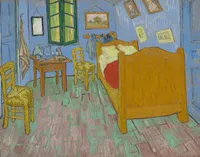
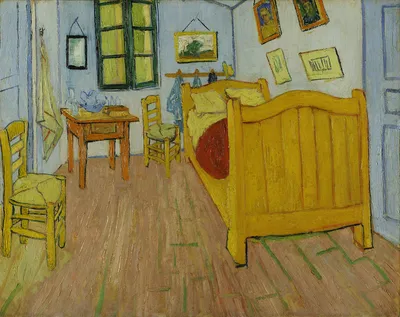
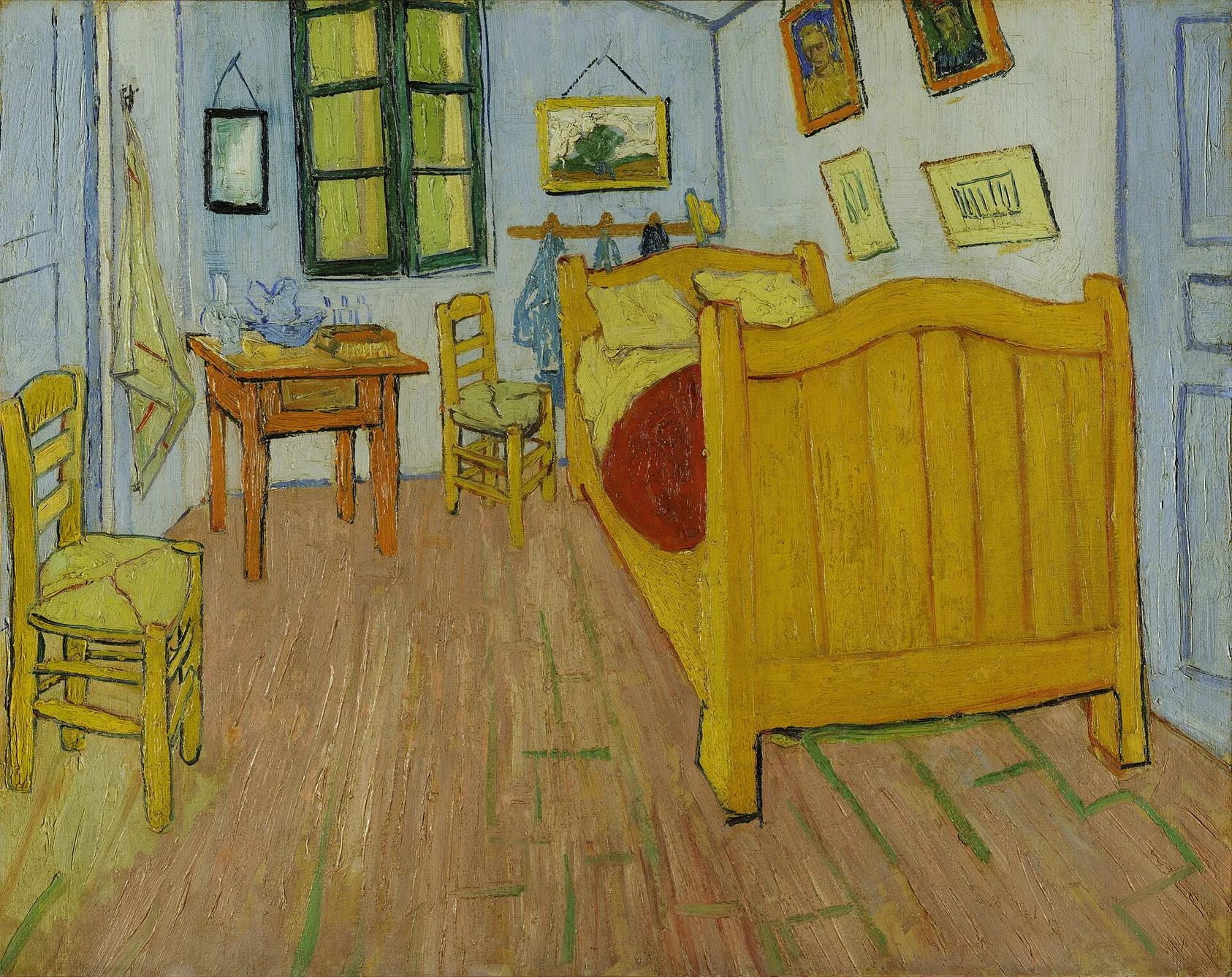
Bedroom in Arles, 1888. Vincent van Gogh. Van Gogh Museum, Amsterdam (Vincent van Gogh Foundation).
Look closer
7 things to notice
 1
01
Two friends keeping watch
High on the right wall hang two small portraits in orange frames, two men's faces looking down at the bed. They are his own paintings of his friends Eugène Boch and Paul-Eugène Milliet, which he called The Poet and The Lover, and they are what mark this first version apart from the two copies. Below them, two pale drawings hang slightly crooked.
02
A view he kept out
At the back of the room the window is the plain green his letter asked for, its small panes glowing yellow, a little mirror hanging on the wall beside it. It looked out on the Place Lamartine and its public gardens, yet he gives us none of that view. The daylight comes in as colour, and stops at the sill.
03
Everything laid out for morning
On the little table at the left sit a blue jug in its basin, a few bottles and small things for washing, all on orange wood. Van Gogh listed these colours to Theo one by one, the table orange, the basin blue, as carefully as an inventory. Even the jug stands ready in its bowl, waiting for the morning.
04
Built to stay put
Half the room is bed: a heavy wooden frame in the fresh butter yellow of his letter, two pillows at the head, and a scarlet blanket thrown over it. He wrote that the solid furniture should promise a rest that would not be shaken. The red blanket is the warmest thing in the room, drawn up to the pillows.
05
A door kept for a friend
On the far left, beside a towel hanging from a nail, stands the edge of a pale door. It led to the guest room Van Gogh was getting ready for Paul Gauguin, who arrived on 23 October, days after this painting was begun. The towel hangs by the door, and the door stays shut.
06
A wardrobe on a row of pegs
Above the head of the bed runs a single row of wooden pegs, with blue clothes and a straw hat hanging from them, and above that a framed green landscape. His letter names the few things on these walls, portraits, a mirror, a towel, some clothes, and then says that is all. A whole wardrobe fits on the pegs.
07
Look underneath: no shadow
In the bottom left corner a rush-seated chair stands close to us, its yellow legs outlined in dark blue, its seat a tangle of straw strokes. Look at the floor beneath it and you find no shadow. Van Gogh took the shadows out on purpose and laid every colour in flat, the way Japanese prints do.
Our take
It looks like a room drawn in a hurry: the floor tilts toward us, the bed fills half the space, the walls meet at odd angles. In fact the room was crooked, a trapezoid with one wide corner and one sharp one, and Van Gogh painted it as it stood. What he changed was the colour. He told his brother Theo that the colour had to do all the work here, so that simply looking at the picture would rest the mind. Nothing in it moves.
He was getting over an illness that had kept him in bed for days, and he called the painting his revenge for that forced rest. He had just bought two beds for the friend he was waiting for, the painter Paul Gauguin. Over the bed hang two small portraits of friends, and the two pillows lie side by side, plumped and ready. Then he waited.
The painter's moment
1853–1890Painted it at 35Post-Impressionism
Vincent van Gogh rented four rooms in the Yellow House in Arles, a town in the south of France, on 1 May 1888, for 15 francs a month, unfurnished. He hoped it would become a house for painters working together, and before Paul Gauguin agreed to come he bought two beds on the advice of his friend the postman Joseph Roulin. He slept there for the first time on 17 September. In mid-October, at 35, after an illness had kept him in bed for days, he painted his own room and sent Theo a sketch of it with a list of every colour. Gauguin arrived on 23 October. Two months later, after a quarrel between them, Van Gogh went back to his room and cut off part of his left ear.
In March 1889, after thirty neighbours signed a petition, the police closed the house. While he was in hospital the Rhône flooded it and damaged this canvas. Theo had it relined and sent back, and in September 1889, by then in the asylum at Saint-Rémy, Van Gogh copied it at full size, in the version now in Chicago, then made a smaller one for his mother and sister Wil. This first version never left the family. It belongs to the Vincent van Gogh Foundation, set up by his nephew, and hangs on permanent loan at the Van Gogh Museum, Amsterdam. In 2016 the Art Institute of Chicago gathered all three bedrooms in one exhibition.
In its time
Bedroom in Arles was painted in 1888, when Van Gogh was 35. Its French title is La Chambre à Coucher. Where it stands on Art Through Time:
Its colors
Elsewhere in the world
- 1884The Berlin ConferenceEurope's powers divide Africa among themselves.
- 1887French Indochina is formedFrance rules Vietnam and Cambodia, and later Laos.
- 1888Brazil abolishes slaveryThe Golden Law makes Brazil the last country in the Americas to end it.
- 1890Wounded KneeU.S. soldiers kill some 250 Lakota men, women and children.
- 1894The Dreyfus AffairA Jewish officer is falsely convicted of treason; France, and its painters, split in two.
The facts
- Title
- Bedroom in Arles
- Artist
- Vincent van Gogh (1853–1890)
- Date
- 1888
- Original medium
- Oil on canvas
- Style
- Post-Impressionism
- Made in
- Netherlands
- Collection
- Van Gogh Museum, Amsterdam (Vincent van Gogh Foundation)
Art Through Design
The mood
It gives a room somewhere to rest its eyes. The colours sit side by side without shadows, yellow against blue, and the whole picture feels like the moment just before you fall asleep.
The palette
Mustard and Bronze are the bed and the chairs, Sage the pale walls, Olive and Moss the greens of the window and the shadows in the wood. From across a room, the yellow bed is what you see, with the red blanket burning in its middle.
Who it finds
- Anyone who has made up a spare bed for someone they could hardly wait to see.
- Anyone who has been ill in bed for days and then wanted to make something beautiful out of the stillness.
- Anyone whose first real home was a single room they rented on hope.
See it in a room
Your photo is never uploaded, and it's gone when you leave.
It reads in three blocks: a yellow bed on the right, a blue wall behind, a pink-brown floor tilting toward you. Close up, it fills with small belongings, a jug in a basin, a straw hat on a peg, two portraits of friends.
It is slightly wider than tall, and it was painted to feel like sleep, so it is at home in a bedroom or a quiet guest room, above a bed or a dresser. A medium size suits it. It is a room inside a room, and it looks best at about the scale of a window.
Order on canvas, acrylic, or print
- True to the original
- Each file is color-matched to the museum original. If the color isn't right, we print it again, with our compliments.
- On canvas
- Fine-art canvas hand-stretched over a ¾″ solid-wood frame, with mirrored edges so nothing is lost.
- In our floating frame
- Our stretched canvas set in a slim floating frame, with a shadow gap so the painting seems to hover.
- As a framed print
- Archival pigment print on museum-grade cotton paper, in a solid-wood frame with UV-protective glazing.
- Ready to hang on arrival
- It arrives with the hanging hardware attached. No framer, no guesswork.
- Perfect on arrival
- If anything arrives damaged or not as you ordered, send us a photo within 7 days of delivery and we'll make it again, with our compliments.
Van Gogh painted his room in Arles in October 1888 so that looking at it would feel like rest. Give it the quietest wall in the house.