The story · 4 min read
These men changed history together, and were never all in one room.
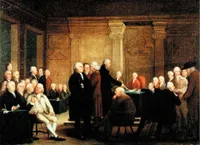
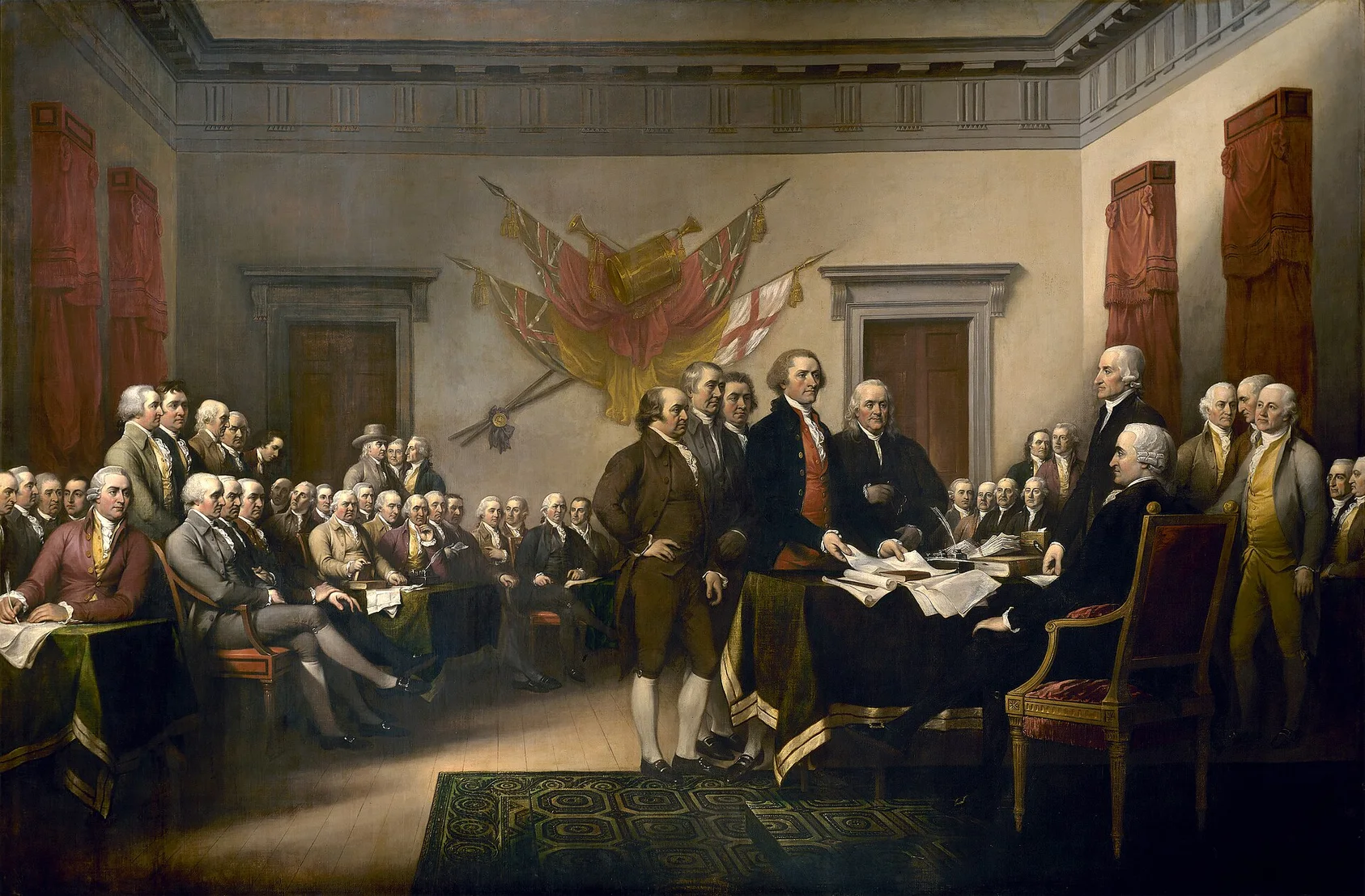
Declaration of Independence, 1817–1819. John Trumbull. United States Capitol Rotunda, Washington.
Look closer
7 things to notice
 1
01
Five men and one piece of paper
At the centre, the drafting committee stands before the table: John Adams with a hand on his hip, Roger Sherman, Robert Livingston, a tall Thomas Jefferson in a red waistcoat laying down the draft, and Benjamin Franklin. Trumbull painted many of these faces from life, and began the composition in Paris with Jefferson's help. Jefferson stands tallest, the paper under his hand.
02
The president reaches for it
At the right, John Hancock, president of the Congress, sits at the table in a red-backed chair, and behind him stands the secretary, Charles Thomson. Thomson's name is not among the final signers, though many historians think he signed an original that was lost. Hancock leans forward to receive the paper.
03
A step on the shoe that isn't
Down by the carpet, Jefferson's foot comes right up to John Adams's shoe. For years people read it as Jefferson stepping on Adams, a joke about the two friendly rivals; looked at closely, their feet are only close together. The engraving on the two-dollar bill gets it right.
04
Trophies taken from the enemy
On the back wall hangs a bundle of flags with trumpets and a drum, crossed like a trophy. They are British regimental colours captured in the war, a detail missing from some versions, including the one on the two-dollar bill. They hang above the delegates as if to remind the room what this paper would cost.
05
Nothing here is signed yet
On the table lie the draft and a scatter of documents, with a quill and an inkstand among them. This is the moment of presentation, 28 June 1776; the famous engrossed copy was signed mostly on 2 August, more than a month later. Nobody has put a name to anything on this table.
06
The man who would not sign
Among the three men standing at the far right is John Dickinson, who took part in the debate and then refused to sign. Trumbull included him, and other non-signers, while fourteen signers are missing because he could never obtain their likenesses. The painting is a portrait of an argument as much as of an agreement.
07
Cut from the two-dollar bill
At the far left sit four delegates: George Wythe, William Whipple, Josiah Bartlett and Thomas Lynch Jr. When the painting went onto the back of the American two-dollar bill, these four were trimmed off, along with two men at the far right and one at the back, and two unidentified figures were added. If you carry one of those notes, these four are not on it.
Our take
Five men stand before John Hancock's table and hand over a draft. Around them sit and stand the delegates of the Second Continental Congress, in silk stockings and powdered hair, in a grey hall hung with captured British flags. People often call it the signing. It shows the presentation of the draft, on 28 June 1776, weeks before most of the signatures. Not the signing.
Trumbull, who had fought in the war himself, spent decades collecting faces. Starting in Paris in 1786 with Jefferson's help, he painted small portraits of the signers from life wherever he could; where a man had died he copied an older portrait, and for two of them he painted their sons. Membership of Congress changed over those months, so these men were never all together at once. Trumbull assembled them anyway.
The painter's moment
1756–1843Painted it at 61Neoclassicism (history painting)
John Trumbull, a veteran of the Revolutionary War, began the picture in Paris in July 1786, where Thomas Jefferson was serving as the American minister. With Jefferson's help he worked out the composition, and over the next five years he painted small portraits of the signers; where a man had died he copied an earlier portrait, as with Arthur Middleton, whose head sits at an angle that stands out. On those visits he also sold subscriptions to engravings of his Revolution paintings. In Paris he introduced Jefferson to the painter Maria Cosway, who became one of Jefferson's closest friends. The small version, which he went on working on until 1820, now hangs at Yale.
In 1817, when Trumbull was 61, he was commissioned to paint this huge version, twelve feet by eighteen; it was bought in 1819 and went up in the Capitol rotunda in 1826, where it hangs with three other paintings of his. He came to be called the painter of the Revolution. The scene was engraved for the back of the $100 National Bank Note in 1863 and for a 24-cent stamp in 1869, and it is on the back of today's two-dollar bill. In 2017 Ancestry.com restaged it with 29 living descendants of the men in it.
In its time
Declaration of Independence was painted in 1817–1819, when Trumbull was 61. Where it stands on Art Through Time:
Its colors
Elsewhere in the world
- 1816Shaka leads the ZuluA small chiefdom becomes a southern African power.
- 1822Brazil declares independencePedro I's cry of 'Independence or death!' founds an empire.
The facts
- Title
- Declaration of Independence
- Artist
- John Trumbull (1756–1843)
- Date
- 1817–1819
- Original medium
- Oil on canvas
- Style
- Neoclassicism (history painting)
- Made in
- United States
- Collection
- United States Capitol Rotunda, Washington
Art Through Design
The mood
It gives a room a sense of occasion: a long assembly of serious people caught at the moment of decision. It makes a space feel more formal and deliberate, like a hall where something important is about to be agreed.
The palette
Bronze, Umber and Onyx are the dark coats and the shadowed floor; Taupe and Camel are the grey walls and the buff breeches. From across a room, the red curtains, the bright flags and the white papers on the table catch the eye.
Who it finds
- Anyone who has stood up in a room to put their name to something that could cost them everything.
- Anyone who knows these faces from the back of a two-dollar bill and wants to see the whole crowd.
- Anyone who has sat through a long, hard meeting and seen it, at last, decide something.
See it in a room
Your photo is never uploaded, and it's gone when you leave.
A long row of figures in a grey hall, with five men standing in the light at the centre: it reads at once as an event. Close up, it becomes a gallery of forty-seven faces, each painted from a likeness, with flags on the wall and papers on the table.
It is about half again as wide as tall, a long ceremonial shape. Its place is wherever decisions get made around a table: an office, a boardroom, a dining room, a study. Go wide, so the faces are large enough to recognise.
Order on canvas, acrylic, or print
- True to the original
- Each file is color-matched to the museum original. If the color isn't right, we print it again, with our compliments.
- On canvas
- Fine-art canvas hand-stretched over a ¾″ solid-wood frame, with mirrored edges so nothing is lost.
- In our floating frame
- Our stretched canvas set in a slim floating frame, with a shadow gap so the painting seems to hover.
- As a framed print
- Archival pigment print on museum-grade cotton paper, in a solid-wood frame with UV-protective glazing.
- Ready to hang on arrival
- It arrives with the hanging hardware attached. No framer, no guesswork.
- Perfect on arrival
- If anything arrives damaged or not as you ordered, send us a photo within 7 days of delivery and we'll make it again, with our compliments.
Trumbull gathered the founders into a room that never quite existed, and they have been presenting their draft since 1819. Hang it where your own decisions get made.