The story · 2 min read
The god of time, eating his own child, and calm about it.
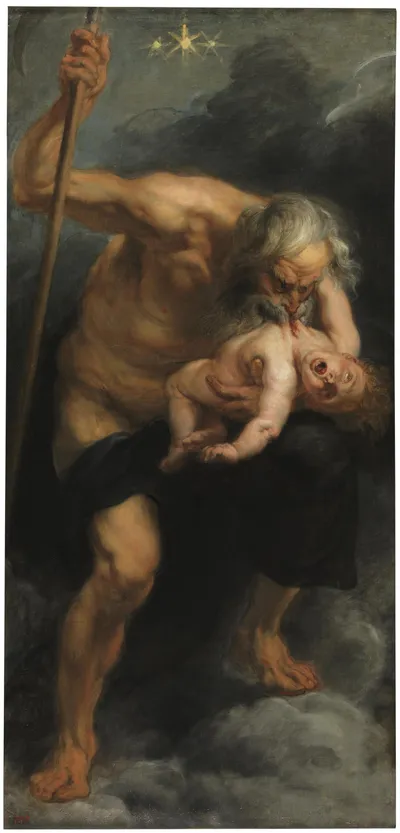
Saturn, c. 1637. Peter Paul Rubens. Museo del Prado, Madrid.
Look closer
7 things to notice
 1
01
Three stars, and Galileo
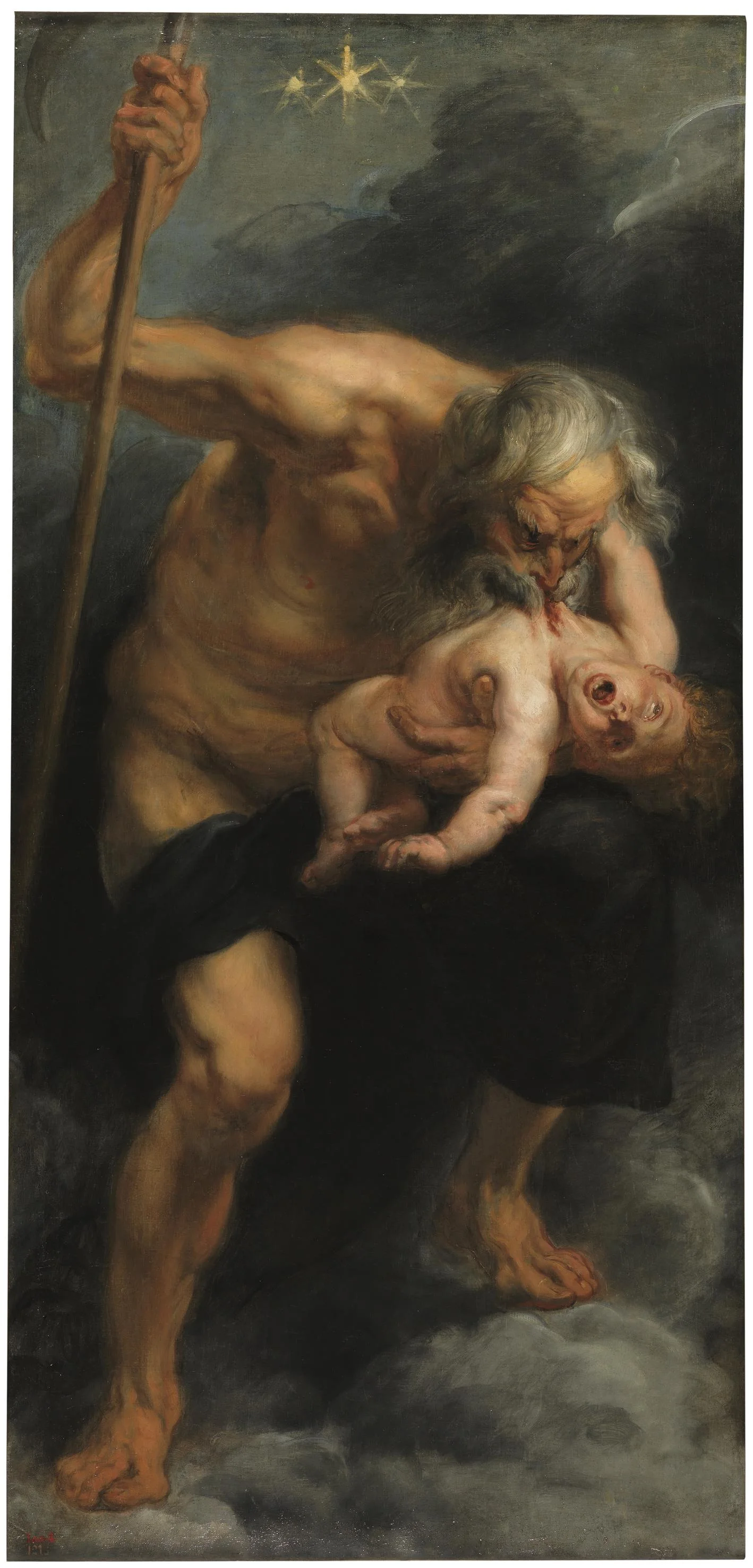
At the top shine three stars. They are the planet Saturn as Galileo described it a few years earlier: one big light with two smaller ones beside it. His telescope could not show the rings.
02
An old man's hunger
Saturn, the god of time, is an old man with wild white hair. Rubens shows him bent over, eyes down, completely absorbed. It is more frightening because he is so calm.
03
A child screaming
In the Greek myth, Saturn swallowed his children whole so none of them could overthrow him. Rubens goes further: this child is being bitten. It is screaming.
04
The scythe of time
Saturn holds a long staff with a curved blade at the top, a scythe. It is the tool of time, which cuts everything down in the end.
05
Muscles from Michelangelo
The huge twisting arm and back come from Michelangelo. Rubens had studied him in Italy, and he gives this old god the body of a wrestler.
06
Standing on cloud
His feet press down on grey cloud. He is a god, and he walks on the sky as if it were a floor.
07
Dark like a cave
Most of the background is near-black and grey cloud, so the pale bodies jump out. Rubens painted the flesh in warm, thick strokes and left the rest to shadow.
The story
What you are looking at
In Greek myth, the god Saturn (called Cronus in Greek) was told one of his children would overthrow him. So each time one was born, he ate it. In 1636 the Flemish painter Peter Paul Rubens painted that myth, and he made it worse: instead of swallowing the child whole, Saturn is taking a bite.
For a king's hunting lodge
King Philip IV of Spain commissioned it for the Torre de la Parada, one of his royal buildings. It is now in the Prado in Madrid.
The famous painter, near the end
Rubens was about 59, rich and famous, married to a young second wife and living on a country estate outside Antwerp. He was suffering badly from gout, which would kill him four years later. Scholars connect the giant twisting body to Michelangelo, whom he had studied as a young man in Italy.
A touch of science
The three stars at the top are a clue that he was keeping up with the news. Galileo had looked at Saturn through his telescope and seen what looked like three stars. The two side ones were in fact its rings, which nobody could yet see clearly.
Our take
The real horror here is about time: it gives us everything and then eats it, starting with our children. Rubens makes the god old and absorbed, almost tender, which is worse than any snarl.
The composition is a tall twisting column of flesh against the dark, all diagonals, so nothing feels steady. Warm skin tones next to grey cloud keep the eye locked on the bodies. It is a hard picture to look at, and a hard one to look away from.
In its time
Saturn was painted around 1637, when Rubens was 60. Its Dutch title is Saturnus (Ovidius, Fasti, IV, 197-200). Where it stands on Art Through Time:
Its colors
Elsewhere in the world
- 1632The Taj Mahal is begunShah Jahan's tomb for Mumtaz Mahal.
- c. 1636The Americas' first synagogueKahal Zur Israel opens in Dutch-ruled Recife, Brazil.
- 1636Gondar becomes Ethiopia's capitalThe Gondarine styles flourish.
- 1642Tasman reaches AotearoaThe first recorded European visit ends in a clash with Māori.
The facts
- Title
- Saturn
- Artist
- Peter Paul Rubens (1577–1640)
- Date
- c. 1637
- Original medium
- Oil on canvas
- Style
- Baroque
- Made in
- Germany
- Collection
- Museo del Prado, Madrid
Art Through Design
The mood
It brings drama and darkness into a room. A huge twisting figure looms out of grey cloud, and the space around it feels intense, unsettling and deadly serious.
The palette
Ink and Walnut are the dark background; Bark and Bronze are the god's body in shadow; Sand is the lit skin. Across a room, the pale tangle of bodies at the top is what grabs you.
Who it finds
- Anyone who has felt the years take something they thought they would keep.
- Anyone who loves the old myths for how cruel they really are.
- Anyone who has watched the people they love grow older faster than seemed fair.
See it in a room
Your photo is never uploaded, and it's gone when you leave.
One huge pale figure twisting up a dark canvas reads from far off as pure movement. Up close, the stars appear at the top, then the child's face, and only then do you understand what you are looking at.
Narrow and tall, it belongs in a private study or a collector's corner for adults. It is not for a child's room or a dining room. Hang it large if you dare, somewhere built for strong art.
Order on canvas, acrylic, or print
- True to the original
- Each file is color-matched to the museum original. If the color isn't right, we print it again, with our compliments.
- On canvas
- Fine-art canvas hand-stretched over a ¾″ solid-wood frame, with mirrored edges so nothing is lost.
- In our floating frame
- Our stretched canvas set in a slim floating frame, with a shadow gap so the painting seems to hover.
- As a framed print
- Archival pigment print on museum-grade cotton paper, in a solid-wood frame with UV-protective glazing.
- Ready to hang on arrival
- It arrives with the hanging hardware attached. No framer, no guesswork.
- Perfect on arrival
- If anything arrives damaged or not as you ordered, send us a photo within 7 days of delivery and we'll make it again, with our compliments.
Rubens painted the god of time eating his own child for a Spanish king in 1636. Hang it where strong art belongs.