The story · 4 min read
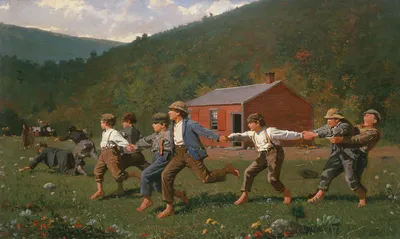
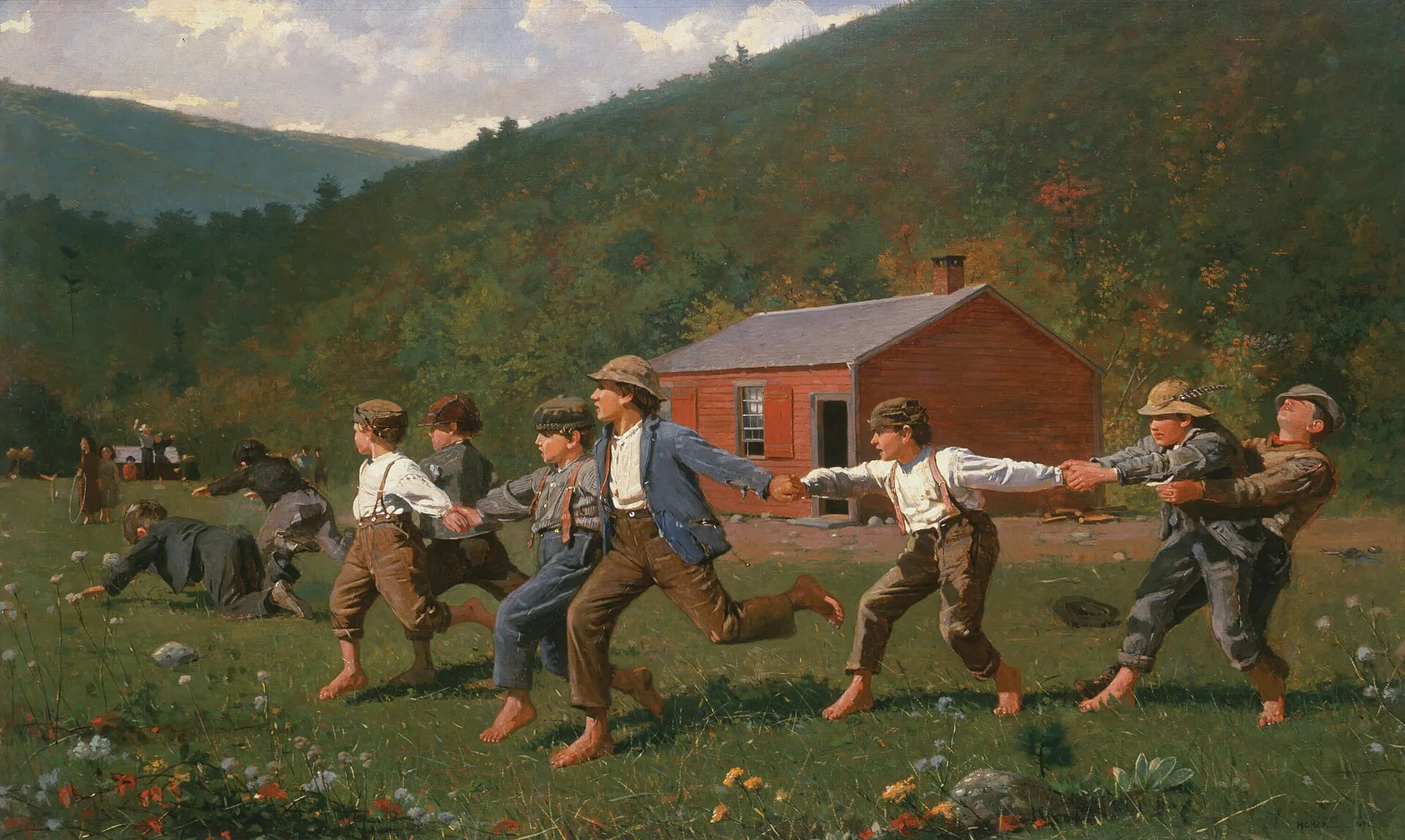
Barefoot boys swinging a line across a meadow, and two already flung off.
Snap the Whip, 1872. Winslow Homer. Butler Institute of American Art, Youngstown, Ohio.
Look closer
7 things to notice
 1
01
Heels dug in at the anchor
At the right end, the two biggest boys lean back with their whole weight, one with a feather in his hat, the other with his face tipped to the sky. They are the anchor of the line, and the force they put in travels down the chain of hands to the smallest boys at the other end. They know exactly what is about to happen.
02
Two already in the grass
At the left end, two boys have lost their grip: one is down on his hands and knees, the other pitches forward ahead of him. The painting has been read as a picture of the simple country life Americans were leaving behind for the cities after the Civil War. For these two, the only trouble is a mouthful of grass.
03
The big boy in the blue jacket
In the middle, the biggest of the runners wears a blue jacket over a white shirt and a brown hat pushed back on his head. Homer is said to have based the scene on local boys he watched playing at the schoolhouse in Hurley, in New York's Hudson Valley, where he spent several summers. You can almost hear him yelling at the others to hold on.
04
Bare feet in the meadow
Every one of them is barefoot, heels flashing, toes digging into the grass among small wildflowers. Homer had spent nearly twenty years as an illustrator, and his clean outlines and lively groups of figures come from that training. The grass looks warm underfoot.
05
A red school with its door open
Behind the line stands the schoolhouse, a single room of red boards with a chimney and an open door. The picture has come to stand as a tribute to the age of the one-room school, and that same year Homer painted The Morning Bell. Soon someone will ring one here.
06
Keeping out of the game
Far off at the left, a few small figures stand by the edge of the woods, two girls in long dresses among them, one with a hoop. They keep their distance from the swinging line. Homer painted many such scenes in these years, farm life, children at play and young people courting.
07
Hills on the turn
Behind the school rise wooded hills, green going to rust, under a sky of drifting white cloud. In the second version, now at the Metropolitan Museum in New York, Homer took the hills out, so the scene could be anywhere. Here the place is particular, and the season is plainly changing.
Our take
A line of barefoot boys tears across a meadow, hands locked, in front of a little red schoolhouse. It is the game called snap the whip: the big boys at one end dig in their heels and swing, and the line whips round until the smallest at the far end can't hold on. Two have already gone flying into the grass. Above them, the hills are colouring for autumn. Lessons are over for now.
Homer had drawn the Civil War from the front lines for Harper's Weekly, and after it he turned to children and summer fields. Americans were leaving the farms for the cities, and a one-room school in the hills already looked like something to miss. He painted two versions. Only this one keeps the mountains.
The painter's moment
1836–1910Painted it at 36American Realism
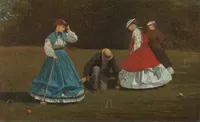
Winslow Homer was 36. Born in Boston, he had worked for nearly twenty years as an illustrator, much of it for Harper's Weekly, which sent him to the front lines of the Civil War to draw battles and camp life. After the war he took up mostly childhood and young women, out of a nostalgia for simpler times, his own and the nation's, in pictures like Croquet Scene and Country School. He spent several summers in the Hudson Valley, and the boys at the Hurley schoolhouse are said to have given him this scene. He painted two almost identical versions in 1872.
In 1875 he gave up illustration to live on his paintings alone, though money stayed tight. The next year Snap the Whip went to the Centennial Exposition in Philadelphia, alongside Breezing Up. Henry James, writing about Homer's work at this time, admitted that he detested its subjects, then conceded that Homer had succeeded beyond argument. This version, with the mountains, hangs in Youngstown, Ohio, at the Butler Institute, the first museum devoted only to American art, where it counts among the best-known works. The other went to the Metropolitan Museum in 1950, a gift of Christian A. Zabriskie.
In its time
Snap the Whip was painted in 1872, when Homer was 36. Where it stands on Art Through Time:
Its colors
Elsewhere in the world
- 1869The transcontinental railroadThe West opens to painters and tourists.
- 1870The Wanderers break awayRealist painters leave the Academy to paint ordinary life.
- 1874The first Impressionist exhibitionArtists show on their own terms in Paris.
- 1875Fort Marion ledger drawingsImprisoned Plains artists draw their world.
- 1876Centennial Exhibition, PhiladelphiaAmerica measures its art against the world.
The facts
- Title
- Snap the Whip
- Artist
- Winslow Homer (1836–1910)
- Date
- 1872
- Original medium
- Oil on canvas
- Style
- American Realism
- Made in
- United States
- Collection
- Butler Institute of American Art, Youngstown, Ohio
Art Through Design
The mood
It brings the noise of a playground into a room, summer heat, bare feet and shouting. It is open and sunny, full of green and warm brown, and it makes a space feel young.
The palette
Olive, Moss and Forest are the meadow and the wooded hills; Hazel is the boys' trousers and the bare earth; Cloud is the white shirts and the sky. At a distance, the row of white shirts across the green is what carries.
Who it finds
- Anyone who went to a small school and remembers the field behind it better than the lessons.
- Anyone who has been the smallest one at the end of the line, holding on for dear life.
- Anyone raising children today and wishing for them a summer exactly like this one.
See it in a room
Your photo is never uploaded, and it's gone when you leave.
A row of running figures strung across a green field, a red schoolhouse in the middle: seen from across the house it reads as pure movement, left to right. Close up, each boy becomes a person, a feather in a hat, braces, rolled trousers, a hat pushed back.
Wide, a little over half as high as it is broad, it suits a family room, a child's bedroom, a kitchen wall or a long hallway, any place with some coming and going. Choose a generous size, so each boy can be told apart. Daylight suits it, since it is a picture of a bright day outdoors.
Order on canvas, acrylic, or print
- True to the original
- Each file is color-matched to the museum original. If the color isn't right, we print it again, with our compliments.
- On canvas
- Fine-art canvas hand-stretched over a ¾″ solid-wood frame, with mirrored edges so nothing is lost.
- In our floating frame
- Our stretched canvas set in a slim floating frame, with a shadow gap so the painting seems to hover.
- As a framed print
- Archival pigment print on museum-grade cotton paper, in a solid-wood frame with UV-protective glazing.
- Ready to hang on arrival
- It arrives with the hanging hardware attached. No framer, no guesswork.
- Perfect on arrival
- If anything arrives damaged or not as you ordered, send us a photo within 7 days of delivery and we'll make it again, with our compliments.
Homer let a line of schoolboys loose in a Hudson Valley meadow in 1872, and they have not stopped running. Hang it where the family comes and goes.