The story · 3 min read
Both owls look ready to fly, and both were already dead.
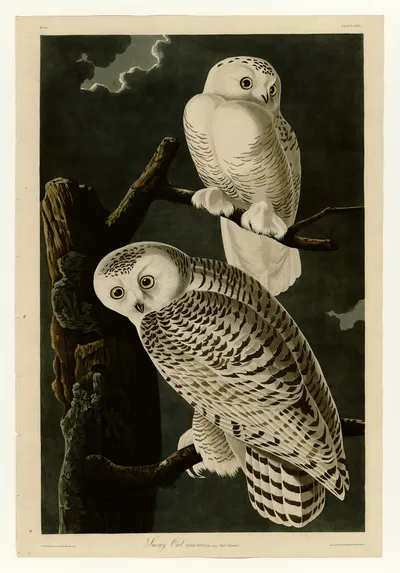
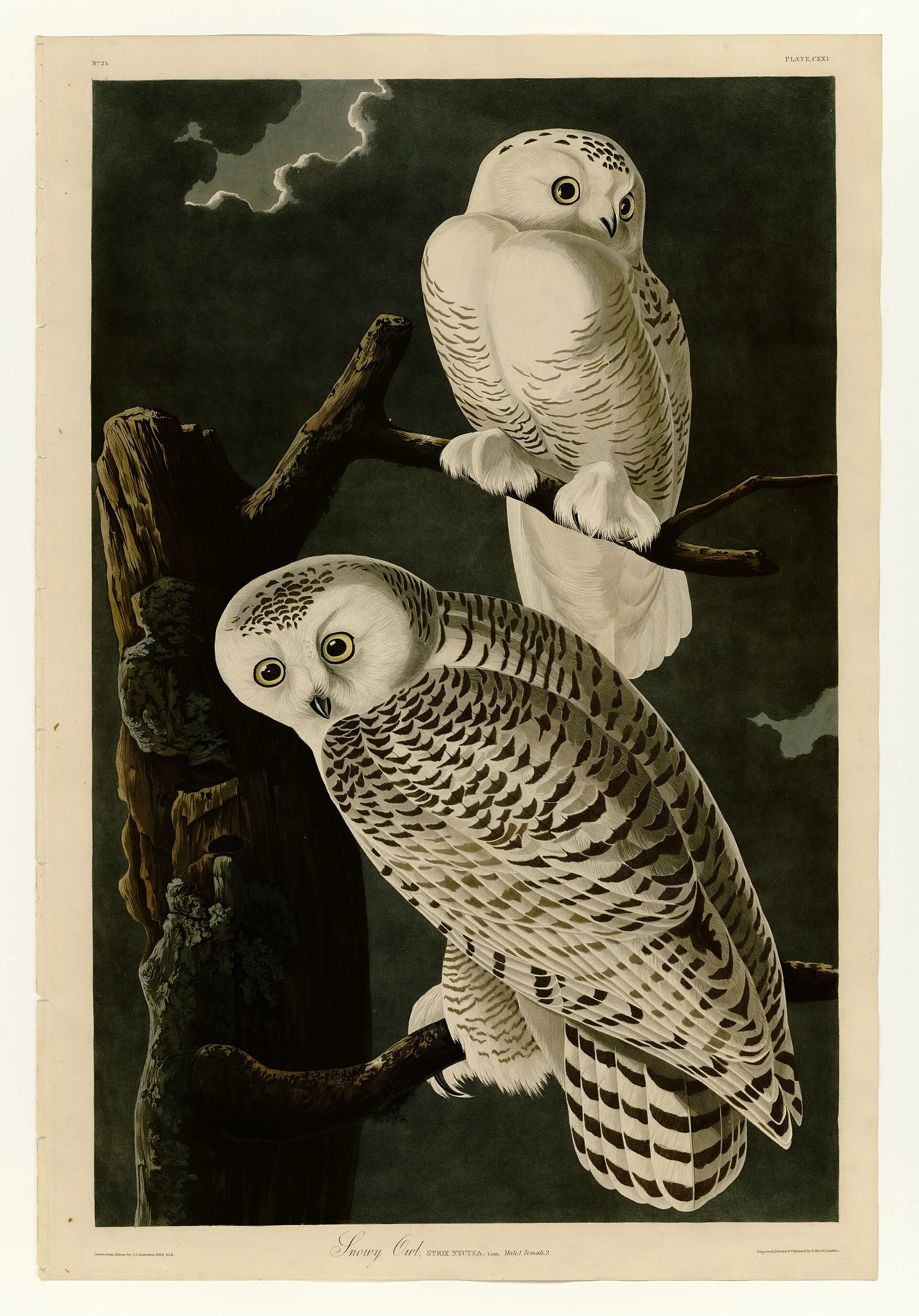
Snowy Owl, Undated (1785–1851). John James Audubon. The Birds of America, plate 121, in several collections.
Look closer
7 things to notice
 1
01
She has already seen you
This is a female snowy owl, drawn the size of the real bird. She looks ready to fly off the page. Audubon had already shot her, then propped up the body to get this pose.
02
The smaller one looks back
The male sits above her. In this species the female is the bigger bird, and Audubon drew them that way. The caption under the picture tells you which is which.
03
No bird book needs a storm
A storm is rolling in behind them, one torn cloud lit along its edge. Nobody needs thunder to identify an owl. Audubon wanted drama, and drama sold.
04
An owl with no business here
Snowy owls hunt on open Arctic tundra, with hardly a tree in sight. He put them on a branch anyway, which brings their faces up to the height of yours.
05
Fifty people to colour one bird
Every copy of this page was coloured by hand. More than fifty people worked down a line in London, each adding one colour. Someone spent an afternoon on these black bars, then started on the next copy.
06
The bark nobody signed
Audubon's assistants painted the plants and backgrounds for pages like this one, and he left their names out of the book. In 1835 a critic called him on it in print.
07
Not indelicate eating
Under the picture sits the bird's name in looping script. In the notes that went with the book, Audubon cut open owls to see what they ate, then gave his verdict on them as food: "not indelicate eating".
The story
What you are looking at
Around 1830, a man named John James Audubon set out to paint every bird in North America at its real size. Some birds are big, so the pages had to be more than three feet tall. This is one sheet from the book that resulted, The Birds of America, and it is a print, made from a copper plate and coloured by hand.
How to make a dead bird look alive
There were no cameras, and birds do not hold still. So he shot them, propped the bodies into lifelike poses and painted them on the spot. A friend who travelled with him said he got up at three in the morning to hunt and spent the rest of the day drawing, for months on end.
Selling the unsellable
Nobody could afford to print this, so he went to Britain and played up the frontiersman, selling it one section at a time to the rich. They called him the American woodsman. When some subscribers quit over the colouring, he said the book would rise in value as much as fools had run it down.
The catch
He also lied. Researchers have found that he made up species, faked data and invented stories about his own birth. After he died, his widow ran out of money and sold the copper plates for scrap. All but 80 were melted down.
Our take
Forward-facing eyes are what make owls feel like people, and Audubon aims four of them straight at you. It is hard to look at this and not feel looked at.
As design it could hardly be simpler: the palest thing he could print on the darkest thing he could print. White on black reads from across a room and stays alert at close range. Everything here is arranged to look alive, and the unsettling part is knowing why it had to be arranged.
In its time
No date is recorded for Snowy Owl; Audubon lived from 1785 to 1851. Where it stands on Art Through Time:
Its colors
The facts
- Title
- Snowy Owl
- Artist
- John James Audubon (1785–1851)
- Date
- Undated (1785–1851)
- Original medium
- Engraving
- Style
- Natural history illustration
- Made in
- France
- Collection
- The Birds of America, plate 121, in several collections
Art Through Design
The mood
It puts two pairs of eyes in the room. The owls stay pale and alert against their black sky, and the space around them feels watched over, cold at the edges and wide awake.
The palette
Ink and Moss are the storm and the shadowed sky; Olive is the bark; Wheat is the paper's old margin; Ivory is the owls themselves. Across a room, the two white birds and their yellow eyes are what you see.
Who it finds
- Anyone who has met an owl's stare on a winter road and stopped the car to look back.
- Anyone who has set out to finish something enormous with the money running out.
- Anyone who keeps a shelf of field guides and has opinions about the plates.
See it in a room
Your photo is never uploaded, and it's gone when you leave.
Pale birds on black, stacked one above the other, carry from the far side of any room like a pair of lit windows. Move closer and the feathers separate into rows of tiny bars, the bark turns to lichen, and a line of copperplate script appears below.
Tall and narrow, about three parts high to two wide, it suits a study, a hallway, a stair landing or the wall above a bed. Go large if you can, since the original sheet was more than three feet tall and the birds were drawn at the size of life.
Order on canvas, acrylic, or print
- True to the original
- Each file is color-matched to the museum original. If the color isn't right, we print it again, with our compliments.
- On canvas
- Fine-art canvas hand-stretched over a ¾″ solid-wood frame, with mirrored edges so nothing is lost.
- In our floating frame
- Our stretched canvas set in a slim floating frame, with a shadow gap so the painting seems to hover.
- As a framed print
- Archival pigment print on museum-grade cotton paper, in a solid-wood frame with UV-protective glazing.
- Ready to hang on arrival
- It arrives with the hanging hardware attached. No framer, no guesswork.
- Perfect on arrival
- If anything arrives damaged or not as you ordered, send us a photo within 7 days of delivery and we'll make it again, with our compliments.
Audubon set two snowy owls on a branch around 1831 and gave them a storm to sit in. Hang it where the hall light stays on at night.