The story · 4 min read
The only man at the party who has read the news.
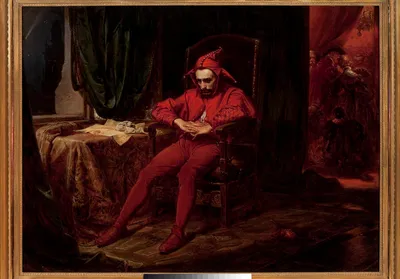
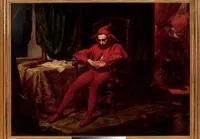
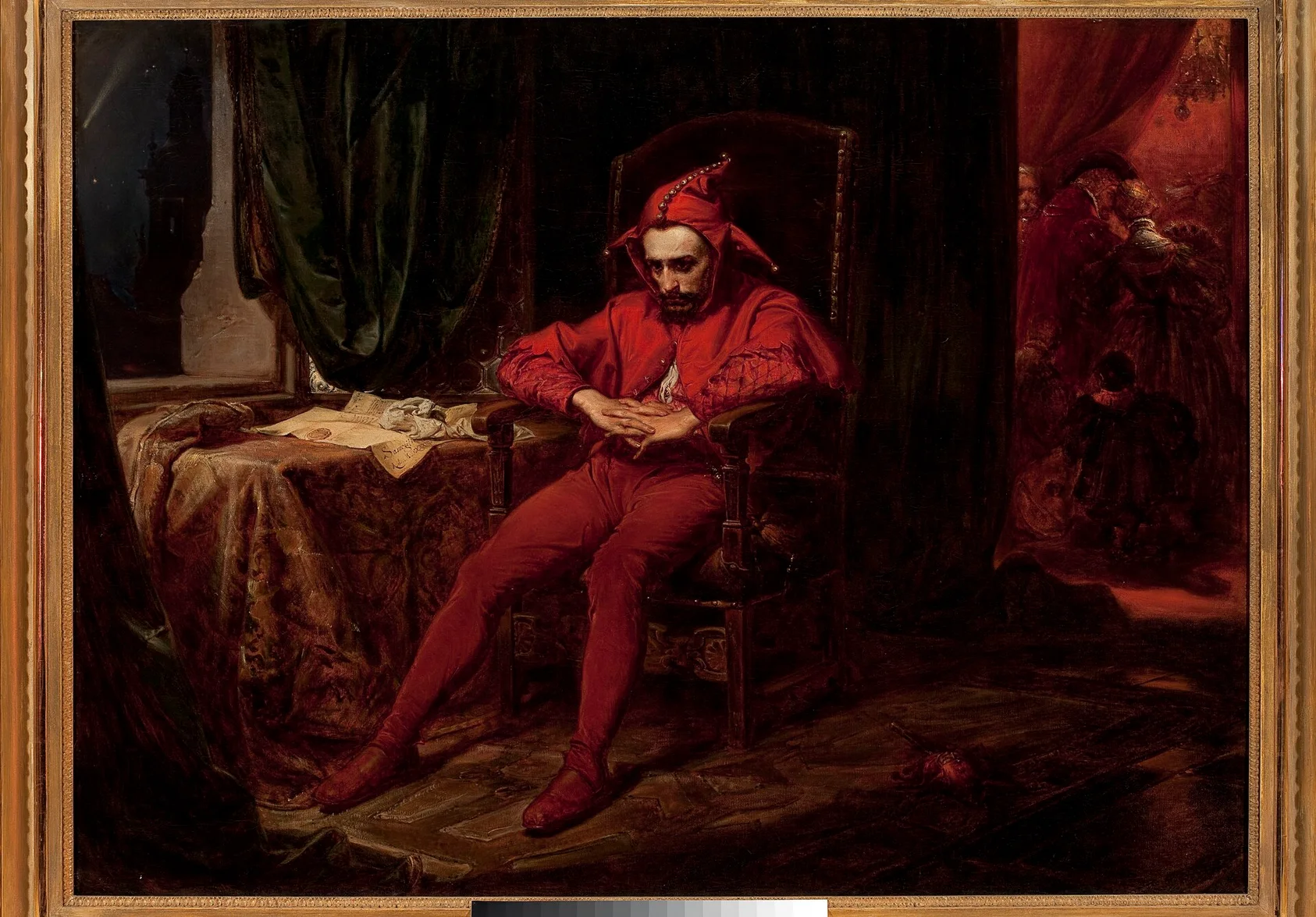
Stańczyk, 1862. Jan Matejko. National Museum in Warsaw.
Look closer
7 things to notice
 1
01
A jester with nothing to say
At the centre, Stańczyk sits slumped in a high-backed chair, his red cap with its little bells pushed back, his eyes fixed on the floor. He was court jester to King Sigismund I the Old, remembered as witty and wise, a satirist who told hard truths, and Matejko painted his own face onto him. Here he looks like the saddest man in the palace.
02
Hands that have stopped performing
His hands lie in his lap, fingers loosely laced, and a small medal of the Black Madonna hangs on his chest. The sources read his accessories as signs of how serious he has become. Hands that should be juggling or gesturing are doing nothing at all.
03
The letter nobody else read
On the table at his side lies an opened letter with a red seal, among scattered papers. It most likely brings news that Smolensk has fallen, and it seems to have been tossed aside by some official while the court celebrates the victory at Orsha. Oddly, it is dated 1533 and names Samogitia, nearly twenty years after Smolensk fell, a puzzle scholars still argue about.
04
A fool's sceptre, thrown down
On the floor to the right lies his marotte, the jester's carved sceptre, dropped and forgotten. The sources take it as one more sign that the fool has stopped being funny. He has put down the tool of his trade.
05
The party in the next room
Through the doorway at the right, in a warm red glow, courtiers in rich clothes dance and talk. Somewhere among them a court dwarf carries a lute, a symbol of glory, and in Matejko's day that pairing signalled a dynasty in decline. The music from that room is the only sound in the picture.
06
A comet over the cathedral
Through the window at the left, a dark cathedral profile stands against the night sky. It is Wawel Cathedral in Kraków, where Poland's kings were crowned, and beside it Matejko painted a comet, an omen of misfortune, with the three stars of Orion's Belt above. The window has blown open, and the wind lifts the tablecloth.
07
A carpet rucked by his feet
At his feet the carpet is crumpled and creased, his red shoes planted in it. It may have rucked up when he dropped into the chair after reading the letter, or from his feet shifting nervously since. You can almost see him fall into that seat.
Our take
Through the doorway on the right, the royal court is dancing. In here, in the dark, the court jester sits slumped in his chair in a red costume, hands clasped, staring at the floor. On the table beside him lies a letter: the city of Smolensk has been lost to Moscow. Everyone else is celebrating a victory. The fool is the only one who understands.
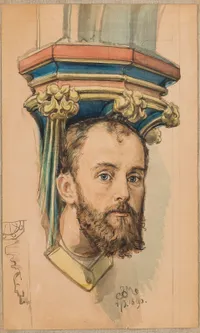
Matejko painted it at 24 and gave the jester his own face. Its loneliness and hopelessness have long been read as a picture of Poland's own political situation in the 19th century. Hardly anyone noticed it at first; it was given away as a lottery prize. Today it is one of the best-known paintings in Warsaw's National Museum.
The painter's moment
1838–1893Painted it at 24Romanticism (history painting)
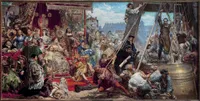
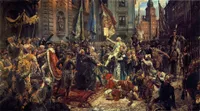
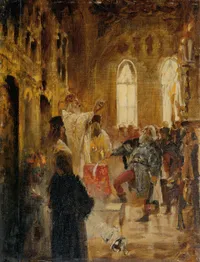
Jan Matejko was 24 when he finished Stańczyk. He had been fascinated by the jester since his youth, and he drew on Seweryn Goszczyński's novel Król zamczyska, whose hero, a loner living in a castle ruin and trying to reconcile past and present, was himself modelled on Stańczyk. Matejko usually painted huge, crowded scenes; a single figure like this is rare in his work. He gave the jester his own face, and went on to use Stańczyk again and again as a way into Polish history, as in The Hanging of the Sigismund Bell.
At first almost nobody noticed. A Kraków art society bought it as a prize for a lottery, and the winner, a man named Korytko, let it get slightly damaged. Only after Matejko became famous was it rediscovered. The National Museum in Warsaw acquired it in 1924; the Nazis looted it in the Second World War, and the Soviet Union seized it and returned it to Poland around 1956. In 1901 Stanisław Wyspiański put the jester on stage in his play The Wedding; from 2024 to 2025 the Louvre showed the painting in an exhibition on fools, and Lady Gaga used it on the back of her album Harlequin.
In its time
Stańczyk was painted in 1862, when Matejko was 24. Where it stands on Art Through Time:
Its colors
Elsewhere in the world
- 1861Russia frees its serfsSome 23 million people are released from bondage.
- 1861The American Civil WarFour years of war, some 620,000 dead, and the end of slavery.
- 1864The Circassians are expelledRussia's conquest of the Caucasus ends in mass killing and deportation.
- 1864The Long Walk and Sand CreekNavajo are marched into exile; Cheyenne and Arapaho are massacred at Sand Creek.
- 1867Canada is born at ConfederationFour provinces unite as one self-governing country.
The facts
- Title
- Stańczyk
- Artist
- Jan Matejko (1838–1893)
- Date
- 1862
- Original medium
- Oil on canvas
- Style
- Romanticism (history painting)
- Made in
- Poland
- Collection
- National Museum in Warsaw
Art Through Design
The mood
It brings a dark, red-lit hush into a room, the feeling of slipping away from a loud party to sit alone. It is moody and theatrical, and it rewards a slow look.
The palette
Onyx fills the dark corners; Oxblood, Garnet and Claret are the jester's red costume and the glow of the ballroom; Amber is the gold of the tablecloth and the frame. From across a room, the red figure in the chair is what you see.
Who it finds
- Anyone who has sat out a party because of bad news nobody else wanted to hear.
- Anyone whose job is to be funny, and who knows the silence afterwards.
- Anyone who loves Poland, its history and its gift for dark irony.
See it in a room
Your photo is never uploaded, and it's gone when you leave.
A single red figure slumped in a dark room, with a glowing doorway on the right: it reads like a scene from a play. Close up, the clues appear one by one, a letter with a seal, a dropped sceptre, a crumpled carpet, a comet in the window.
It is a landscape shape, wider than tall. Its place is a room for evenings, a den, a reading room, the corner where the drinks are poured. Medium to large, so the party beyond the doorway can still be read, and hang it where lamplight, not daylight, falls on it.
Order on canvas, acrylic, or print
- True to the original
- Each file is color-matched to the museum original. If the color isn't right, we print it again, with our compliments.
- On canvas
- Fine-art canvas hand-stretched over a ¾″ solid-wood frame, with mirrored edges so nothing is lost.
- In our floating frame
- Our stretched canvas set in a slim floating frame, with a shadow gap so the painting seems to hover.
- As a framed print
- Archival pigment print on museum-grade cotton paper, in a solid-wood frame with UV-protective glazing.
- Ready to hang on arrival
- It arrives with the hanging hardware attached. No framer, no guesswork.
- Perfect on arrival
- If anything arrives damaged or not as you ordered, send us a photo within 7 days of delivery and we'll make it again, with our compliments.
Matejko sat a jester down with the bad news in 1862, while the court danced next door. Hang him in the room you slip away to when the party gets loud.