The story · 3 min read
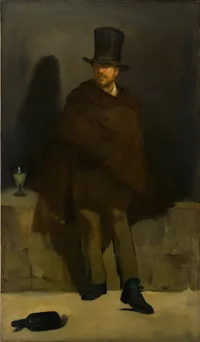
His teacher looked at this and said the drunk was Manet.
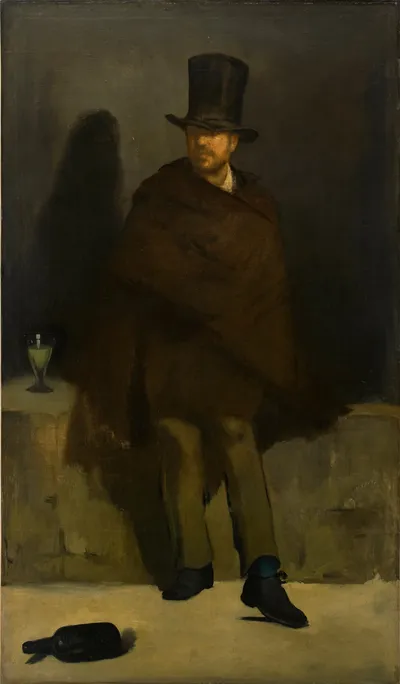
The Absinthe Drinker, 1859. Édouard Manet. Ny Carlsberg Glyptotek, Copenhagen.
Look closer
7 things to notice
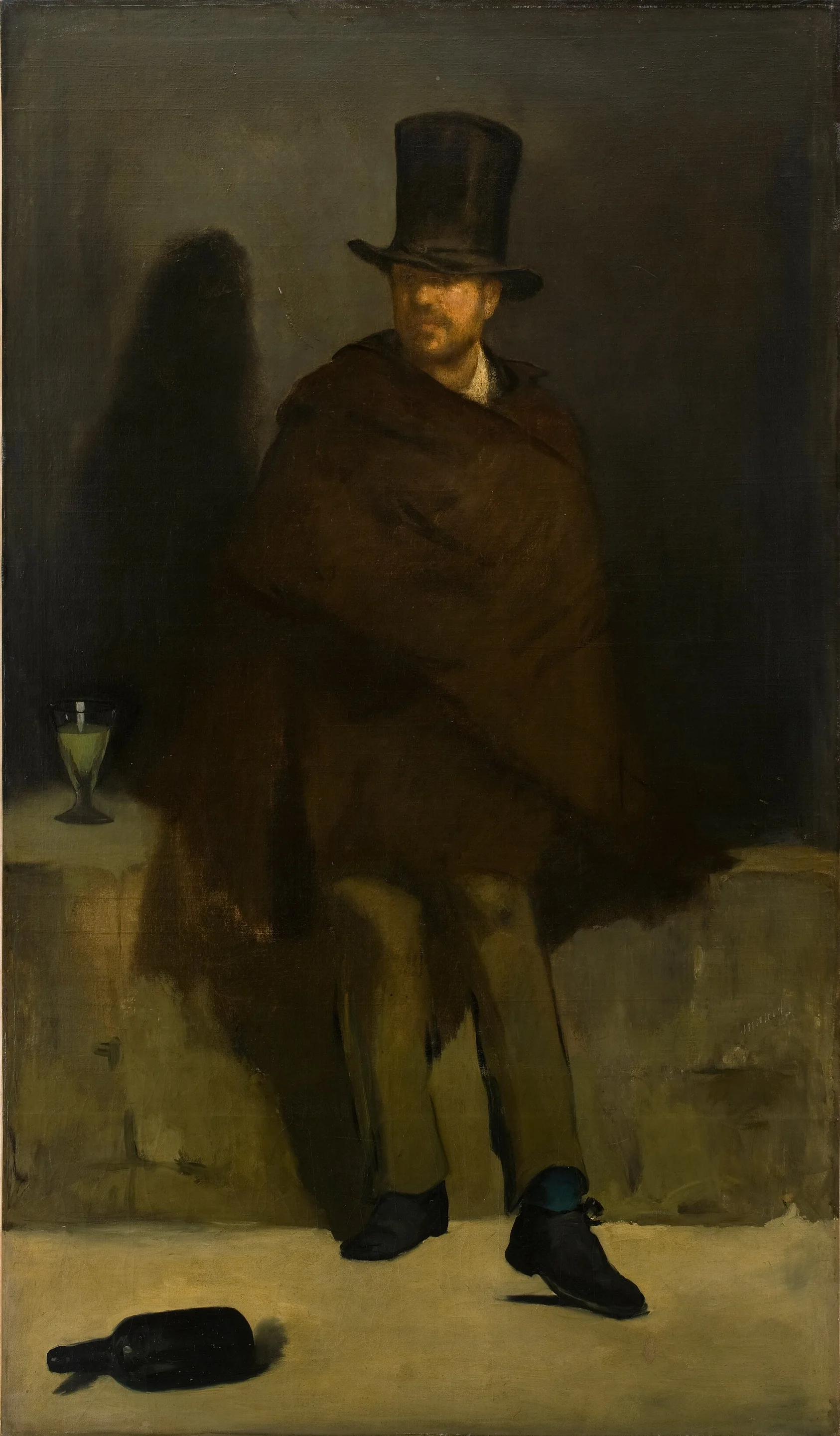 1
01
A gentleman's hat on a rag-picker
A top hat and a long cloak were what rich men wore. This man dug through rubbish for a living. He carries the hat as if someone might still bow to it.
02
The eyes stay under the brim
The brim hides his eyes, and the rest of the face goes rough and orange. He will let you look at him. He will not look back.
03
Added years afterward
That is absinthe, a strong green liquor people believed could wreck your mind. The judges never saw this glass. Manet added it at least eight years later.
04
Emptied and left to roll
His bottle lies on its side on the ground, empty, a long way from his hand. It tells you how his night went before you have looked at his face.
05
Legs that do not quite join
Look at where the legs meet the body: it does not really work. One historian thinks the legs were not even there when the jury turned the picture down.
06
A shadow keeps him company
A wall, a floor and a tall smear of shadow: that is everything Manet gave him. Great men got palaces behind them in paintings this size. He gets this.
07
Drab on purpose
Almost the whole canvas is brown, grey or black, the brush marks left showing when judges wanted a surface like glass. It looks dirty because his life was.
The story
What you are looking at
This man's name was Collardet. He picked through the trash of Paris for things to sell, and he was an alcoholic. Around 1859 a young painter named Édouard Manet stood him up almost six feet tall, in a top hat. Paintings that big were meant for kings and generals.
Why it was an insult
Manet showed it to his old teacher, a successful painter named Thomas Couture. Couture looked at it and told him, more or less: the absinthe drinker here is you, and you have lost your moral sense.
One vote
Every year a single jury in Paris decided which paintings the public got to see. It was called the Salon, and if it turned you down you barely existed. This was the first picture Manet ever sent in. It was rejected, and one judge voted for it: Eugène Delacroix, a giant of the older generation.
He would not let it go
Manet kept the rejected canvas for more than ten years and kept changing it. He cut it down, added the glass, and reused the same cloaked man in another painting. In 1872 a dealer finally bought it. Manet went on to cause far bigger scandals, and today this first failure hangs in a museum in Copenhagen.
Our take
Pride first, then shame. He has dressed for an occasion that was never going to happen, hat straight, chin level, like a man who has decided that if he stands up tall enough nobody will mention the bottle.
Manet gives him one tall dark column in an empty rectangle, the way loneliness tends to look. The colours stay low and muddy, so the small green glass lands like a thought he cannot stop having. Couture thought the picture had no morals. To us it asks something harder: how much of a person is left to respect when all that remains is the costume.
In its time
The Absinthe Drinker was painted in 1859, when Manet was 27. Its German title is Absinthtrinker. Where it stands on Art Through Time:
Its colors
Elsewhere in the world
- 1857The Uprising of 1857Indian soldiers and rulers rise against the Company; the Mughal court ends.
- 1861The American Civil WarFour years of war, some 620,000 dead, and the end of slavery.
- 1861Russia frees its serfsSome 23 million people are released from bondage.
- 1864The Circassians are expelledRussia's conquest of the Caucasus ends in mass killing and deportation.
- 1864The Long Walk and Sand CreekNavajo are marched into exile; Cheyenne and Arapaho are massacred at Sand Creek.
The facts
- Title
- The Absinthe Drinker
- Artist
- Édouard Manet (1832–1883)
- Date
- 1859
- Original medium
- Oil on canvas
- Style
- Realism
- Made in
- France
- Collection
- Ny Carlsberg Glyptotek, Copenhagen
Art Through Design
The mood
It darkens a room and steadies it. One tall figure stands in a muddy, windowless brown, and the space takes on the feel of a side street at a late hour, thoughtful and a little unkempt.
The palette
Ink and Peat are the hat, the shoes and the cloak; Moss and Olive are the wall; Bronze is the worn ground and the trousers. Across a room, the small orange face and the pale floor are what catch.
Who it finds
- Anyone who has shown their best work to the person who taught them and been told it was disgraceful.
- Anyone who has known a proud man with an empty pocket and a good hat.
- Anyone who has gone on fixing something for years after the argument was over.
See it in a room
Your photo is never uploaded, and it's gone when you leave.
One upright figure in a top hat, nearly the full height of the canvas, reads clearly at the end of a corridor. Move in and the green glass appears at the edge, then the bottle on the ground, then his shadow climbing the wall behind him.
Tall and narrow, close to two parts high for one wide, it needs height more than width: a stair wall, a hall, a study with a high ceiling, a bar or a billiard room. Hang it large so that he stands close to your own size and looks you over.
Order on canvas, acrylic, or print
- True to the original
- Each file is color-matched to the museum original. If the color isn't right, we print it again, with our compliments.
- On canvas
- Fine-art canvas hand-stretched over a ¾″ solid-wood frame, with mirrored edges so nothing is lost.
- In our floating frame
- Our stretched canvas set in a slim floating frame, with a shadow gap so the painting seems to hover.
- As a framed print
- Archival pigment print on museum-grade cotton paper, in a solid-wood frame with UV-protective glazing.
- Ready to hang on arrival
- It arrives with the hanging hardware attached. No framer, no guesswork.
- Perfect on arrival
- If anything arrives damaged or not as you ordered, send us a photo within 7 days of delivery and we'll make it again, with our compliments.
Around 1859 Manet stood a rag-picker up like a duke and sent him to the Salon. Hang him where a corridor ends, so he can watch.