The story · 5 min read
The last day of the world, and even the saints are unsure of their verdict.
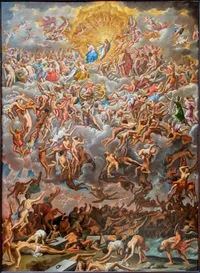
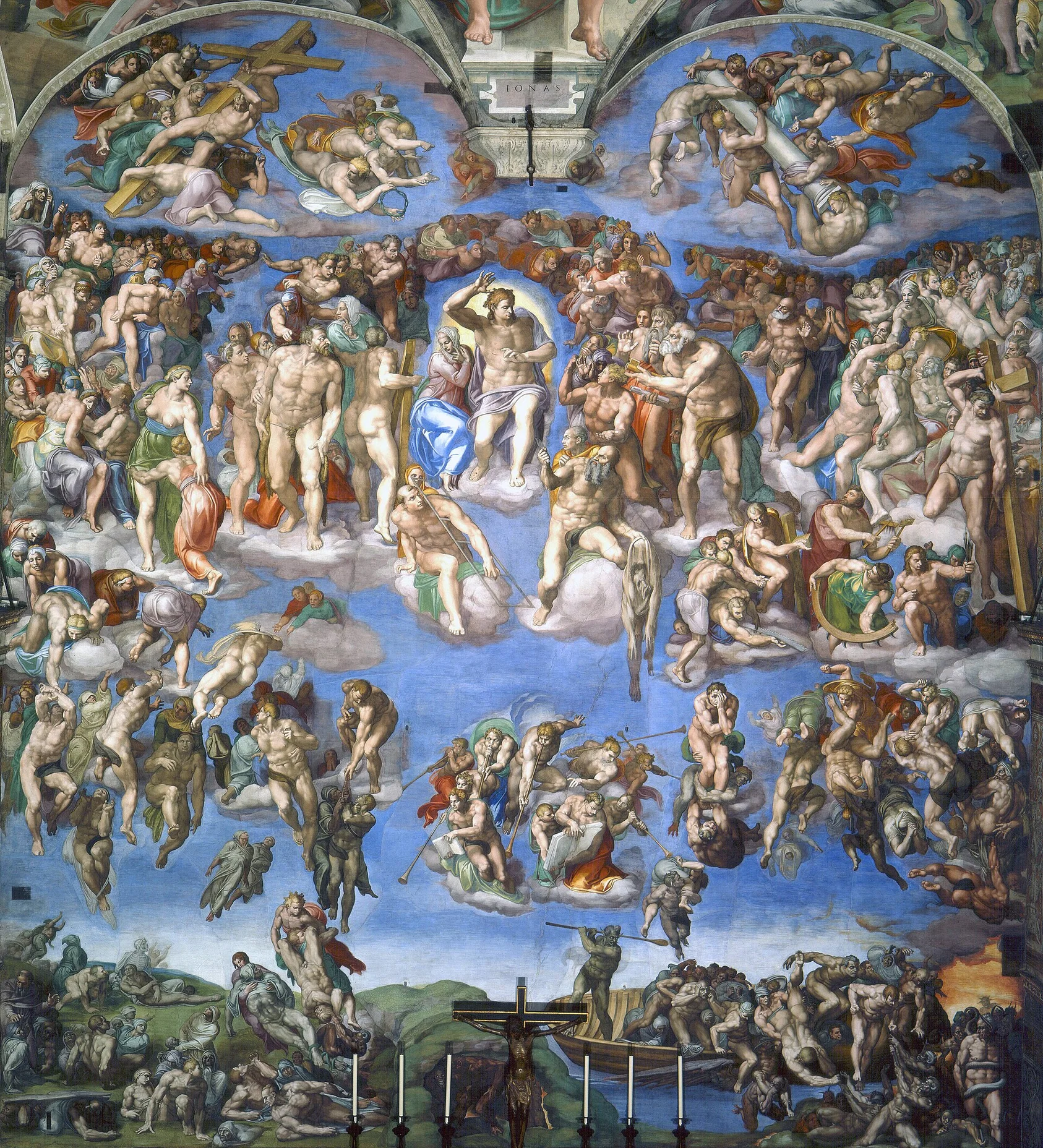
The Last Judgment, 1536–1541. Michelangelo. Sistine Chapel, Vatican City.
Look closer
7 things to notice
 1
01
One raised arm, and everything moves
At the top centre, Christ half rises from his cloud, young and beardless, right arm lifted, eyes cast down toward the damned. The sources trace that body to the old gods, Hercules, Apollo and Jupiter with his thunderbolts, and the wounds of the cross show on it. Beside him Mary, as if past pleading, pulls her hands to her chest inside her blue robe and looks down at the saved.
02
His own face, emptied out
Below Christ's feet, a bald, bearded saint sits on a cloud with a blade in one hand and a limp human skin in the other. He is Bartholomew, martyred by flaying, and most writers agree the sagging face on that skin is Michelangelo's, which Edgar Wind read as a prayer to throw off the outer self. Bernadine Barnes notes that recent viewers find self-doubt in where it dangles: over the drop toward Hell.
03
Repainted for looking the wrong way
To the right, a woman in green kneels behind a broken spiked wheel, and above her a saint lifts a pair of iron combs. They are Catherine and Blaise, and Daniele da Volterra chiselled most of them off the wall and painted them again, because Blaise had seemed to be staring at Catherine's bare behind. In the new version his eyes go up to Christ, the combs raised in his fist.
04
Seven trumpets in one blast
In the open blue below Christ, wingless angels crowd a cloud, seven blowing long trumpets as the Book of Revelation describes and others carrying the open books of the saved and the damned. Critics objected that Scripture sends those trumpets to the earth's four corners. Michelangelo packed them onto one cloud, right in front of you, and the biggest book sits open on an angel's knee.
05
The second he understands
Just right of the angels, a dark-haired man hangs in the air, one hand pressed over half his face, one eye wide, while two devils grip his legs and drag him down. The sources describe a soul who has only now understood that he is damned, frozen with horror. Around him people struggle; he seems to have stopped, his fingers spread across his cheek.
06
Bones first, then the rest
The dead climb out of the ground in the bottom left corner, a few still bare skeletons, most already wearing their flesh again. Hands reach down from the clouds to haul some of them up, and critics later complained that the risen ought to come back all in one state. Here they return at their own pace, a skeleton sitting up on the grass among them.
07
A critic, kept in Hell forever
A heavy man stands in the far bottom right corner, donkey's ears on his head, a snake coiled round his body. He is Minos, Dante's judge of the underworld, wearing the face of Biagio da Cesena, the pope's master of ceremonies, who had called these nudes fit for a bathhouse. When Biagio complained, Paul III is said to have joked that his power stopped short of Hell, and the snake stayed where it was.
Our take
A Last Judgment was supposed to keep its order at the top: calm ranks of saints above, the frantic dead below. Michelangelo let the commotion climb the whole wall. More than 300 bodies turn around one young, beardless Christ with his arm raised, and no one near him is at rest. Saints hold up the gridiron, the wheel and the skin that killed them, and the art historian Sydney Freedberg saw them as great powers suddenly made helpless. Heaven itself is waiting to hear.
The pope who first asked for this wall had once sentenced him to death, for defending Florence against the Medici. Pardoned, Michelangelo took the commission anyway, and finished it under the next pope. Just below Christ he painted his own face on an empty human skin, dangling from a saint's hand above the way down to Hell. Nobody in the crowd seems to notice it.
The painter's moment
1475–1564Painted it at 61Renaissance
Michelangelo came to this wall out of the hardest years of his life. When Florence threw out the Medici in 1527, he worked on the city's defences; when it fell in 1530, Pope Clement VII, himself a Medici, sentenced him to death. He is thought to have hidden for two months in a small room under the family's chapels at San Lorenzo, lit by one tiny window, where charcoal and chalk drawings were found in 1975. Pardoned, he moved to Rome in 1534, and Clement asked him for the fresco shortly before he died that year. His successor, Paul III, made sure it was started and finished. The wall cost Michelangelo a friendship of more than twenty years: Sebastiano del Piombo had it smoothed for oil paint, and Michelangelo, furious, had it roughened again for fresco. In Rome he met the poet Vittoria Colonna, who became one of his closest friends.
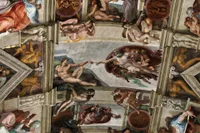
He painted from 1536 to 1541, 25 years after the ceiling above, and went almost straight on to the Pauline Chapel and The Conversion of Saul. The quarrel over the nudes outlived him. In 1563 the Council of Trent ruled that the chapel's pictures be covered where they offended, and Daniele da Volterra, an admirer, painted cloths over the barest bodies and was nicknamed Il Braghettone, the breeches maker. El Greco offered to repaint the whole wall, decently. Nearly 40 figures were draped in the end. Candle smoke from the altar darkened it for centuries, until the cleaning of 1980 to 1994 brought back its oranges, greens and yellows and took off about 15 of the later cloths. It has never left the Sistine Chapel's altar wall.
In its time
The Last Judgment was painted in 1536–1541, when Michelangelo was 61. Where it stands on Art Through Time:
Its colors
Elsewhere in the world
- 1531The Virgin of GuadalupeBy tradition she appears to Juan Diego; her image becomes Mexico's own.
- 1532Pizarro captures AtahualpaThe conquest of the Inca Empire begins at Cajamarca.
The facts
- Title
- The Last Judgment
- Artist
- Michelangelo (1475–1564)
- Date
- 1536–1541
- Original medium
- Fresco
- Style
- Renaissance
- Collection
- Sistine Chapel, Vatican City
Art Through Design
The mood
It lifts a room. Bodies rise on the left and fall on the right, and the eye circles the young Christ at the top without ever settling. Even a small room takes on the height of a chapel.
The palette
Mixed together, the wall comes to stone greys: Slate and Flint in the shadows of the bodies, Pebble and Silver in the clouds, Charcoal along the dark ground at the bottom. From across a room, though, the blue sky behind them is what you see first.
Who it finds
- Anyone who has waited for a verdict, from a doctor, a court or a committee, and watched the faces around them while they waited.
- Anyone who has worked for someone who once wished them gone. Michelangelo took this wall from the pope who had sentenced him to death.
- Anyone who has looked back at an old self and wanted to step out of it. Michelangelo hung his own face on an empty skin.
See it in a room
Your photo is never uploaded, and it's gone when you leave.
Seen whole, the blue does the work: a field of sky crowded with bodies, a ring of them around one bright figure, a band of dark earth along the bottom. Close up, you start finding hundreds of small dramas: a saint with a wheel, a man hiding half his face, a skeleton climbing out of the ground.
It is taller than it is wide, the shape of an altar wall, so it belongs where a wall has height: a stairwell, a tall hall, the end of a long room. Give it size. Small, the figures blur into one texture; large, you can find Biagio in his corner.
Order on canvas, acrylic, or print
- True to the original
- Each file is color-matched to the museum original. If the color isn't right, we print it again, with our compliments.
- On canvas
- Fine-art canvas hand-stretched over a ¾″ solid-wood frame, with mirrored edges so nothing is lost.
- In our floating frame
- Our stretched canvas set in a slim floating frame, with a shadow gap so the painting seems to hover.
- As a framed print
- Archival pigment print on museum-grade cotton paper, in a solid-wood frame with UV-protective glazing.
- Ready to hang on arrival
- It arrives with the hanging hardware attached. No framer, no guesswork.
- Perfect on arrival
- If anything arrives damaged or not as you ordered, send us a photo within 7 days of delivery and we'll make it again, with our compliments.
Michelangelo spent more than four years turning a chapel wall into the last day of the world. Hung at home, it keeps a whole room looking up.