The story · 4 min read
Two men breaking stones by a road, and no faces to pity.
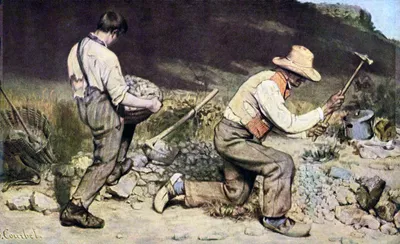
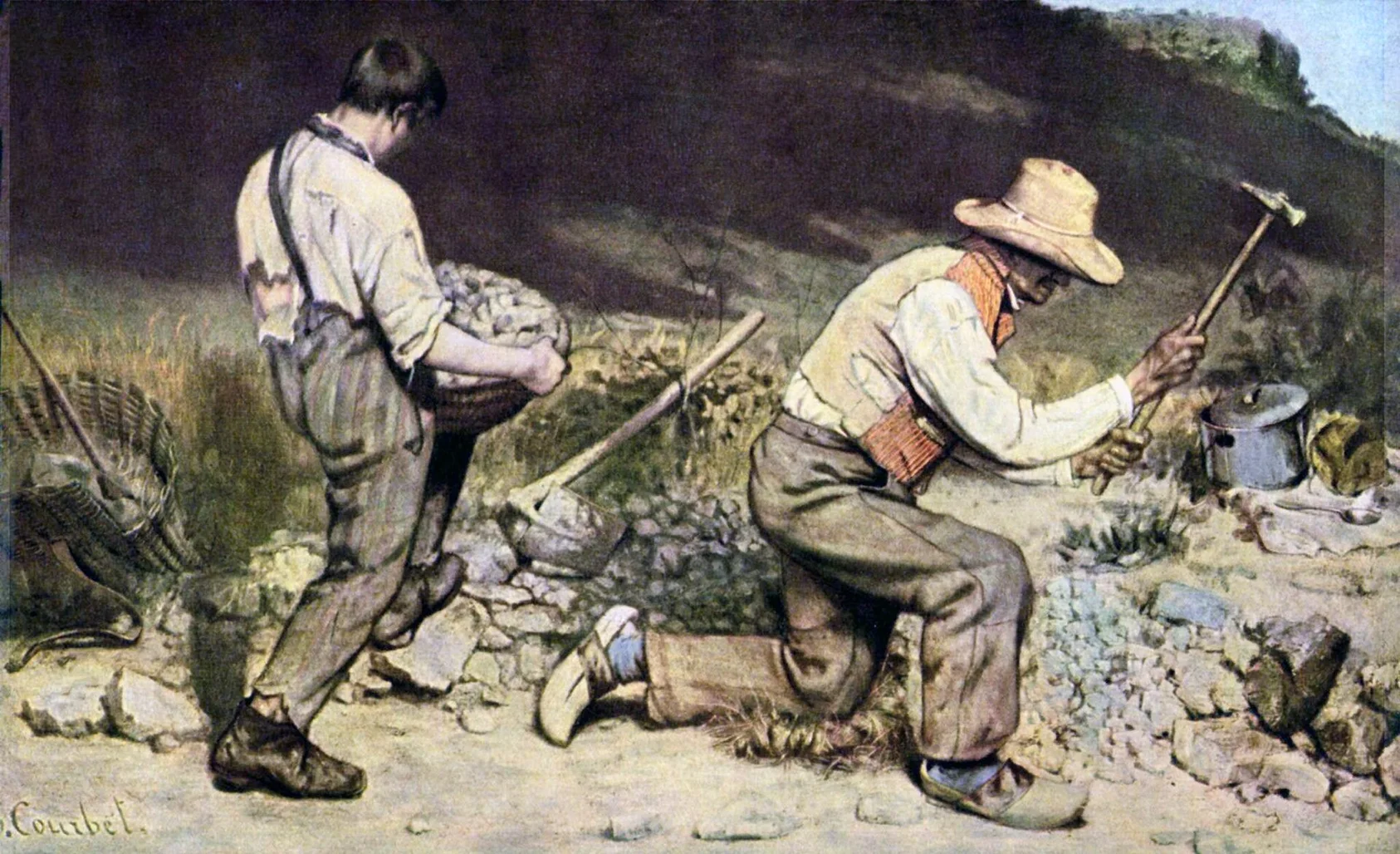
The Stone Breakers, 1849. Gustave Courbet. Formerly Gemäldegalerie Alte Meister, Dresden (lost 1945).
Look closer
7 things to notice
 1
01
A hammer raised at seventy
On the right, an old man in a battered straw hat kneels over the stones with a sledgehammer lifted in both hands, a red waistcoat showing under his white shirt. In a letter Courbet put his age at seventy and called him bent double over the stones, and the French word he chose, courbé, sounds almost like his own name. The hat's brim keeps the face in shadow.
02
Heels through worn-out socks
His left knee is down in the dust, the foot behind it in a wooden clog, with a scrap of blue sock showing above. Courbet wrote of cracked clogs and bare heels poking through socks that had once been blue, and the satirical papers mocked the clogs with oversized cartoons. That blue is the brightest colour he owns.
03
A back turned to the Salon
A young man in a torn shirt stands at the left with his back to us, a leather strap over one shoulder holding up his ragged trousers. Courbet hid both faces, which critics found unsettling; the two read as stand-ins for every road worker in France. Of this one we see only the back of a sunburnt neck.
04
A basketful of broken road
The young man braces a heavy basket of broken stones against his body, his arms bare where the shirt has worn through. Courbet saw two men at this work near Maisières and asked them to his studio the next morning; there, he told his friends Francis and Marie Wey, he painted his picture. Every stone in the basket took a blow.
05
Boots that walked to work
Down by the young man's feet, his leather boots are caked with mud and split open at the sides, a detail Courbet spelled out in his own description. Critics at the Salon called the pair brutish, worn and dirty. These boots have done more miles than most of the people who said so.
06
A scrap of sky, far off
In the top right corner, past the dark slope of the hill, a thin wedge of blue sky shows through. Critics complained about the poor lighting; the hillside closes over the men like a wall and leaves the sky a corner to itself. Neither of them looks up at it, though you might.
07
A name signed in the dust
The painter's name sits in the bottom left corner, signed on the dusty ground: Courbet. The canvas that carried this signature disappeared at the end of the Second World War, but he had painted a smaller, reversed version, now in Winterthur in the Oskar Reinhart Collection. Here the name lies in the dirt where the men work.
Our take
A boy carries a basket of broken stones; an old man kneels with his hammer raised. That is all. Courbet saw two men like this on a country road in November 1849, asked them to come to his studio the next morning, and painted them at a size usually kept for history and heroes. Neither shows his face. They could be anyone who works with their hands for a living.
Paris was scandalised at the Salon of 1850: critics called the workers brutish and dirty and complained about the thick, rough paint. The social theorist Pierre-Joseph Proudhon held it up as the model of a socialist painting. Then, in the last months of the Second World War, it vanished from Dresden, almost certainly burned. What survives is its image.
The painter's moment
1819–1877Painted it at 30Realism
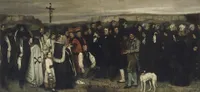
Gustave Courbet was 30 and had just broken through. At the Salon of 1849 his After Dinner at Ornans won a gold medal and was bought by the state, which meant his work no longer needed a jury's approval to be shown at the Salon. He used that freedom at once. In November he began The Stone Breakers, and to the next Salon he sent it together with A Burial at Ornans, two enormous pictures of ordinary people from his own region. Later he said the label of Realist had been thrust on him, and that he would not paint an angel since he had never set eyes on one.
Critics were outraged. The poet Max Buchon saw in the two men the dawn and dusk of a galley slave's life, and the writer Champfleury announced that from now on critics would have to fight for or against realism. Proudhon, whom Courbet painted again and again, made it his example of socialist art. The Dresden gallery bought it around 1882 and treated it as the summit of his work. In February 1945, as the city was bombed, it was reportedly lost with more than 150 other paintings on a truck bound for the Königstein fortress; the historian Richard Raskin argued that it had already gone missing in 1944. The smaller, reversed second version survives in Winterthur.
In its time
The Stone Breakers was painted in 1849, when Courbet was 30. Its French title is Les Casseurs de pierres. Where it stands on Art Through Time:
Its colors
Elsewhere in the world
- 1846The Mexican–American WarMexico loses about half its territory to the United States.
- 1848Revolutions across EuropeRealists paint workers and the poor.
- 1848The Seneca Falls ConventionThe first women's rights convention demands the vote.
- 1850The Taiping RebellionSome 20 million die in China's civil war.
- 1853Japan opens to the WestJapanese prints astonish European painters.
The facts
- Title
- The Stone Breakers
- Artist
- Gustave Courbet (1819–1877)
- Date
- 1849
- Original medium
- Oil on canvas
- Style
- Realism
- Made in
- France
- Collection
- Formerly Gemäldegalerie Alte Meister, Dresden (lost 1945)
Art Through Design
The mood
It brings hard work into a room without making a speech about it. Two figures, a pile of stones, a hot hillside: it gives a space weight, and a reminder of what holds the roads up.
The palette
Charcoal is the shadowed hillside, Loam and Flint the stones and the patched clothes, Dust and Chalk the dry road and the white shirts. From across a room, the two pale shirts and the red waistcoat stand out against the dark slope.
Who it finds
- Anyone whose parents or grandparents worked with their hands, and who has not forgotten it.
- Anyone who has done hard physical work in the heat and knows the ache that comes after.
- Anyone who loves a painting with something to say, and the nerve to say it plainly.
See it in a room
Your photo is never uploaded, and it's gone when you leave.
Two figures in a frieze, one standing and one kneeling, with a dark hill behind them and a road of rubble at their feet: the arrangement is plain and strong. Close up, every patch and tear shows, the blue sock, the leather strap, the split boot, the basket of stones.
It is wide and fairly low, almost twice as wide as tall. Its natural place is a long wall: a study, a workshop, a hall or a kitchen. Give it width so the two men are near life-size in feeling. Small, they become a scene; large, they become people.
Order on canvas, acrylic, or print
- True to the original
- Each file is color-matched to the museum original. If the color isn't right, we print it again, with our compliments.
- On canvas
- Fine-art canvas hand-stretched over a ¾″ solid-wood frame, with mirrored edges so nothing is lost.
- In our floating frame
- Our stretched canvas set in a slim floating frame, with a shadow gap so the painting seems to hover.
- As a framed print
- Archival pigment print on museum-grade cotton paper, in a solid-wood frame with UV-protective glazing.
- Ready to hang on arrival
- It arrives with the hanging hardware attached. No framer, no guesswork.
- Perfect on arrival
- If anything arrives damaged or not as you ordered, send us a photo within 7 days of delivery and we'll make it again, with our compliments.
Courbet set two road workers to their stones in 1849, and the painting outlived its own canvas. Hang it where real work gets done.