The story · 3 min read
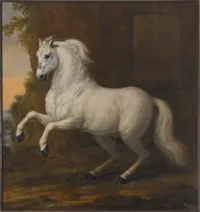
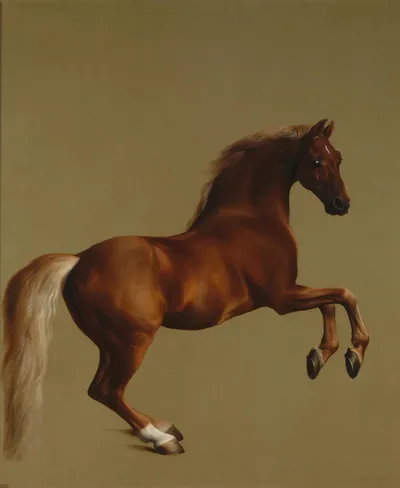
Portraits this big were for kings, and this one is of a horse.
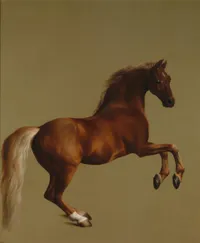
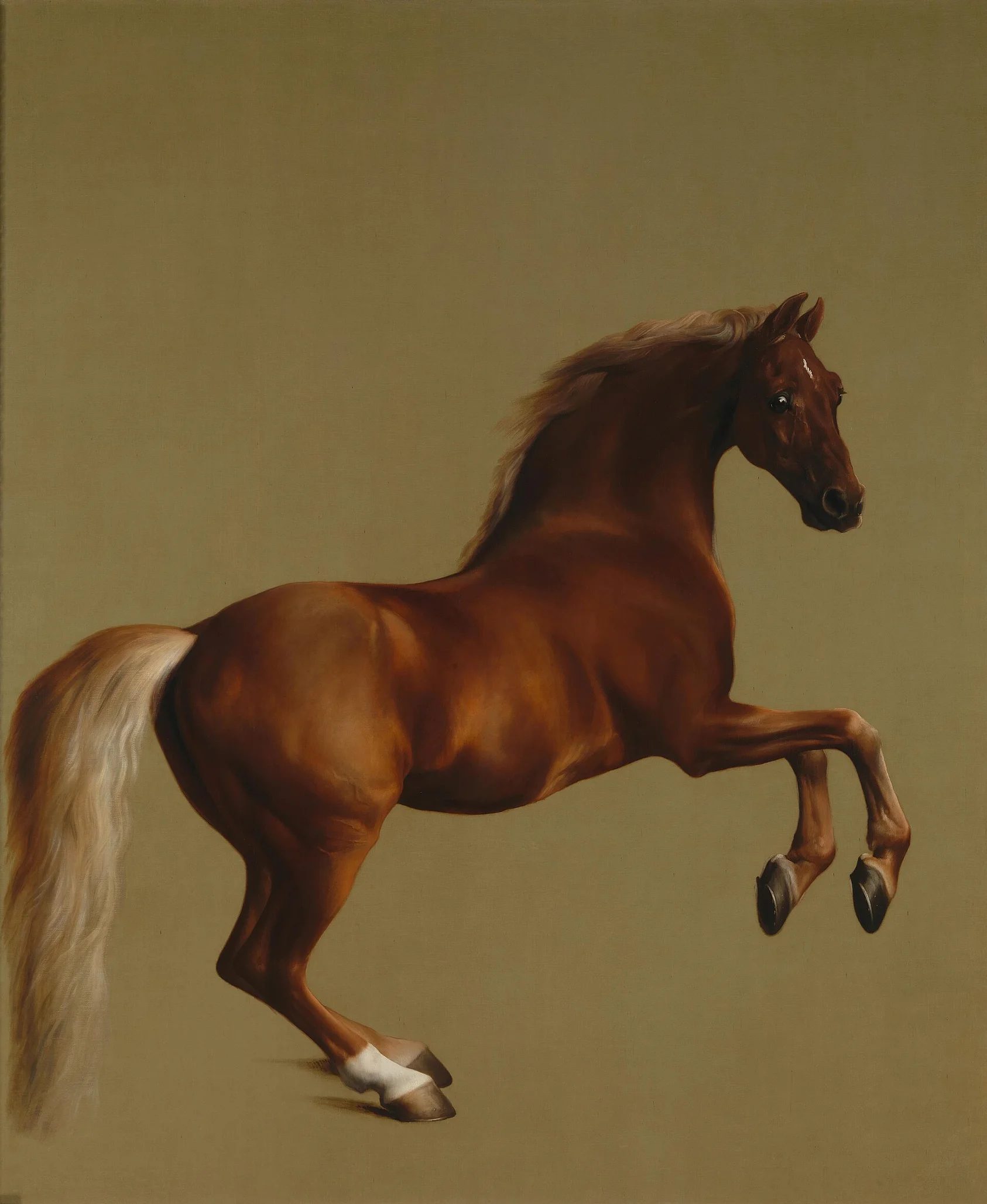
Whistlejacket, 1762. George Stubbs. National Gallery, London.
Look closer
7 things to notice
 1
01
Looking straight back at you
This is Whistlejacket, a real racehorse, painted about the size of life. He is rearing up and turning his head. Stubbs gives him an eye as alert as a person's.
02
Copper with a pale gold edge
The mane runs from dark copper into pale gold, the oil pulled out in fine lines. Against that flat honey background, every strand stands up on its own.
03
He cut up horses first
Every muscle here is correct. Stubbs had spent 18 months dissecting dead horses, hanging them from hoists so he could draw them layer by layer.
04
Nobody on his back
Painters had shown horses rearing like this before, in grand pictures by Rubens and Velázquez. There was always a king in the saddle. Here the back is bare, and the horse has the whole canvas.
05
A tail like poured cream
The pale tail falls almost to the ground, built up in long creamy strokes. It is the lightest thing on the canvas, and it balances the dark head at the opposite corner.
06
Unfinished, said the rumours
No stable, no sky, no grass. People were so astonished by this blank honey-coloured wall that stories spread that the painting had been abandoned. Modern historians think he meant it.
07
Veins under the skin
Look along this raised leg and you can find veins and small flaws in the skin. Earlier horse painters drew a generic horse. Stubbs painted this one.
The story
What you are looking at
A racehorse, and nothing else, painted the size of life. In 1762 that was outrageous. Paintings that size were kept for kings and heroes, and animal painting was ranked close to the bottom of the art world. The horse belonged to the Marquess of Rockingham, an enormously rich man who loved racing and later became Prime Minister.
The man who took horses apart
George Stubbs wanted to know what was under the skin, so for a year and a half he dissected dead horses in Lincolnshire and hung them from ropes to draw them. The drawings became a famous book. Aristocrats started lining up.
The horse tried to fight it
According to a story from Stubbs's friend, when the picture was almost done a stable boy led the real Whistlejacket past it. The horse took it for a rival stallion and went for it, lifting the boy off the ground. Historians suspect the story is too good to be true, which has not stopped anyone from telling it.
Eleven million pounds
It stayed in the family for more than 230 years, in a room built just for it. In 1997 the National Gallery in London paid £11 million for it. It now hangs so that you can see it through ten rooms in a straight line.
Our take
Take away the king, the battle and the landscape, and something surprising happens: the horse looks like nobody's property. Most of us never get to be looked at this carefully. To us he seems both magnificent and alone.
The design is one huge curved shape on a flat field. Warm chestnut on warm honey should be dull, but the two colours are so close that the only drama left is in the body itself. All that empty space is the reason he looks so alive.
In its time
Whistlejacket was painted in 1762, when Stubbs was 38. Where it stands on Art Through Time:
Its colors
Elsewhere in the world
- 1757The Battle of PlasseyCompany rule begins in Bengal.
- 1767Ayutthaya fallsBurmese armies destroy the Thai capital; Bangkok rises in 1782.
The facts
- Title
- Whistlejacket
- Artist
- George Stubbs (1724–1806)
- Date
- 1762
- Original medium
- Oil on canvas
- Style
- Romanticism
- Made in
- United Kingdom
- Collection
- National Gallery, London
Art Through Design
The mood
It brings power and a kind of calm into a room. One great chestnut horse rises against a plain honey ground, and the space around it feels open, warm and held to attention.
The palette
Honey and Bronze are the empty background; Chestnut and Walnut are the horse's coat and its shadows; Wheat is the pale tail and mane. Across a room, one dark curved shape against gold is all you see.
Who it finds
- Anyone who has stood next to a thoroughbred and felt how much of it there was.
- Anyone who has studied something so closely that they ended up knowing it from the inside.
- Anyone who would rather be left alone in a big empty field than put on a show.
See it in a room
Your photo is never uploaded, and it's gone when you leave.
One big horse on an empty ground is about as clear as a picture gets, and it reads from the far end of any room. Closer, the veins and muscles appear, and then the small wet shine of the eye.
Upright and close to square, it wants height: a staircase, a tall hall or a long dining room. It should be big, since the original horse is painted the size of life.
Order on canvas, acrylic, or print
- True to the original
- Each file is color-matched to the museum original. If the color isn't right, we print it again, with our compliments.
- On canvas
- Fine-art canvas hand-stretched over a ¾″ solid-wood frame, with mirrored edges so nothing is lost.
- In our floating frame
- Our stretched canvas set in a slim floating frame, with a shadow gap so the painting seems to hover.
- As a framed print
- Archival pigment print on museum-grade cotton paper, in a solid-wood frame with UV-protective glazing.
- Ready to hang on arrival
- It arrives with the hanging hardware attached. No framer, no guesswork.
- Perfect on arrival
- If anything arrives damaged or not as you ordered, send us a photo within 7 days of delivery and we'll make it again, with our compliments.
Stubbs painted one horse the size of life around 1762 and left out everything else. Hang it where it has the wall to itself.