The story · 3 min read
The man who owned this angel ran out of places to take it.
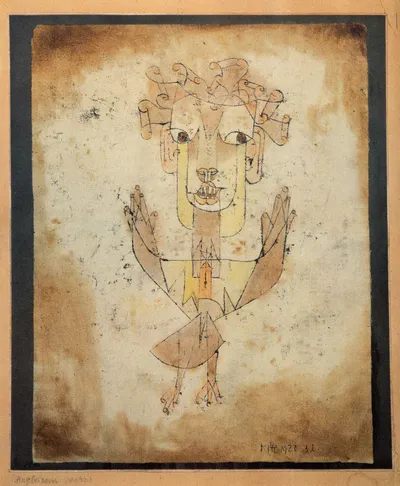
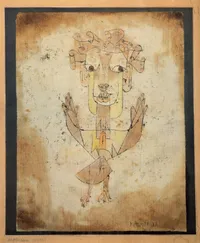
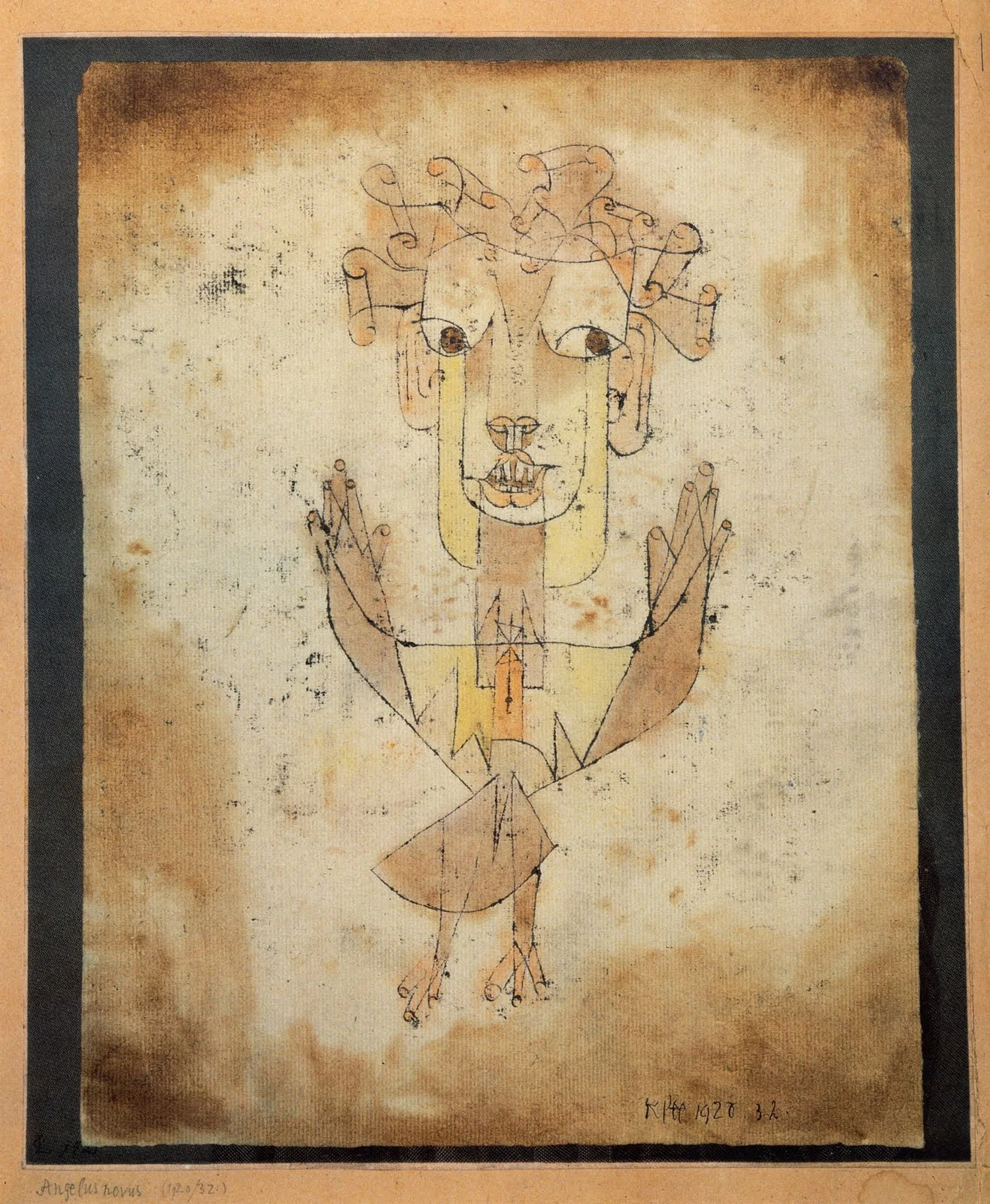
Angelus Novus, 1920. Paul Klee. Israel Museum, Jerusalem.
Look closer
7 things to notice
 1
01
Eyes that cannot look away
This little figure is an angel. Klee drew it in 1920 with two dark eyes set wide. A philosopher who owned it thought it looked about to flee something it could not stop staring at.
02
Curls drawn like rolled paper
Each lock of hair ends in a tight curl, like the end of a scroll. Some scholars connect that to Klee's interest in Jewish mysticism. Whatever is written on them stays rolled up.
03
A mouth left open
Small square teeth, lips parted. The wobbly line comes from a method Klee invented, pressing a drawing through an oiled sheet so that it blurs and stutters as it transfers.
04
Arms that cannot come down
These wings end in fingers. The philosopher imagined a storm blowing so hard that the angel could no longer fold them. The fingers stay spread.
05
Martin Luther underneath
In 2015 an artist discovered something odd about this sheet: Klee had glued it on top of an old engraving of Martin Luther. For a century Luther has been lying face to face with this angel's back.
06
It spent the war in a library
When the Nazis reached France, its owner gave this sheet to a friend who worked at France's national library. He hid it there until the war was over.
07
From a Munich desk to Jerusalem
Klee signed it, dated it 1920 and gave it a catalogue number, 32. It then travelled across Europe in the worst years of the century and ended up in a museum in Jerusalem.
The story
What you are looking at
A small sheet of paper by a Swiss-German artist named Paul Klee, made in 1920. It looks like something a clever child might draw: a frightened little angel with its arms up. It would be one drawing among thousands, except for the man who bought it.
The man who could not leave it
A German Jewish writer named Walter Benjamin paid for it in 1921 and treated it as a companion for the rest of his life. When the Nazis took power in 1933 he fled to Paris and brought it with him.
The most famous paragraph about a drawing
In 1940 Benjamin wrote that this angel is the angel of history. It faces the past and sees one endless pile of wreckage. It wants to stay and fix things, but a storm from Paradise pushes it backward into the future. That storm, he said, is what we call progress.
How it survived
He gave it to a friend to hide and fled for Spain. He took his own life there in September 1940, the night before he was to be sent back. After the war the sheet passed from friend to friend, as his will asked, and reached Jerusalem.
Our take
Something here is almost unbearable: how small and silly it is, given what it came to carry. A cartoonish creature with bad teeth became the face of a whole century's dread.
Klee's line trembles, and that is why it works. Confident lines feel like authority; shaky ones feel like nerves. The colour is the tan of old paper, so the eyes are the only dark, fixed points on the sheet. We keep coming back to them, the way you keep checking a door.
In its time
Angelus Novus was painted in 1920, when Klee was 41. Where it stands on Art Through Time:
Its colors
Elsewhere in the world
- 1914The First World WarExpressionists and Dadaists answer the catastrophe.
- 1919The Amritsar massacreBritish troops fire on a peaceful crowd, killing hundreds.
- 1919Korea declares independenceMillions join peaceful protests; Japan's police and army crush them.
- 1920Women win the voteThe Nineteenth Amendment is ratified.
- 1922Week of Modern Art, São PauloBrazil declares its own modernism.
The facts
- Title
- Angelus Novus
- Artist
- Paul Klee (1879–1940)
- Date
- 1920
- Original medium
- Watercolor on paper
- Style
- Expressionism
- Made in
- Switzerland
- Collection
- Israel Museum, Jerusalem
Art Through Design
The mood
It brings a small, wide-eyed unease into a room. Pale stained paper and thin wandering lines stay soft on the wall, and then the stare arrives, and the space feels watched and strangely tender.
The palette
Oat and Wheat are the worn paper; Sand and Bronze are the old stains around its edges; Walnut is the thin drawn line and the dark mount. Across a room, the figure is a faint pale shape with two dark eyes.
Who it finds
- Anyone who has left a home in a hurry and thought hard about the one thing to take.
- Anyone who has read a sentence so good it changed what they saw in a picture.
- Anyone who keeps looking backward while the years go on carrying them forward.
See it in a room
Your photo is never uploaded, and it's gone when you leave.
Faint and upright on its stained sheet, the angel reads from afar as a pale smudge with two black dots for eyes. Closer in, the lines start to tremble, the teeth appear, and you find the small claws and the curls.
It was made small, so it wants a small wall: a desk, a shelf-side niche, a narrow passage or the space beside a bed. Keep it modest in scale, with plenty of bare wall around it, and hang it low enough that you meet its eyes when you sit.
Order on canvas, acrylic, or print
- True to the original
- Each file is color-matched to the museum original. If the color isn't right, we print it again, with our compliments.
- On canvas
- Fine-art canvas hand-stretched over a ¾″ solid-wood frame, with mirrored edges so nothing is lost.
- In our floating frame
- Our stretched canvas set in a slim floating frame, with a shadow gap so the painting seems to hover.
- As a framed print
- Archival pigment print on museum-grade cotton paper, in a solid-wood frame with UV-protective glazing.
- Ready to hang on arrival
- It arrives with the hanging hardware attached. No framer, no guesswork.
- Perfect on arrival
- If anything arrives damaged or not as you ordered, send us a photo within 7 days of delivery and we'll make it again, with our compliments.
Klee drew this frightened little angel in 1920, and a philosopher carried it through the worst years of the century. Hang it near your desk.