The story · 2 min read
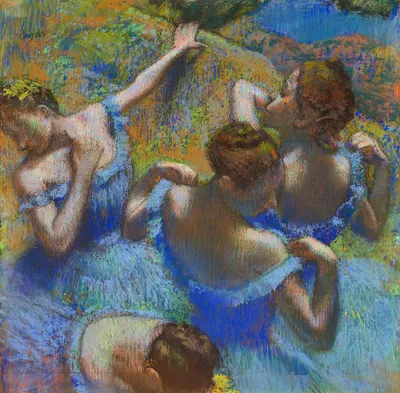
Four dancers fix their straps, and Degas could barely see them.
Blue Dancers, c. 1898. Edgar Degas. Pushkin Museum of Fine Arts, Moscow.
Look closer
7 things to notice
 1
01
Straightening up before the stage
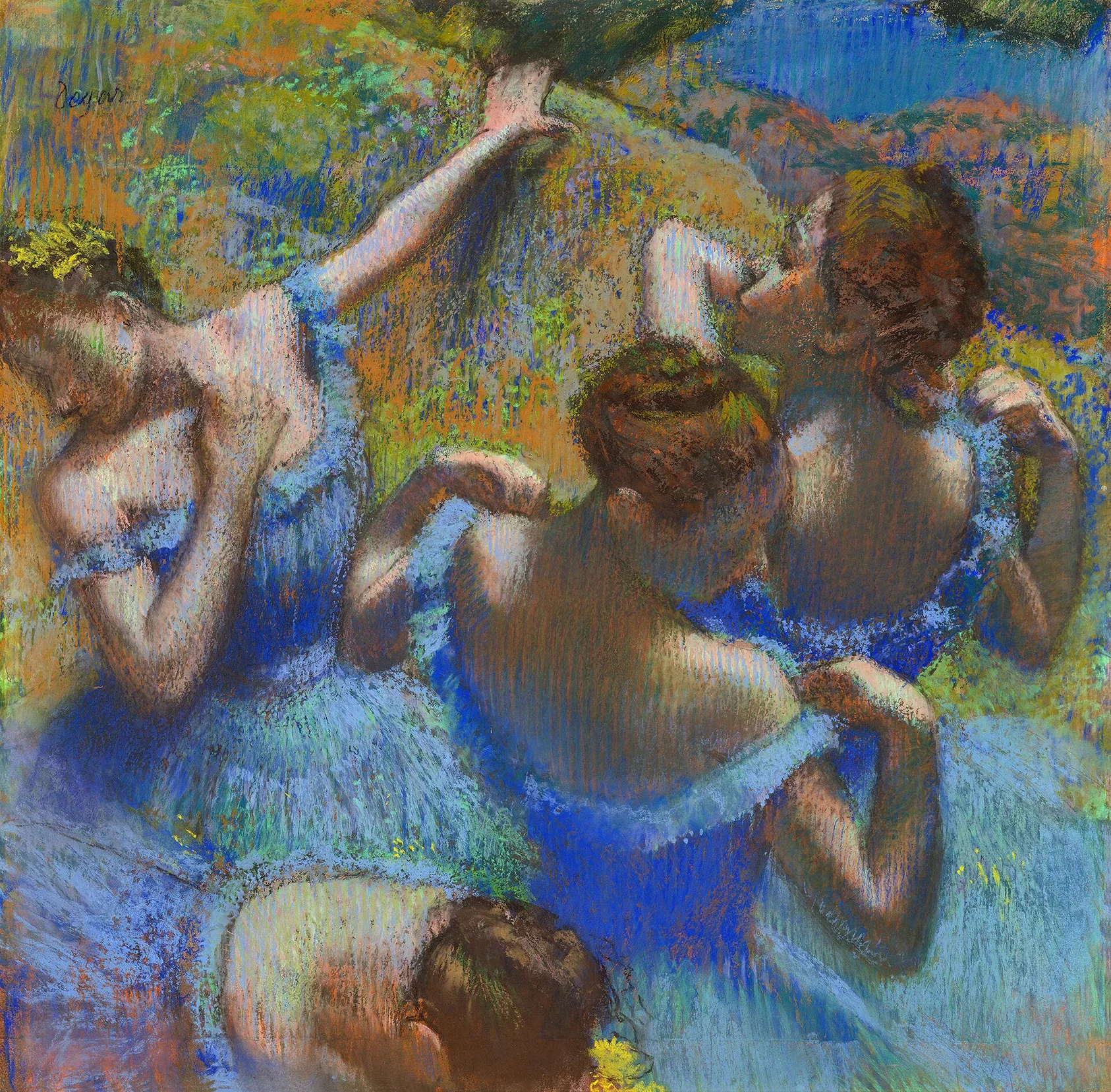
A dancer on the left reaches back to adjust her shoulder strap. Degas painted dancers backstage far more than on stage, as working women doing a job.
02
An arm thrown up
One arm reaches high into the top of the picture, fixing hair or a strap. The arm is cut off by the edge. He loved cropping his scenes this way, as Japanese prints did.
03
A bare back in the light
The middle dancer shows us her back, the skin built up in layers of pink and orange chalk. Degas skipped the pretty side and went after the movement.
04
Blue scribbled into tulle
The blue tutus are made of fast, hatched lines of pastel, dry chalk laid on in layers. Up close it is almost wild. From a step back it turns into tulle.
05
Scenery that is pure colour
The background is bands of orange, green and blue chalk. It is probably stage scenery, but by now Degas cared more about colour than about telling you where they are.
06
A head that is all hair
At the bottom, one dancer bends down out of sight, so we see only the top of her head. Nobody here is posing for us.
07
His name in the corner
Degas signs in the top left. By this time he was in his sixties and his eyesight had been failing for years.
The story
What you are looking at
Four ballet dancers in blue costumes, crowded together in the wings just before going on stage, adjusting their straps. Around 1898 Edgar Degas drew them in pastel, coloured chalk worked in layers. More than half of everything he ever made shows dancers.
The painter who hated the label
Degas exhibited with the Impressionists and helped found the group, but he refused to be called one. He did not paint outdoors. He preferred to call himself a realist, and he showed dancers as professionals at work, tired and busy, a long way from fairies.
Painting while going blind
His eyes had troubled him since he was in the army in 1870. After 1890 they got much worse. He switched more and more to pastel, which let him work with big, bold strokes and strong colour, and he blamed his eyes when he could not finish a picture.
To Moscow
The dealer Durand-Ruel sold it to Sergei Shchukin, a Russian textile tycoon who collected modern French art. It stayed in his collection until 1918, and since 1948 it has hung in the Pushkin Museum in Moscow.
Our take
These dancers are not performing yet, and that is what makes them feel real. This is the nervous moment before going out, all elbows and straps, when nobody is watching except a painter who could hardly see them.
Blue and orange are opposite colours, and Degas sets them hard against each other, so the whole sheet seems to vibrate. The bodies overlap and crowd the frame. Less detail, more colour: as his eyes failed, the feeling got stronger.
In its time
Blue Dancers was painted around 1898, when Degas was 64. Where it stands on Art Through Time:
Its colors
Elsewhere in the world
- 1894The Dreyfus AffairA Jewish officer is falsely convicted of treason; France, and its painters, split in two.
- 1896The Battle of AdwaEthiopia defeats Italy and stays independent.
- 1897Benin City is burnedBritish troops loot thousands of bronzes, now in museums worldwide.
- 1898The Philippines declares independenceThe U.S. takes the islands instead; some 200,000 Filipino civilians die in the war that follows.
- 1901Australia becomes a nationSix colonies federate on ancient land.
The facts
- Title
- Blue Dancers
- Artist
- Edgar Degas (1834–1917)
- Date
- c. 1898
- Original medium
- Pastel
- Style
- Impressionism
- Made in
- France
- Collection
- Pushkin Museum of Fine Arts, Moscow
Art Through Design
The mood
It brings electric blue and warm orange into a room. Crowded dancers glow against bright stage colour, and the space around them feels lively, warm and full of nervous energy.
The palette
Sapphire and Slate are the blue tutus; Olive and Mushroom are the stage scenery; Bark is the shadow between bodies. Across a room, the blue is what you see, glowing against the orange.
Who it finds
- Anyone who danced as a child and remembers the wait in the wings.
- Anyone who has fixed a costume strap thirty seconds before going on.
- Anyone who kept working at what they loved as their body made it harder.
See it in a room
Your photo is never uploaded, and it's gone when you leave.
A mass of blue and orange reads from across a room like a burst of colour. Up close, the dancers emerge one by one, and the chalk breaks into thousands of separate lines.
Close to square, it belongs in a dressing room, a bedroom with a mirror, or a dance studio. It works small and gets more dazzling when large, since the chalk strokes become part of the pleasure. Placed at head height, the dancers seem to be getting ready right beside you.
Order on canvas, acrylic, or print
- True to the original
- Each file is color-matched to the museum original. If the color isn't right, we print it again, with our compliments.
- On canvas
- Fine-art canvas hand-stretched over a ¾″ solid-wood frame, with mirrored edges so nothing is lost.
- In our floating frame
- Our stretched canvas set in a slim floating frame, with a shadow gap so the painting seems to hover.
- As a framed print
- Archival pigment print on museum-grade cotton paper, in a solid-wood frame with UV-protective glazing.
- Ready to hang on arrival
- It arrives with the hanging hardware attached. No framer, no guesswork.
- Perfect on arrival
- If anything arrives damaged or not as you ordered, send us a photo within 7 days of delivery and we'll make it again, with our compliments.
Around 1898 Degas drew four dancers in the wings, with his eyesight going. Hang it where you get ready.
.jpg&w=200)