The story · 4 min read
Two people at one table, and each completely alone.
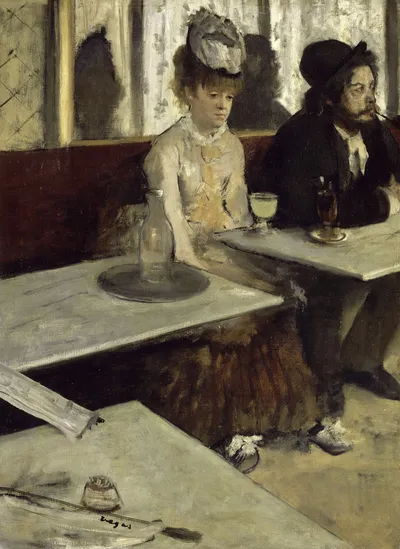
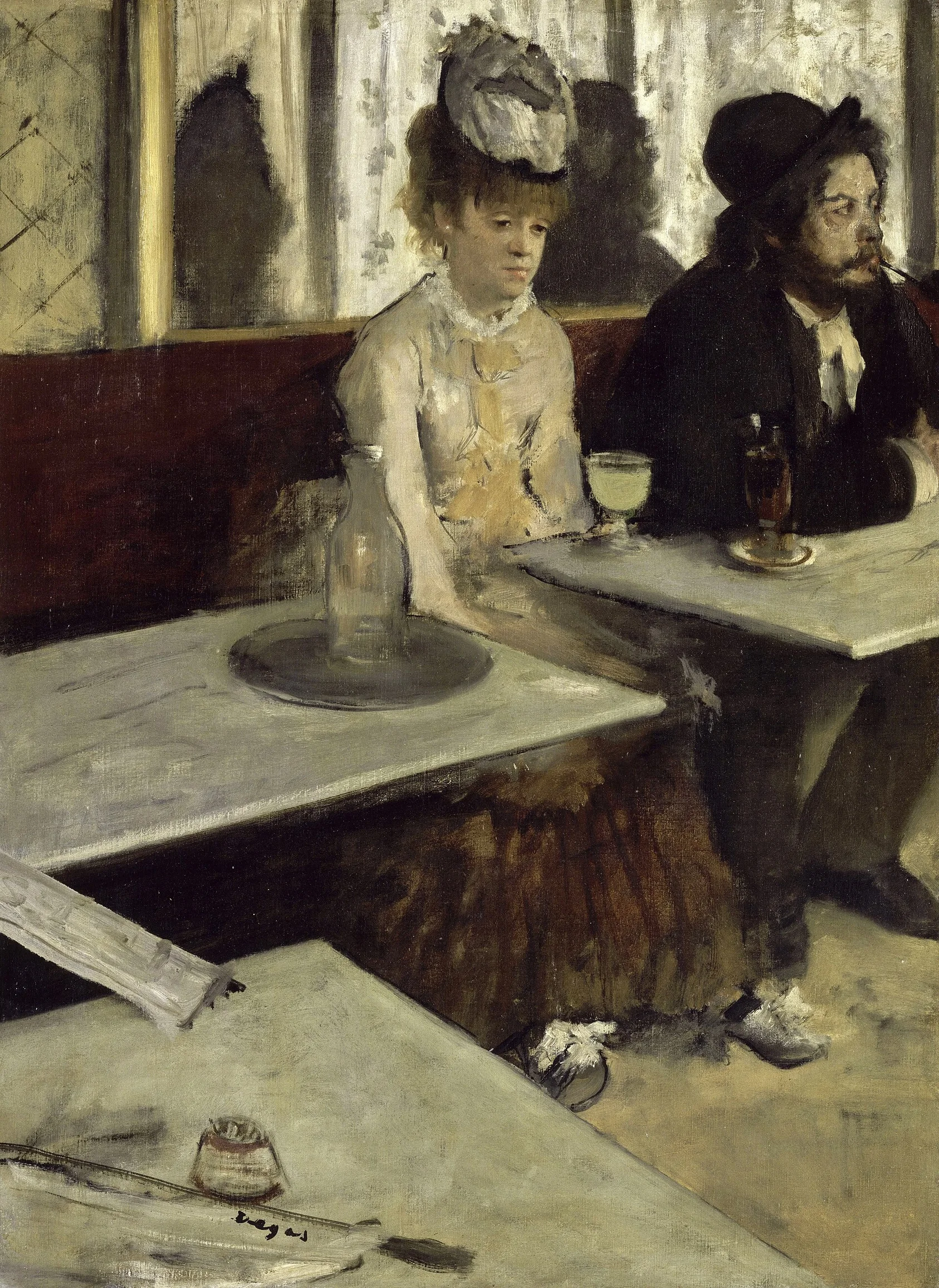
L'Absinthe, 1875–1876. Edgar Degas. Musée d'Orsay, Paris.
Look closer
7 things to notice
 1
01
A face with nowhere to look
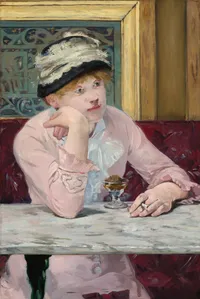
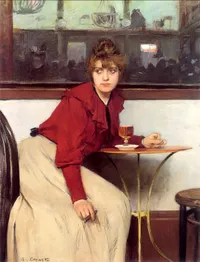
The woman sits upright in a pale dress with a ruffled collar and a small feathered hat, her eyes lowered, her mouth slack. She is the actress Ellen Andrée, who also sat for Manet, in Plum Brandy among other pictures. Here she plays loneliness so well that London took it for a confession.
02
A glass of green on the marble
In front of her stands a stemmed glass of cloudy, pale green absinthe. Shown in London in 1893 under the title L'Absinthe, the picture was read by English critics as a warning about drink, and about the French in general. Its first title was simply In a Café.
03
Looking off the edge
Beside her, the man in a black hat and coat bites on a pipe and stares out to the right, past the edge of the canvas. He is Marcellin Desboutin, a painter and etcher, cast here as a café regular. His whole body has turned away from her.
04
His drink, sliced by the frame
A tall glass of a darker drink stands on a saucer in front of him. Degas's compositions of these years look like snapshots, cut off at odd angles, and the sources connect the habit to his interest in photography. This table, too, runs straight out of the picture.
05
An empty carafe in front
A clear glass carafe stands empty on a round tray, on the nearer table. In 1876 critics called the whole picture ugly and disgusting, and found little in it worth admiring. The carafe holds just as little.
06
Tables leading the eye
A newspaper hangs on a wooden reading rod across a bare table at the lower left. The tables run in a zigzag from the bottom of the picture up to the couple, pushing them into the top corner. You look at them the way you might glance across a café from your own seat.
07
Signed beside a match holder
A little match holder stands on the near table, and beside it Degas has signed his name in dark letters. The painting's first owner was a Brighton collector, Captain Henry Hill, who bought it in London in 1876. It spent its early years in England, where it was never much loved.
Our take
In a Paris café, a woman in a pale dress sits with a glass of absinthe in front of her and stares at nothing. Beside her a man in a battered hat clamps his pipe and looks off the edge of the canvas. Their shoulders touch, and they are miles apart. Degas pushed them into the top right corner, behind a zigzag of empty marble tables. We have just glanced over from another seat.
Both were friends playing a part: the actress Ellen Andrée and the painter and etcher Marcellin Desboutin, posed at the Café de la Nouvelle-Athènes. Critics called it ugly and disgusting. In London in 1893, renamed L'Absinthe, it was read as a sermon against drink and against the French. She was an actress, doing her job.
The painter's moment
1834–1917Painted it at 41Impressionism
Edgar Degas had come back to Paris from New Orleans in 1873, and the next year his father died. Then he learned that his brother René had run up enormous business debts. To save the family's name, Degas sold his house and the art collection he had inherited and paid them off, and, never having needed to before, he had to live on what his paintings earned. He threw himself into the independent exhibitions of the painters who became known as the Impressionists, and into scenes of modern Paris: ballet rehearsals, which sold well, and café life, as here.
The picture drew bad reviews in 1876 and hung again in the Impressionists' third group show of 1877. In 1892 it came up at auction in London and was mocked; bought for the collector Arthur Kay, it went on show at the Grafton Gallery in 1893 as L'Absinthe and caused an uproar, the painters William Blake Richmond and Walter Crane among those who saw it as a blow to morality. The novelist George Moore first called it a lesson, then decided it was simply a work of art with nothing to do with drink. Kay sold it to a Paris dealer that April, and it now hangs in the Musée d'Orsay.
In its time
L'Absinthe was painted in 1875–1876, when Degas was 41. Where it stands on Art Through Time:
Its colors
Elsewhere in the world
- 1874The first Impressionist exhibitionIndependent artists show on their own terms.
- 1875Fort Marion ledger drawingsImprisoned Plains artists draw their world.
- 1876Centennial Exhibition, PhiladelphiaAmerica measures its art against the world.
- 1876Russia bans books in UkrainianThe Ems Decree suppresses the Ukrainian language in print.
- 1876Battle of the Little BighornRecorded by Lakota and Cheyenne artists.
The facts
- Title
- L'Absinthe
- Artist
- Edgar Degas (1834–1917)
- Date
- 1875–1876
- Original medium
- Oil on canvas
- Style
- Impressionism
- Made in
- France
- Collection
- Musée d'Orsay, Paris
Art Through Design
The mood
It brings a quiet, slightly melancholy hour into a room, the hush of a café between the busy times. It is sober and honest, and it makes a space feel thoughtful.
The palette
Linen and Khaki are the marble tables and the mirror's grey light; Olive and Umber are the walls and the woman's dress; Ebony is the man's coat and the dark bench. From across a room, the pale tables and the two figures in the top corner are what you see.
Who it finds
- Anyone who has sat beside someone at a table and felt completely alone.
- Anyone who keeps a favourite café, and the same seat in it, year after year.
- Anyone who prefers an honest picture of a bad afternoon to a pretty one of a good day.
See it in a room
Your photo is never uploaded, and it's gone when you leave.
A zigzag of pale tables leading up to two figures in a corner: it reads like a glance across a café. Nearer, the small things come out, a glass of green, a pipe, a newspaper on its stick, a match holder beside the signature.
Upright and slightly taller than wide, it belongs where you sit with a cup of coffee: a kitchen corner, a breakfast nook, a study with a small table. A medium size keeps it intimate. Hang it at seated eye level, the way Degas framed it, so you share the room with the two of them.
Order on canvas, acrylic, or print
- True to the original
- Each file is color-matched to the museum original. If the color isn't right, we print it again, with our compliments.
- On canvas
- Fine-art canvas hand-stretched over a ¾″ solid-wood frame, with mirrored edges so nothing is lost.
- In our floating frame
- Our stretched canvas set in a slim floating frame, with a shadow gap so the painting seems to hover.
- As a framed print
- Archival pigment print on museum-grade cotton paper, in a solid-wood frame with UV-protective glazing.
- Ready to hang on arrival
- It arrives with the hanging hardware attached. No framer, no guesswork.
- Perfect on arrival
- If anything arrives damaged or not as you ordered, send us a photo within 7 days of delivery and we'll make it again, with our compliments.
Degas sat two friends side by side in a Paris café in 1876, and they have not exchanged a word since. Hang it where you take your morning coffee.