The story · 3 min read
He was out of time and money, so he painted the woman he loved instead.
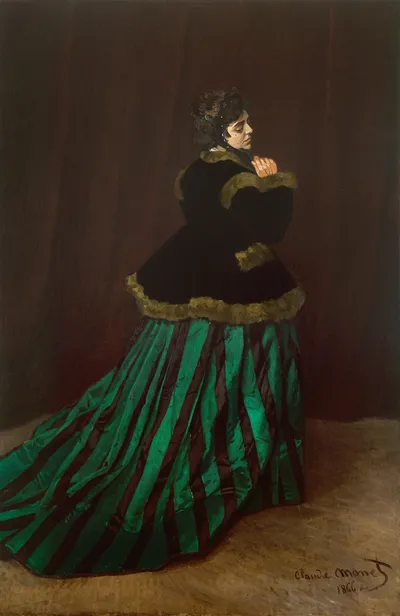
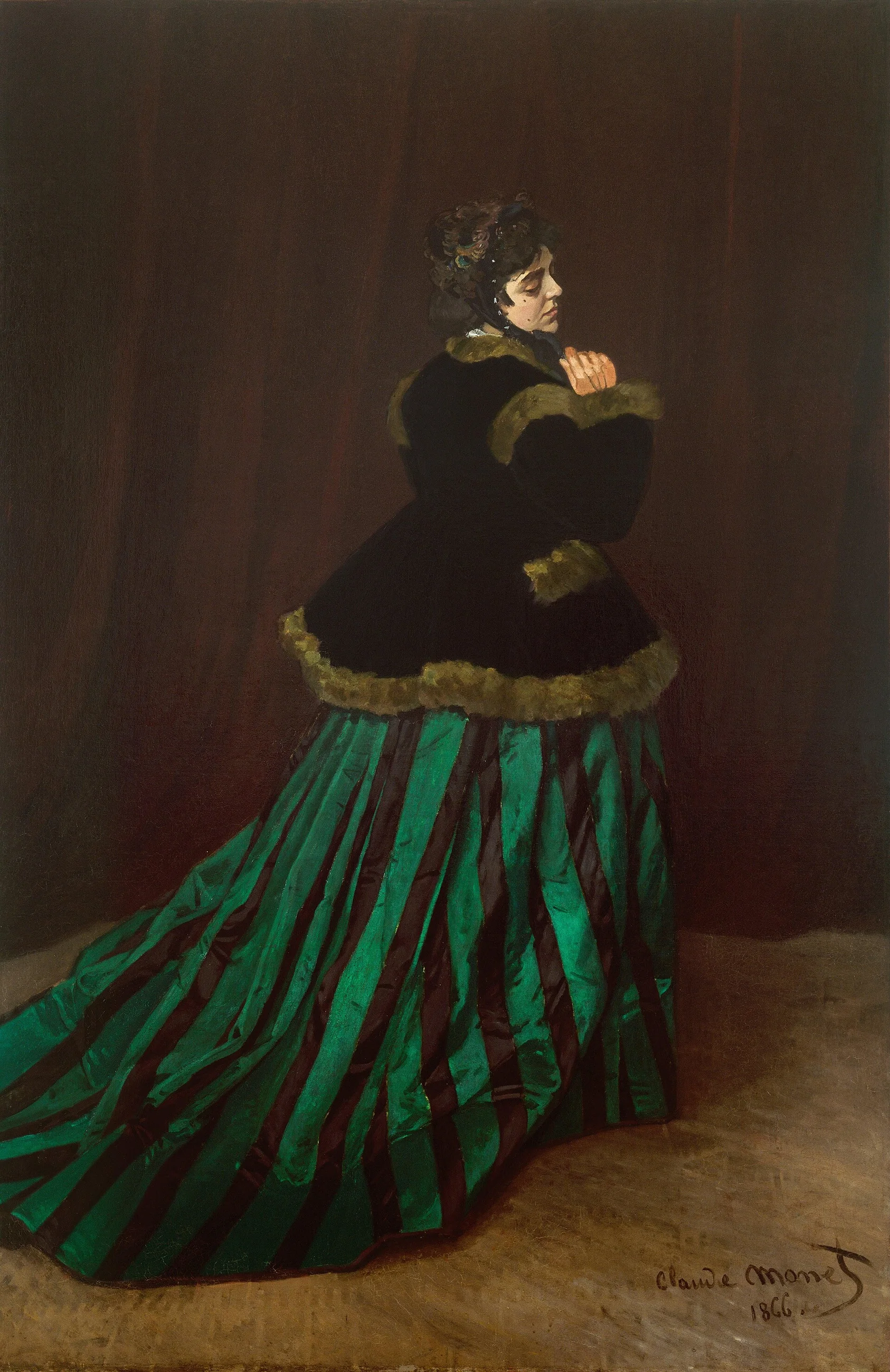
Camille, 1866. Claude Monet. Kunsthalle Bremen.
Look closer
7 things to notice
 1
01
Listening to something else
This is Camille Doncieux, who would become Monet's wife. She has just glanced back over her shoulder, eyes down. She seems to be listening to herself.
02
One bright glove
A yellow leather glove sits at her collar, a small warm note in all that black. A fashionable Parisian woman in 1866 would have worn one just like it.
03
So dark it barely has edges
A black jacket edged in fur takes up the middle of the picture. It is so dark that it reads almost as one flat shape, and it makes the green below look even louder.
04
Green that jumps off the wall
Emerald and black silk stripes, the height of fashion, painted in long fast strokes that follow every fold. This dress is why the picture became famous. It takes the light first.
05
Walking out of the frame
Look at the left side of the canvas. Her long silk train runs out past the edge, so she seems to be on her way somewhere. That sense of a passing moment was new.
06
A curtain close to black
Behind her hangs a dark red curtain, so dark that it is almost black. Nothing else is back there, and she has nowhere to hide.
07
A name that was about to matter
Bottom right: Claude Monet, 1866. He was 25, and this was the picture that made Paris learn his name.
The story
What you are looking at
She is wearing green striped silk, and she has been painted as large as life, in 1866. It looks like a fashion plate. It was also a rescue job. Claude Monet, 25 and short of money, had planned a giant canvas for the most important art show in France, and he could not finish it in time.
Plan B
So he turned to Camille Doncieux, a model he had met the year before and fallen for. He posed her like someone just turning away, in the most fashionable dress he could show. He sent it in to the Paris Salon. The critics, to his relief, liked it.
What came next
It was one of the last times they liked him for a long while. His next pictures were rejected. Camille gave birth to their son in 1867, and his father cut off his money over the relationship. They married in 1870, just before war broke out. Today this first portrait of her belongs to the Kunsthalle in Bremen, in Germany, a long way from the room where he finished it in such a hurry.
Our take
She is beautifully dressed and looking away, and that is what stays with you. A private person lives inside all this silk. He had just fallen in love, and he paints her as somebody he can't quite get hold of.
The design is simple: a dark upper half and a blazing green lower half, like a bell. Green and black in stripes give the eye something to run down, then the train pulls it sideways, off the canvas, after her.
In its time
Camille was painted in 1866, when Monet was 26. Its French title is Camille, ou La Femme à la robe verte. Where it stands on Art Through Time:
Its colors
Elsewhere in the world
- 1864The Circassians are expelledRussia's conquest of the Caucasus ends in mass killing and deportation.
- 1864The Long Walk and Sand CreekNavajo are marched into exile; Cheyenne and Arapaho are massacred at Sand Creek.
- 1867Canada is born at ConfederationFour provinces unite as one self-governing country.
- 1868The Meiji RestorationJapan modernizes; Nihonga and Yōga.
- 1869The transcontinental railroadThe West opens to painters and tourists.
The facts
- Title
- Camille
- Artist
- Claude Monet (1840–1926)
- Date
- 1866
- Original medium
- Oil on canvas
- Style
- Realism
- Made in
- France
- Collection
- Kunsthalle Bremen
Art Through Design
The mood
It brings a rich, dark elegance into a room. One tall figure in black and emerald stands against deep shadow, and everything near her feels formal, hushed and a little dramatic.
The palette
Ink and Walnut are the curtain and the jacket; Emerald is the silk; Bark is the fur in shade; Bronze is the bare floor. Seen from the door, the green skirt is what you notice first, then the small pale face.
Who it finds
- Anyone who has made their best work because the big plan fell through.
- Anyone who has looked at the person they love and known they were somewhere else for a moment.
- Anyone who has worn the best dress they owned to something that mattered more than they let on.
See it in a room
Your photo is never uploaded, and it's gone when you leave.
One tall dark shape with a green skirt reads strongly from any distance, like a figure in a doorway. Move in and you find the fur, the yellow glove and the quick, wet strokes along each fold of silk.
tall, it wants a stair wall, a narrow hall or a dressing room, and the height matters more than anything else. It was painted life size, so go as large as the wall will take.
Order on canvas, acrylic, or print
- True to the original
- Each file is color-matched to the museum original. If the color isn't right, we print it again, with our compliments.
- On canvas
- Fine-art canvas hand-stretched over a ¾″ solid-wood frame, with mirrored edges so nothing is lost.
- In our floating frame
- Our stretched canvas set in a slim floating frame, with a shadow gap so the painting seems to hover.
- As a framed print
- Archival pigment print on museum-grade cotton paper, in a solid-wood frame with UV-protective glazing.
- Ready to hang on arrival
- It arrives with the hanging hardware attached. No framer, no guesswork.
- Perfect on arrival
- If anything arrives damaged or not as you ordered, send us a photo within 7 days of delivery and we'll make it again, with our compliments.
Monet painted Camille in green silk in 1866 because the big picture would not get finished. Hang it where you pass on your way out.