The story · 4 min read
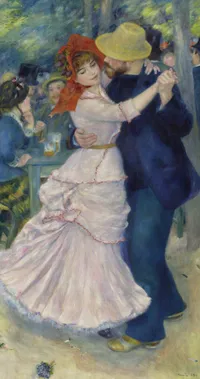
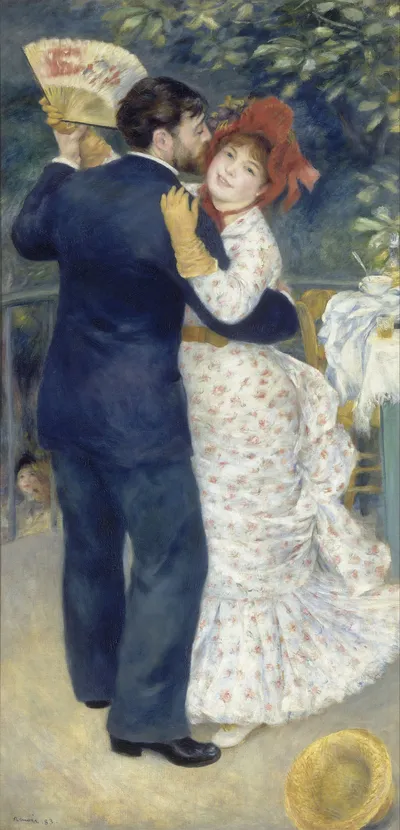
The woman he would marry, mid-dance, smiling straight at us.
Dance in the Country, 1883. Pierre-Auguste Renoir. Musée d'Orsay, Paris.
Look closer
7 things to notice
 1
01
Caught looking our way
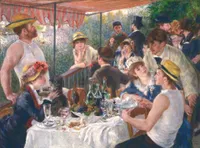
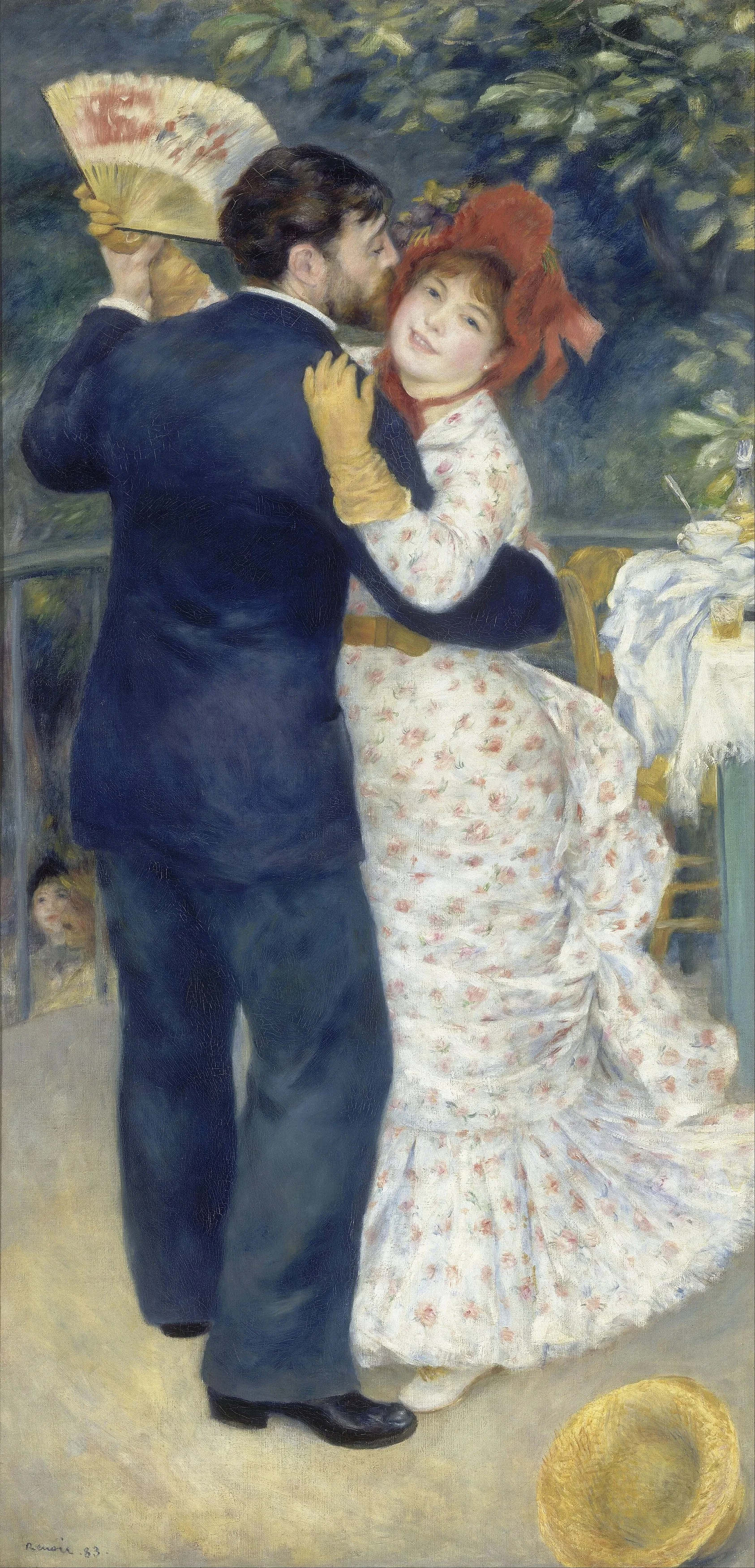
Under a red bonnet, Aline's round face turns toward us with a wide, open smile, her cheeks flushed. She had already posed for Renoir in Luncheon of the Boating Party, as the woman playing with a dog, and the same bonnet reappears on his dancer at Bougival. She seems delighted to be seen.
02
A fan keeping time
Raised behind his shoulder, her right hand holds an open fan patterned in red, her fingers in a bright yellow glove. Renoir dressed her in warm colours, yellow gloves and a red hat, so the whole scene glows. You can almost feel the breeze from it.
03
A face pressed to her cheek
He bends his dark head close to hers, so we see only his ear, his beard and the back of his collar. He is Paul Lhote, a friend of the painter, said to have posed for the Bougival dancer as well. Whatever he is saying, she is looking at us instead.
04
A hat nobody has picked up
In the bottom right corner, a straw hat lies upside down on the floor, dropped and forgotten. Renoir painted the couple life-size, filling almost the entire canvas, so small things like this hat sit right at its edges. Its owner has better things to do.
05
Watching from below
At the far left, a small face peers up from below the level of the floor, behind the railing. Renoir painted this canvas after a trip to Italy in 1881, where Raphael inspired him, and it marks his effort to move beyond Impressionism. This onlooker is sketched in a few quick touches; the dancers are solid as statues.
06
A drink abandoned for a dance
On the right, a little table under a white cloth holds a cup with a spoon, a carafe and a glass, beside an empty cane chair. Paul Durand-Ruel had asked Renoir in 1882 for pictures on the theme of the ball. Someone has left their glass for the floor.
07
The dealer who kept it
Renoir's signature and the year, 83, sit in the bottom left corner. Durand-Ruel first showed the painting that April and bought it three years later; it stayed with him as long as Renoir lived. The signature is small and quick, tucked under the dancers' feet.
Our take
Two dancers turn on a wooden floor under a chestnut tree, so close they fill the whole canvas. He is dark-suited, his face buried against her cheek; she is in a white dress sprigged with flowers and a red bonnet, a fan raised in one yellow-gloved hand, and she looks straight out at us, smiling broadly. A straw hat has fallen to the floor. A drink sits forgotten on the table. Nobody is in a hurry.
She is Aline Charigot, a young dressmaker who later became Renoir's wife. The man is his friend Paul Lhote. Of the three dance pictures Renoir made that year, only here does the woman meet your eye. It is the happiest of them.
The painter's moment
1841–1919Painted it at 42Impressionism
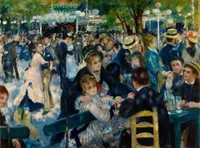
Pierre-Auguste Renoir was 42. He had travelled to Italy in 1881 and come home inspired by Raphael, and he was trying to move beyond the quick, broken touch of Impressionism toward firmer figures. In 1882 his dealer Paul Durand-Ruel asked him for pictures on the theme of the ball, and between January and April 1883 Renoir painted three, each a couple dancing in a different setting: this one, Dance at Bougival and Dance in the City. His model here was Aline Charigot, a dressmaker twenty years younger than he, whom he had painted in Luncheon of the Boating Party two years before. He had painted dancing before, in Bal du moulin de la Galette, where the dancers make a crowd; here a single pair fills the canvas.
Durand-Ruel first showed the picture in April 1883. That summer he spent a little over a month on Guernsey, coming back with fifteen canvases. Aline gave birth to their son Pierre in 1885, and they married in 1890; their second son, Jean, grew up to make films. After the wedding Renoir painted Aline and the family again and again, along with the boys' nurse, her cousin Gabrielle Renard. He died in 1919, and the Musée d'Orsay in Paris owns the painting today.
In its time
Dance in the Country was painted in 1883, when Renoir was 42. Its French title is La danse à la campagne. Where it stands on Art Through Time:
Its colors
Elsewhere in the world
- 1881Pogroms sweep the empireSome two million Jews leave for America and beyond by 1914.
- 1884The Berlin ConferenceEurope's powers divide Africa among themselves.
- 1885Leopold II takes the CongoHis forced-labor regime costs millions of lives.
- 1885The Indian National Congress is foundedThe movement for self-rule takes shape.
- 1887French Indochina is formedFrance rules Vietnam and Cambodia, and later Laos.
The facts
- Title
- Dance in the Country
- Artist
- Pierre-Auguste Renoir (1841–1919)
- Date
- 1883
- Original medium
- Oil on canvas
- Style
- Impressionism
- Made in
- France
- Collection
- Musée d'Orsay, Paris
Art Through Design
The mood
It brings warmth and flirtation into a room. A smiling face, a swirl of flowered dress and summer leaves overhead make a space feel cheerful, sunny and openly happy.
The palette
Indigo and Slate are his suit and the shade under the trees; Ivory is her flowered dress; Oat and Stone are the sunlit floor and the leaves. From across a room, her white dress against his dark suit, with the red bonnet above, draws the eye.
Who it finds
- Anyone who married the person they once danced with on a summer evening.
- Anyone who loves Renoir at his happiest, all sunlight, flowered cotton and flirtation.
- Anyone who has looked over a partner's shoulder at a dance and caught a friend's eye.
See it in a room
Your photo is never uploaded, and it's gone when you leave.
A dark suit and a white flowered dress fill the frame from top to bottom, with a red bonnet and a raised fan at the top: it reads at once as a couple whirling in the sun. Closer, the small pleasures appear, a dropped hat, a glass on a table, a face peeping up from below the floor.
Tall and slim, its height roughly double its width, it belongs in a bedroom, a hallway, a dressing room or the narrow wall beside a door. Large is best, since the couple were painted life-size. Hang it next to a doorway and they seem to dance in from the next room.
Order on canvas, acrylic, or print
- True to the original
- Each file is color-matched to the museum original. If the color isn't right, we print it again, with our compliments.
- On canvas
- Fine-art canvas hand-stretched over a ¾″ solid-wood frame, with mirrored edges so nothing is lost.
- In our floating frame
- Our stretched canvas set in a slim floating frame, with a shadow gap so the painting seems to hover.
- As a framed print
- Archival pigment print on museum-grade cotton paper, in a solid-wood frame with UV-protective glazing.
- Ready to hang on arrival
- It arrives with the hanging hardware attached. No framer, no guesswork.
- Perfect on arrival
- If anything arrives damaged or not as you ordered, send us a photo within 7 days of delivery and we'll make it again, with our compliments.
Renoir painted the woman he would marry, dancing under a chestnut tree in 1883. Hang it where the happiest evenings in the house begin.