The story · 4 min read
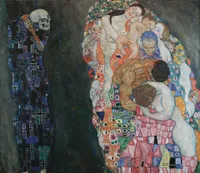
Death stands to one side, waiting, and the sleepers don't notice.
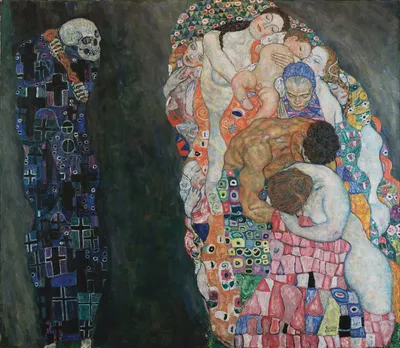
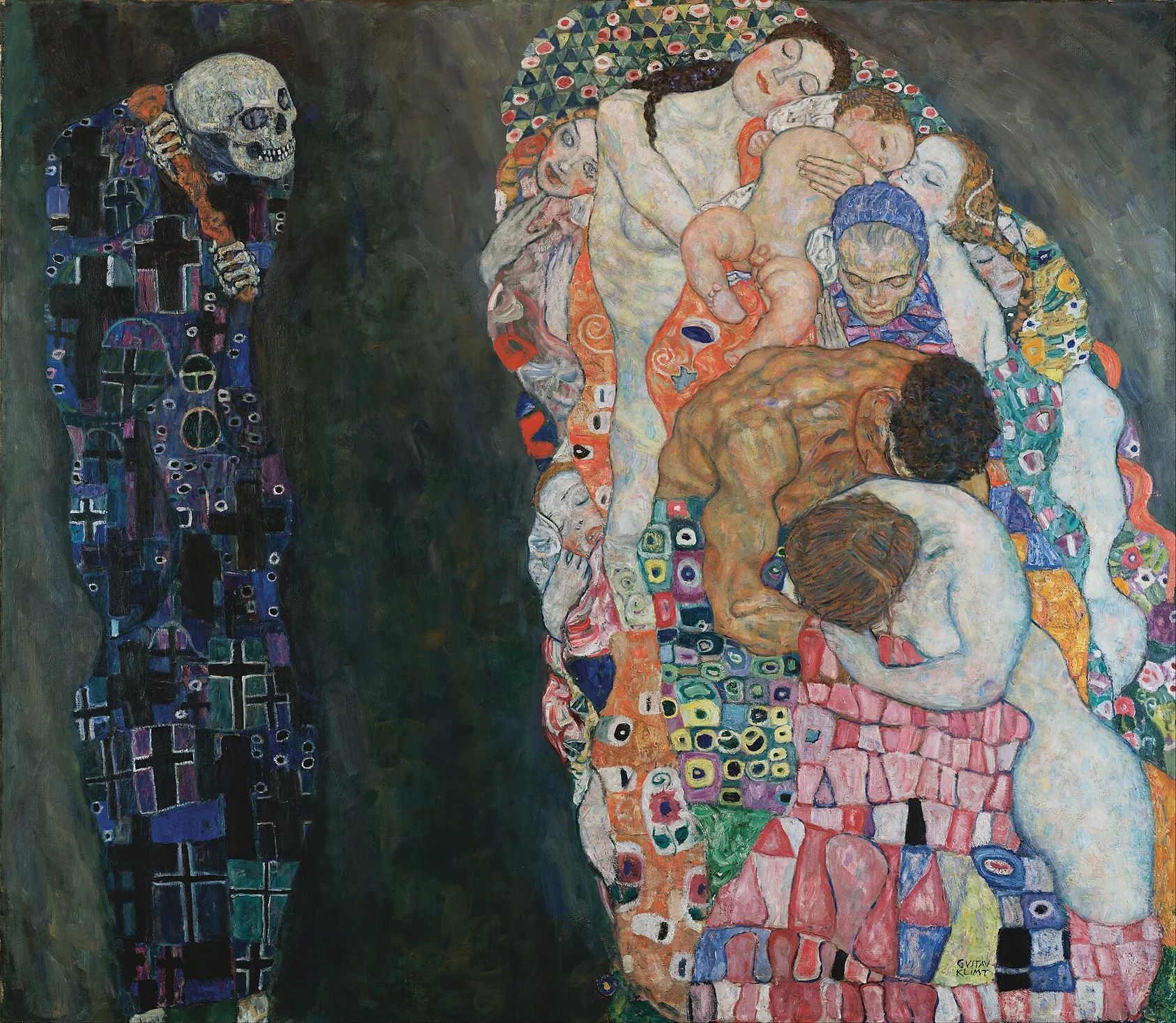
Death and Life, 1910. Gustav Klimt. Leopold Museum, Vienna.
Look closer
7 things to notice
 1
01
A grin under the hood
At the top left, Death's skull grins out of a dark hood, one bony hand gripping a short red club. Klimt set him apart, alone on his half of the canvas, facing the crowd of the living across the empty green. He seems to be picking his moment, and you can almost hear the silence.
02
A robe printed with crosses
Death's long robe falls in blocks of blue, violet and black, marked with crosses and small rings. Death and life was one of Klimt's central themes, one he shared with Edvard Munch and Egon Schiele. Here the patterning that dresses his lovers elsewhere dresses the grave.
03
Asleep, with a baby on her chest
At the top of the heap, a young mother sleeps with her head tipped back, a plump baby curled against her. The sources name the painting's subjects as youth, closeness, ageing and the nearness of death. This is new life, high in the pile, eyes shut.
04
An old face among the young
Below them an old woman in a blue headscarf bows her head, eyes lowered, her face lined. Ageing is one of the themes the sources name, and she carries it alone in a crowd of smooth young skin. One hand rests against her cheek.
05
Lovers who don't look up
Lower down, a man with a broad brown back holds a pale woman whose face is pressed against him. The expectation before a physical union, the sources say, is one of the painting's subjects. Neither of them has noticed who is watching from the left.
06
Patterns added at the end
Wrapped around the sleepers are blankets of colour, squares and circles of orange, pink, green and violet. When Klimt reworked the painting in 1915, after it had been exhibited five times, he added more of these mosaic-like patterns. They make the living look like one quilted body.
07
A name lettered on a patch
In the bottom right corner Klimt lettered his name on a patch of pale yellow, in capitals: GUSTAV KLIMT. The picture travelled widely in his lifetime, to Rome, Dresden, Budapest, Mannheim, Prague, Berlin, Stockholm and Copenhagen. It reached Zurich in 1918, the year he died.
Our take
On the left, Death stands alone in a robe covered with crosses, a skull grinning under a hood, a red club in his hands. On the right, across a gulf of dark green, the living are piled together in a heap of patterned cloth: a mother and her baby, a young woman, an old woman with her head bowed, two lovers locked in an embrace. Most of them are asleep. Death is wide awake, and leaning in.
Klimt began it the year he walked out of the Vienna Secession he had helped to found, and went on reworking it for seven years. It won a first prize in Rome, travelled across Europe, and then he took it back and painted over its gold background with a darker colour, in the year his mother died. The gold is gone. Death stayed.
The painter's moment
1862–1918Painted it at 48Art Nouveau (Vienna Secession)
Gustav Klimt was in his mid-forties and famous in Vienna as a painter of women when he began it. His father had been a gold engraver, and his own golden phase had just produced The Kiss. In 1908 he left the Vienna Secession, the group he had helped found in 1897 and led as its president. Death was no abstraction for him. In 1892 a stroke killed his father, and months later his brother Ernst died after a heavy cold; the two losses changed him, and afterwards Emilie Flöge, the sister of Ernst's widow, became his lifelong companion.
He showed Death and Life in Rome in 1911, where it took first prize at the world exhibition, and then in Dresden, Budapest, Mannheim and Prague. In 1915, after five exhibitions, he changed it: the gold background went, replaced by a darker colour, and he added more patterned mosaics. His mother, Anna, died that year. Klimt himself died in February 1918, at 55. After his death the painting kept travelling, to Venice in 1958 and New York and London in 1965, and it now hangs in the Leopold Museum in Vienna. Seen there, beside the rest of the collection, it reads as the most personal of his allegories.
In its time
Death and Life was painted in 1910, when Klimt was 48. Where it stands on Art Through Time:
Its colors
Elsewhere in the world
- 1910The Mexican RevolutionA decade of upheaval; the muralists will paint its history.
- 1910Japan annexes KoreaThe end of the Joseon dynasty.
- c. 1910The Stolen GenerationsFor six decades, Aboriginal children are taken from their families.
- 1911The Xinhai RevolutionTwo thousand years of empire end in China.
- 1914The First World WarExpressionists and Dadaists answer the catastrophe.
The facts
- Title
- Death and Life
- Artist
- Gustav Klimt (1862–1918)
- Date
- 1910
- Original medium
- Oil on canvas
- Style
- Art Nouveau (Vienna Secession)
- Made in
- Austria
- Collection
- Leopold Museum, Vienna
Art Through Design
The mood
It brings a serious, beautiful thought into a room. One side is dark and still, the other crowded with sleeping colour, and the space between them makes the wall feel deep.
The palette
Spruce and Slate are the dark green emptiness between Death and the living; Mauve, Flint and Pearl are the skin and the softer patterns. From across a room, the bright heap of figures on the right and the pale skull on the left are what you see.
Who it finds
- Anyone who has held a newborn and sat with an old relative in the same week, and felt time fold.
- Anyone who has lost someone and found that life still crowds back in, warm and close.
- Anyone who loves Klimt beyond The Kiss and wants the picture he kept reworking.
See it in a room
Your photo is never uploaded, and it's gone when you leave.
A dark figure on the left, a bright mass of bodies on the right and an empty space between: it reads at once as a confrontation. Close up, the faces emerge one by one, a baby, an old woman, two lovers, and Death's patient grin.
Slightly wider than tall and close to square, it belongs where people pause to think: a reading room, a long hall, a quiet sitting room. Go large, so the gulf between the two halves can be felt across the room. It rewards a wall with nothing else on it.
Order on canvas, acrylic, or print
- True to the original
- Each file is color-matched to the museum original. If the color isn't right, we print it again, with our compliments.
- On canvas
- Fine-art canvas hand-stretched over a ¾″ solid-wood frame, with mirrored edges so nothing is lost.
- In our floating frame
- Our stretched canvas set in a slim floating frame, with a shadow gap so the painting seems to hover.
- As a framed print
- Archival pigment print on museum-grade cotton paper, in a solid-wood frame with UV-protective glazing.
- Ready to hang on arrival
- It arrives with the hanging hardware attached. No framer, no guesswork.
- Perfect on arrival
- If anything arrives damaged or not as you ordered, send us a photo within 7 days of delivery and we'll make it again, with our compliments.
Klimt left Death waiting on the far side of the canvas from 1908 to 1915, and the sleepers have not woken. Hang it where you sit and think.