The story · 3 min read
A practice sketch of two hands became the world's picture of prayer.
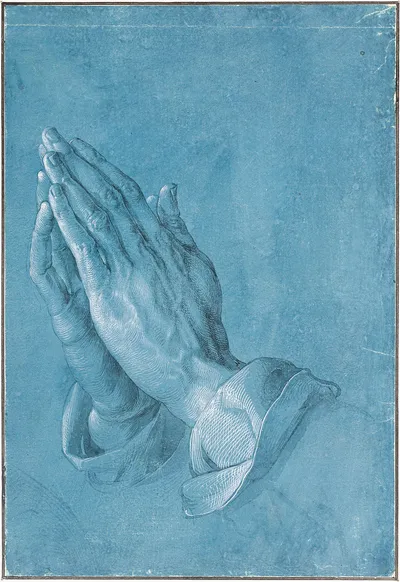
Praying Hands, 1508. Albrecht Dürer. Albertina, Vienna.
Look closer
7 things to notice
 1
01
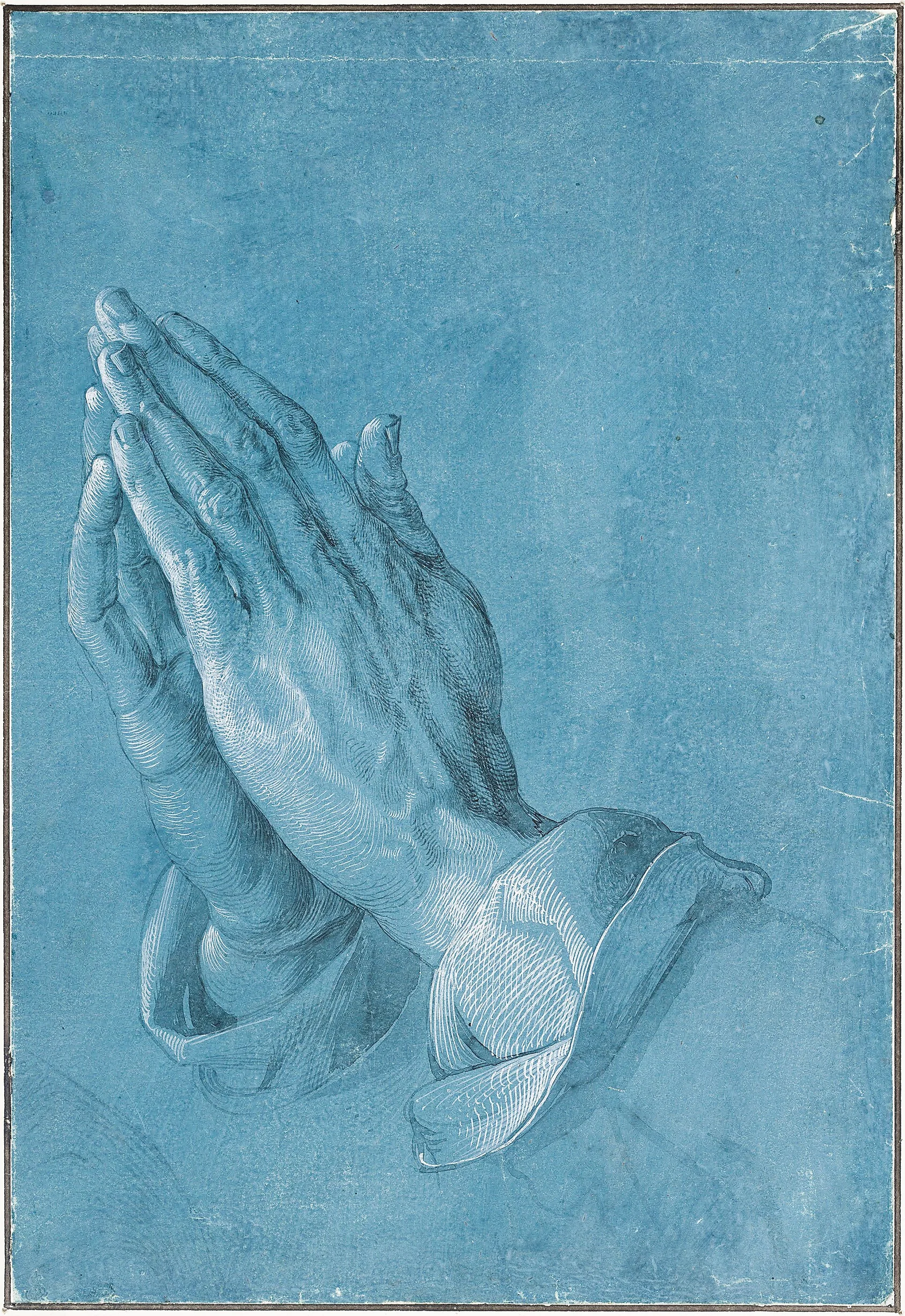
Fingertips just touching
The fingers press together at the tips, the nails drawn one by one. These are bony, real hands, the hands of someone who works.
02
Every knuckle and vein
Dürer draws the knuckles, creases and raised veins with hundreds of fine ink lines. He was the best draughtsman in Germany, and he wanted you to see exactly how a hand is built.
03
White drawn onto blue
The light on the palms is drawn on in white, line by line, over blue paper he had prepared himself. The blue becomes the shadow and the white the light.
04
Stopped in the middle of work
The sleeves are pushed back, as if the person had stopped working to pray. Their folds are drawn in long white curves.
05
Not quite symmetrical
One thumb sits a little away from the other, the way real hands rest, slightly uneven. That small imperfection is part of why it feels human.
06
Where the head used to be
This sheet once also had a sketch of the apostle's head. It was cut away and separated long ago, so the hands are left alone on the blue.
07
Practice for a lost altarpiece
These hands were drawn for a large altarpiece in Frankfurt, where they belonged to one of the apostles. That altarpiece burned in 1729. The sketch survived the painting.
The story
What you are looking at
Two hands pressed together in prayer, drawn in black and white ink on blue paper around 1508 by Albrecht Dürer, the great German artist of his age. It was never meant to be famous. It was one of 18 working sketches he made for a large altarpiece.
The altarpiece that burned
The painting was a triptych, three panels, for a church in Frankfurt. These were the hands of one of the apostles kneeling around the Virgin Mary. In 1729 the altarpiece was destroyed by fire. The sketch, stored somewhere else, is what lasted.
Whose hands?
Dürer was one of eighteen children, and it is often said that these are his brother's hands. Nobody can prove it. Some scholars now think the drawing, done so carefully on precious blue paper, was a record of the finished painted hands that Dürer wanted to keep for himself.
Everywhere
It was first shown in public in Vienna in 1871. Since then it has become the most reproduced picture of prayer in the Western world, on posters, mugs, phone cases, tattoos and the cover of a Drake mixtape. Andy Warhol, who copied it, has a version carved on his gravestone. The original is in the Albertina museum in Vienna.
Our take
To us, what makes these hands moving is how ordinary they are. Prayer here is small and plain: someone with rolled sleeves stopping in the middle of a day to ask for help.
Blue paper, black lines and white highlights: three colours, and that restraint makes it calm. The hands rise in one upward triangle, pointing the eye toward the top of the sheet. Everything else is left empty. The quiet comes from what he chose to leave out.
In its time
Praying Hands was painted in 1508, when Dürer was 37. Where it stands on Art Through Time:
Its colors
Elsewhere in the world
- 1508Michelangelo paints the Sistine ceilingRome becomes the capital of the High Renaissance.
- 1511Portugal takes MalaccaEuropean empires arrive in the spice trade.
The facts
- Title
- Praying Hands
- Artist
- Albrecht Dürer (1471–1528)
- Date
- 1508
- Original medium
- Ink on paper
- Style
- Northern Renaissance
- Made in
- Germany
- Collection
- Albertina, Vienna
Art Through Design
The mood
It brings calm and a quiet kind of devotion into a room. Two pale hands rise against soft blue paper, and the space around them feels gentle, settled and hopeful.
The palette
Sky, Ice and Teal are the blue paper in its light and shade; Slate is the deeper shadow between the hands. Across a room, the white-lit hands on blue are what you see.
Who it finds
- Anyone who has prayed with their hands still dirty from a day's work.
- Anyone who remembers this picture hanging over a grandmother's bed or kitchen table.
- Anyone who has asked for help in a hard year and found that it came.
See it in a room
Your photo is never uploaded, and it's gone when you leave.
Two pale hands on blue paper read from anywhere in a room, as simple as a symbol. Up close, the drawing becomes thousands of fine lines, each knuckle and vein built stroke by stroke.
Upright and quiet, it fits a bedroom, a hallway, a prayer corner or a study where you sit to think. It works at small sizes, close to the real sheet, and keeps its calm when printed large.
Order on canvas, acrylic, or print
- True to the original
- Each file is color-matched to the museum original. If the color isn't right, we print it again, with our compliments.
- On canvas
- Fine-art canvas hand-stretched over a ¾″ solid-wood frame, with mirrored edges so nothing is lost.
- In our floating frame
- Our stretched canvas set in a slim floating frame, with a shadow gap so the painting seems to hover.
- As a framed print
- Archival pigment print on museum-grade cotton paper, in a solid-wood frame with UV-protective glazing.
- Ready to hang on arrival
- It arrives with the hanging hardware attached. No framer, no guesswork.
- Perfect on arrival
- If anything arrives damaged or not as you ordered, send us a photo within 7 days of delivery and we'll make it again, with our compliments.
Dürer drew two working hands in prayer on blue paper around 1508. Hang them where you start or end the day.