The story · 4 min read
A cathedral of solid stone, dissolving into evening light.
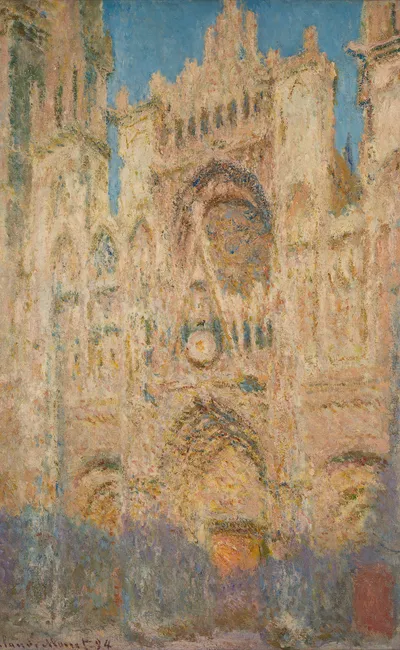
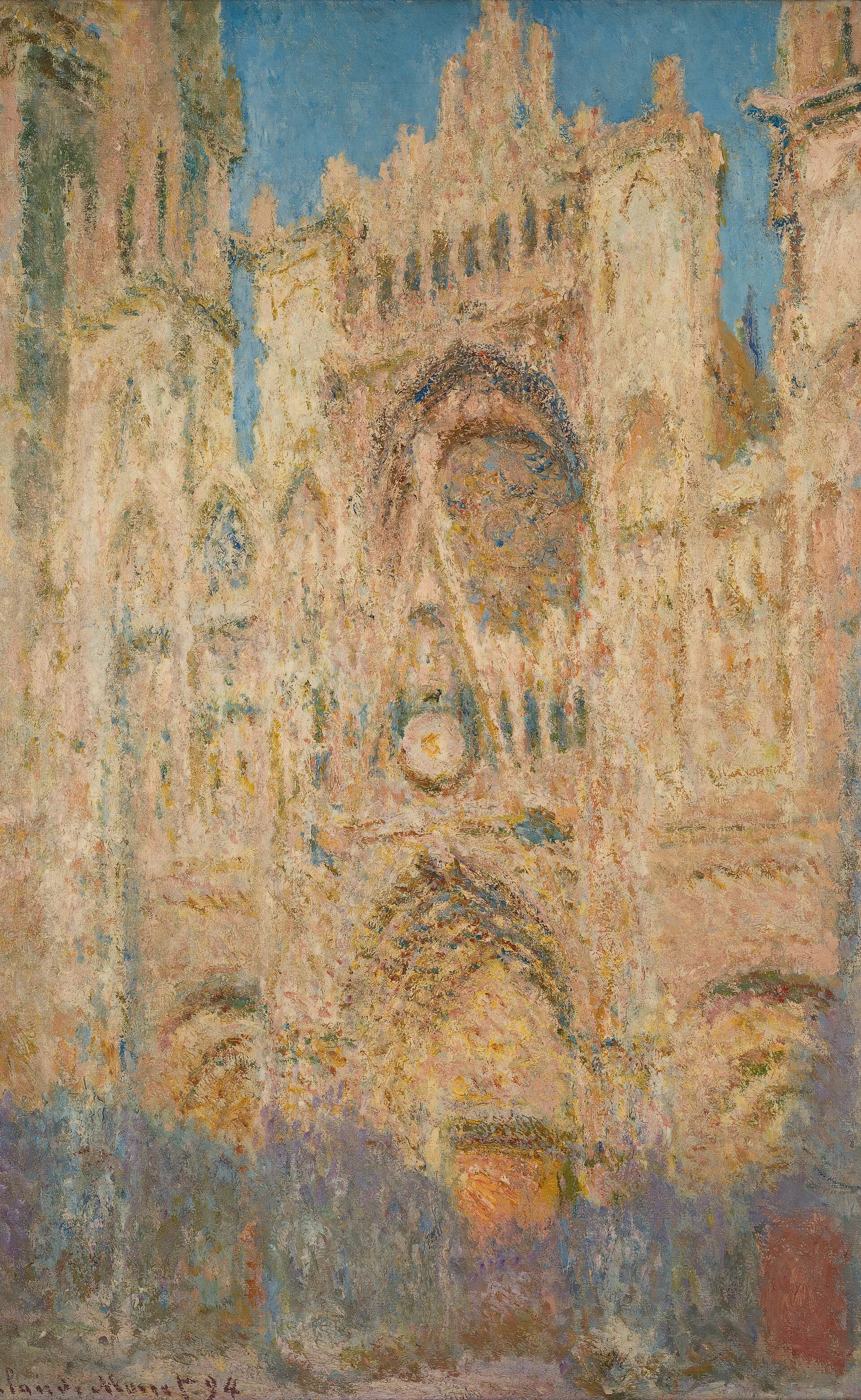
Rouen Cathedral, End of the Day, 1892–1894. Claude Monet. Pushkin State Museum of Fine Arts, Moscow.
Look closer
7 things to notice
 1
01
A rose window going soft
In the middle of the façade, the great round window is a ring of blue and violet strokes set in a crust of apricot paint. For Monet the light falling on a thing had become as important as the thing itself. The window is barely there; the light on it is everything.
02
A small sun held in the stone
Below it a small white disc catches the last light, flecked with yellow. Paul Hayes Tucker described these surfaces as built up layer on layer, like the masonry of the cathedral itself. Up close you can see each ridge of paint.
03
A strip of sky above the stone
At the top, the pointed gables and pinnacles stand against a patch of bright blue sky. The early 1890s saw a revival of interest in Catholicism in France, and a great Gothic cathedral stood for the best of French history. Monet looked at it and painted the weather on its face.
04
A doorway catching fire
At the foot of the central portal, a patch of orange glows out of the violet shade. Monet could catch a scene quickly and finish it later from sketches and memory; he painted this series in Rouen in 1892 and 1893 and reworked it in his studio in 1894. The orange is the last warm thing left on the façade.
05
Evening coming up the steps
Along the bottom, the base of the cathedral sinks into violet and blue shade, the colour of evening rising from the street. Robert Pelfrey wrote that by keeping the subject the same, Monet could record pure visual sensation, which changed hour by hour. This band of shadow is the end of the day arriving.
06
Paint as thick as stonework
On the right, the tower is built from thick, crusty strokes of cream, pink and pale gold, with hardly a straight line among them. While he worked on the series Monet had nightmares of the cathedral, pink, blue and yellow, collapsing on top of him. In paint, at least, the walls held.
07
Signed two years on
The signature runs along the bottom left corner: Claude Monet 94. He had begun in front of the cathedral and finished in the studio. In 1895 he chose twenty of the best for his dealer's gallery in Paris and sold eight before the show was over.
Our take
This is the west front of Rouen Cathedral, every spire, arch and statue of it, and it seems to be melting. The late sun has turned the stone to apricot and cream, the shadows at the foot of the doors have gone violet, and a scrap of blue sky shows above the gables. Monet painted this same façade more than thirty times. The building stayed put. The light kept moving.
He rented rooms across the street and worked there as the light changed, moving from one canvas to the next. He wrote that each day he saw something he had missed the day before, and that he was trying to do the impossible; he dreamed of the cathedral falling on him in pink and blue and yellow. The paint here stands up from the canvas like stone.
The painter's moment
1840–1926Painted it at 52Impressionism
Claude Monet was in his early fifties and at last secure. He had bought the house at Giverny in 1890, his dealer Paul Durand-Ruel was selling his work, and his haystacks, shown together in 1891, had made the series his own form. In 1892 he married Alice Hoschedé, and that year he rented space across the street from the cathedral in Rouen, in Normandy, and set to work. He had painted mostly landscapes until then; a building was something new. He worked on several canvases at once, sometimes eight, giving each about an hour before the light moved on.
In 1895 Durand-Ruel's gallery showed twenty of the cathedrals, chosen by Monet from more than thirty, and eight sold before the exhibition closed. Camille Pissarro and Paul Cézanne went to see them and praised them highly. Some urged the French state to acquire the whole set and keep it together; nobody listened, and the paintings scattered, five of them to the Musée d'Orsay and the rest to collections around the world. London's National Gallery managed to hang five side by side for one exhibition in 2018, a rare sight. It was the most exhaustive series he had attempted.
In its time
Rouen Cathedral, End of the Day was painted in 1892–1894, when Monet was 52. Where it stands on Art Through Time:
Its colors
Elsewhere in the world
- 1888Brazil abolishes slaveryThe Golden Law makes Brazil the last country in the Americas to end it.
- 1890Wounded KneeU.S. soldiers kill some 250 Lakota men, women and children.
- 1893Hawaiʻi's queen is overthrownU.S.-backed businessmen depose Liliʻuokalani; annexation follows in 1898.
- 1893New Zealand women win the voteThe first self-governing country to grant it.
- 1894The Dreyfus AffairA Jewish officer is falsely convicted of treason; France, and its painters, split in two.
The facts
- Title
- Rouen Cathedral, End of the Day
- Artist
- Claude Monet (1840–1926)
- Date
- 1892–1894
- Original medium
- Oil on canvas
- Style
- Impressionism
- Made in
- France
- Collection
- Pushkin State Museum of Fine Arts, Moscow
Art Through Design
The mood
It fills a wall with warm, glowing stone. From a distance it is almost abstract, a field of apricot and violet, and it gives a room the feeling of late sun on an old building.
The palette
Apricot, Sand and Bronze are the sunlit stone; Taupe is the shade in the arches; Teal is the patch of sky and the cool shadow at the base. From across a room, the glowing façade and the scrap of blue at the top are what you see.
Who it finds
- Anyone who has watched the same view from a window for years and never seen it the same way twice.
- Anyone who loves an old building at the end of a sunny day.
- Anyone who has tried to do something impossible and kept at it anyway.
See it in a room
Your photo is never uploaded, and it's gone when you leave.
Up close it dissolves into crusts of paint; from across the room the cathedral front assembles itself, spires, rose window and doors. It works like a magic trick, and it changes with every step back.
Tall and narrow, its height more than one and a half times its width, it suits a stairwell, a tall hallway, a narrow wall between windows or a room with a high ceiling. Go tall. In soft daylight its colours shift through the day, as the real façade's did for Monet, so a spot with changing light suits it best.
Order on canvas, acrylic, or print
- True to the original
- Each file is color-matched to the museum original. If the color isn't right, we print it again, with our compliments.
- On canvas
- Fine-art canvas hand-stretched over a ¾″ solid-wood frame, with mirrored edges so nothing is lost.
- In our floating frame
- Our stretched canvas set in a slim floating frame, with a shadow gap so the painting seems to hover.
- As a framed print
- Archival pigment print on museum-grade cotton paper, in a solid-wood frame with UV-protective glazing.
- Ready to hang on arrival
- It arrives with the hanging hardware attached. No framer, no guesswork.
- Perfect on arrival
- If anything arrives damaged or not as you ordered, send us a photo within 7 days of delivery and we'll make it again, with our compliments.
Monet watched the light go down Rouen Cathedral from across the street in the 1890s, and turned the stone into air. Hang it where the evening sun comes in.