The story · 4 min read
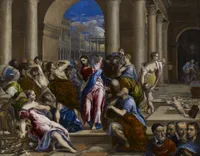
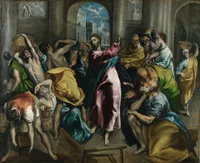
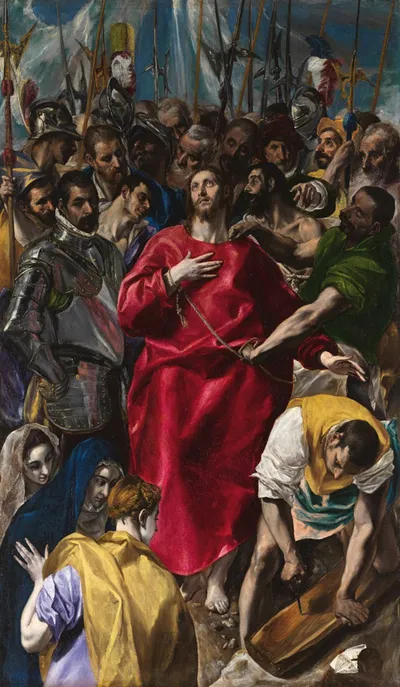
One calm face in a robe of blazing red, and a mob closing in.
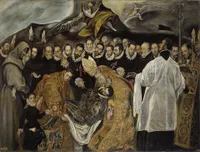
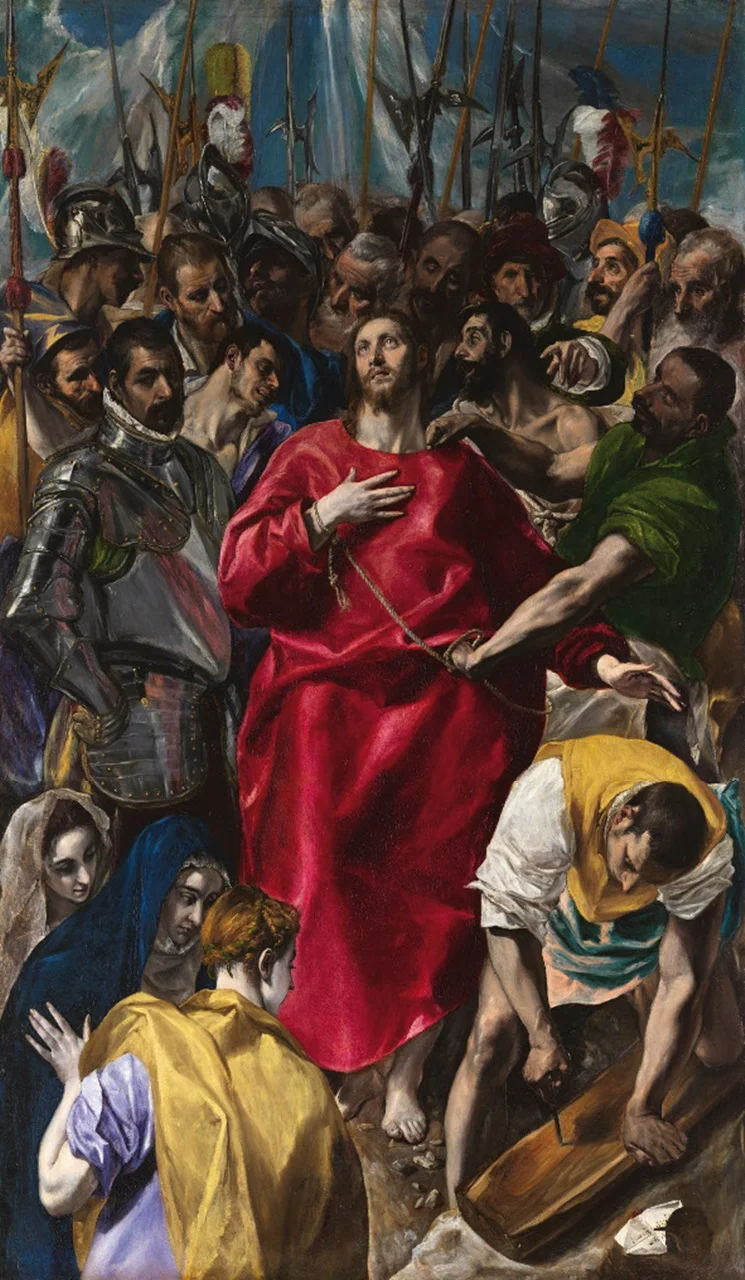
The Disrobing of Christ, c. 1578. El Greco. Toledo Cathedral, sacristy.
Look closer
7 things to notice
 1
01
Eyes turned up to heaven
Christ's face tilts upward, eyes lifted to the light, calm in the middle of the shoving throng. Something here recalls the great Byzantine icons of Christ, the tradition El Greco had trained in on Crete. The faces around him are coarse, and close enough to breathe on him.
02
A hand held to the heart
His right hand rests flat on his chest, and a rough rope loops round the wrist and down across the red robe. El Greco probably took the rope from Saint Bonaventure's Meditations on the Passion, the same book that gave him the three grieving women. The hand on the heart seems to accept everything.
03
About to tear the robe
On the right, a man in a green tunic reaches across with a muscled arm and grips the rope, ready to rip the robe away. The stripping came just before the crucifixion, and by this date it was a rare subject in Western painting. In a moment the red will be gone.
04
Boring a hole for the nail
Below, a workman in a yellow vest bends over the cross with a drill, making a hole for the nail that will go through Christ's feet. His pose may come from a figure bending forward in Raphael's Miraculous Draught of Fishes, which El Greco would have known from Rome. He keeps his eyes on the job, and that is the horror of it.
05
Three women at the edge
At the lower left, three women watch in distress, one in a deep blue mantle, one in yellow with her back to us. Cathedral officials objected that the Gospels do not place the three Marys here, and El Greco was asked to remove them. Four centuries on, they grieve at the front of the picture.
06
Heads piled to the sky
Above Christ the heads climb in rows, among helmets and lances, right up to a strip of blue sky. Harold Wethey thought El Greco remembered late Byzantine paintings that suggest a crowd by piling heads row upon row; the commissioners complained that these tormentors stood higher than Christ. You feel the press of bodies from every side.
07
A bare foot among the stones
At the bottom, below the hem of the red robe, Christ's bare foot rests on rough ground strewn with small stones. The hole being bored beside them has one purpose: the nail meant for his feet. El Greco makes the foot pale and motionless, the calmest thing in the picture after his face.
Our take
Christ stands in the middle of a mob in a robe of blazing red, his wrists tied with a rope, his eyes turned up to heaven. Around him the crowd is packed so tight that the heads stack up in rows to the top of the canvas, under a forest of lances. A man in green grips the rope and is about to tear the robe off him. Below, a workman in yellow bores a hole in the cross for the nail. Christ's face is calm. Everyone else is busy.
El Greco painted it for the sacristy of Toledo Cathedral, his first great commission in Spain, and the clergy who ordered it complained. Three grieving women at the front were not in the Gospels, and the tormentors stood higher than Christ's head. He was told to change it and left it as it was, and the cathedral paid him little more than a third of what his own appraiser asked. It still hangs where he made it to hang.
The painter's moment
1541–1614Painted it at 37Mannerism
El Greco was 36. Born on Crete in 1541 and trained there in the Post-Byzantine tradition, he had worked in Venice and then in Rome, where he befriended Luis de Castilla, son of the dean of Toledo Cathedral. That friendship brought him to Spain. A document of 2 July 1577 that mentions this painting is the first trace of him in the country, and he began it that summer while also working on paintings for the Toledo church of Santo Domingo el Antiguo. He meant Toledo as a step toward the court of Philip II; he spent the rest of his days there and painted View of Toledo in the city.
He delivered it in spring 1579, to stand over the main altar of the cathedral's sacristy in a gilded wooden altar he designed himself. Then came the argument over money. His own appraiser valued the picture at 950 ducats; after arbitration he received 350, along with instructions to remove the figures the officials disliked, which he ignored. The altar was later destroyed, though his small carved group of the Miracle of Saint Ildefonso survives on the frame. The painting was a huge success all the same, and more than seventeen versions are known. After cleaning at the Prado in Madrid in 2013, it went back to Toledo in 2014.
In its time
The Disrobing of Christ was painted around 1578, when El Greco was 37. Where it stands on Art Through Time:
Its colors
Elsewhere in the world
- 1572The last Inca ruler is executedTúpac Amaru's death ends the Inca state at Vilcabamba.
The facts
- Title
- The Disrobing of Christ
- Artist
- El Greco (1541–1614)
- Date
- c. 1578
- Original medium
- Oil on canvas
- Style
- Mannerism
- Made in
- Italy
- Collection
- Toledo Cathedral, sacristy
Art Through Design
The mood
It fills a room with intensity. The red at its centre is so strong it seems to give off heat, and the crowd pressing in from every side makes the wall feel close and alive.
The palette
Garnet is Christ's robe; Ebony and Umber are the dark armour and the press of figures; Taupe and Wheat are the faces and the workman's pale sleeves. Across a room, one shape matters most: the column of red in the middle.
Who it finds
- Anyone who has kept their composure while every voice around them was raised.
- Anyone who has stood in Toledo Cathedral, or means to one day, and wants that red at home.
- Anyone who has done good work, been paid a third of its worth, and refused to change a thing.
See it in a room
Your photo is never uploaded, and it's gone when you leave.
A column of red in the middle, a wall of faces around it, flashes of yellow and blue at the bottom corners: from a distance it reads as one figure against a storm of people. Close up, every face has its own expression, mocking, arguing, grieving, curious.
Tall, its height not quite twice its width, it suits a stairwell, the end of a corridor or a narrow wall where people pass and look up. It wants size. Give it a wall to itself, because that red will pull every other colour in the room toward it.
Order on canvas, acrylic, or print
- True to the original
- Each file is color-matched to the museum original. If the color isn't right, we print it again, with our compliments.
- On canvas
- Fine-art canvas hand-stretched over a ¾″ solid-wood frame, with mirrored edges so nothing is lost.
- In our floating frame
- Our stretched canvas set in a slim floating frame, with a shadow gap so the painting seems to hover.
- As a framed print
- Archival pigment print on museum-grade cotton paper, in a solid-wood frame with UV-protective glazing.
- Ready to hang on arrival
- It arrives with the hanging hardware attached. No framer, no guesswork.
- Perfect on arrival
- If anything arrives damaged or not as you ordered, send us a photo within 7 days of delivery and we'll make it again, with our compliments.
El Greco painted this crowd for Toledo Cathedral in his first two years in Spain, and its red has not dimmed. Hang it where you need courage.