The story · 3 min read
Everybody is fighting over hay, and the cart is heading straight for hell.
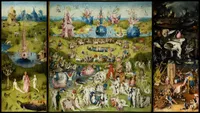
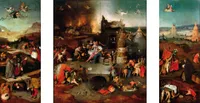
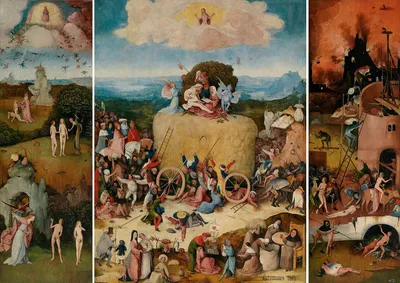
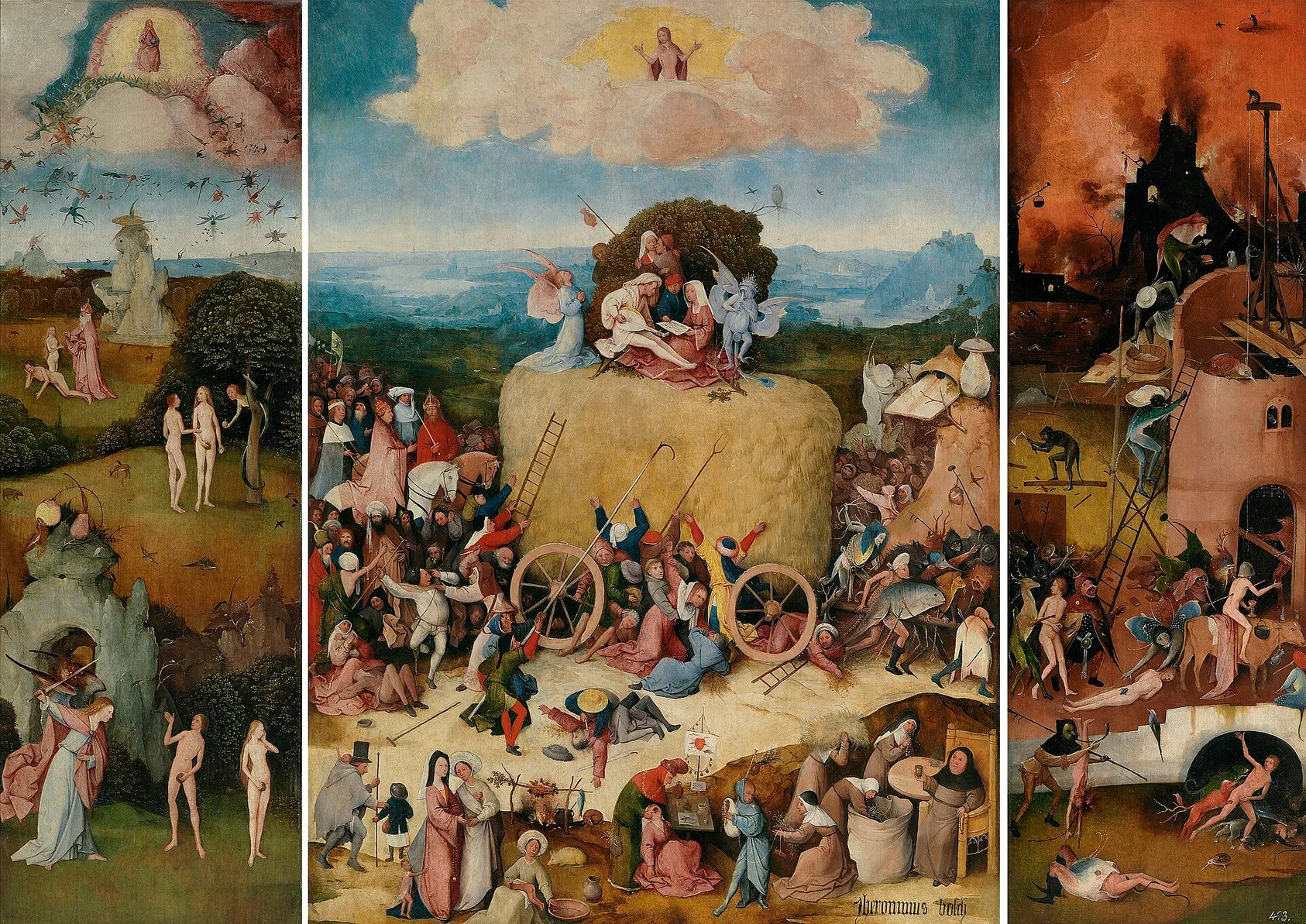
The Haywain Triptych, c. 1510. Hieronymus Bosch. Museo del Prado, Madrid.
Look closer
7 things to notice
 1
01
The one nobody looks up at
Christ appears in the clouds at the top, arms open, showing his wounds. Only one angel on the wagon is looking at him. Everyone else is busy.
02
A party on top of the pile
Lovers sit on top of the hay making music, an angel praying on one side and a blue devil playing on the other. They have not noticed where the cart is going.
03
Crushed under the wheels
Around the wagon, people climb ladders, grab at hay, stab each other and fall under the wheels. Bosch packs this middle panel with every kind of greed.
04
Kings and popes ride along
A pope and an emperor follow the wagon on horseback, calmly. The powerful do not have to scramble. They just ride behind.
05
The church helps itself
At the bottom right a fat friar waits with a drink while nuns stuff hay into a sack for him. Bosch did not spare the clergy.
06
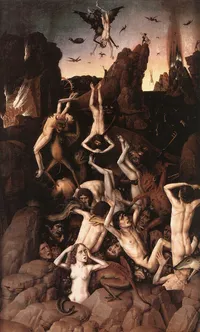
Hell is a building site
On the right panel, demons are busy building a tower. Hell here is a workplace, with ladders and scaffolding, and the sinners arriving below.
07
Angels turning into bugs
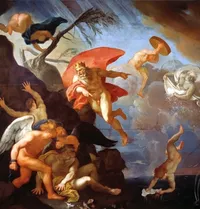
Up in the left panel, rebel angels tumble out of heaven, and as they fall through the clouds they turn into insects. The whole story starts with this.
The story
What you are looking at
Read it like a comic strip, left to right. On the left, the story begins: angels thrown out of heaven, Adam and Eve, the first sin. In the middle, the whole of humanity scrambles over a giant cart of hay. On the right, the cart has arrived where it was always going, which is hell. Hieronymus Bosch painted it around 1516, and the date comes from testing the age of the wood.
Who is pulling the cart
Look at the front of the wagon. It is being dragged along by monsters. All the people around it lean to the right as they walk, so your eye gets carried along with them, from today's sins straight into the fire.
A king's favourite
King Philip II of Spain loved Bosch and bought this in 1570 along with five others for his palace-monastery, the Escorial. Later it was sold and split into three separate paintings, which went to three different places. Only in 1914 did the Prado in Madrid put it back together.
When you close it
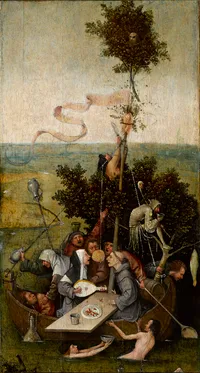
The wings fold shut, and on the outside Bosch painted a man walking alone through a dangerous countryside, past a robbery and a hanged man, beating off a dog. He keeps walking.
Our take
To us, the frightening thing here is how normal everyone looks. Nobody is a monster except the monsters. They are just people wanting more, too busy to look up.
Bosch builds it like a slide. The wagon is the heaviest shape, and everything tilts toward the right, into the reds and blacks of hell. His colours are few and bright, blue, yellow, vermilion, so the tiny figures stay clear as beads. The calm blue sky above, with Christ in it, is what makes the noise below feel so sad.
In its time
The Haywain Triptych was painted around 1510, when Bosch was 60. Its Dutch title is De hooiwagen. Where it stands on Art Through Time:
Its colors
Elsewhere in the world
- 1508Michelangelo paints the Sistine ceilingRome becomes the capital of the High Renaissance.
- 1511Portugal takes MalaccaEuropean empires arrive in the spice trade.
- 1516Venice creates the first ghettoThe city confines its Jews to a walled quarter; the word spreads.
The facts
- Title
- The Haywain Triptych
- Artist
- Hieronymus Bosch (1450–1516)
- Date
- c. 1510
- Original medium
- Oil on panel
- Style
- Northern Renaissance
- Collection
- Museo del Prado, Madrid
Art Through Design
The mood
It fills a wall with tiny busy life and a lot to discover. Bright little figures spread across a green and blue world, and the room around them feels lively, crowded and full of stories.
The palette
Wheat and Bronze are the great haystack; Walnut is the dark of hell; Oat is the pale sky and ground; Sage is the distant country. Across a room, the gold mound in the middle is what you see first.
Who it finds
- Anyone who has watched people trample each other at a sale and thought of something older.
- Anyone who likes a picture they can look at for an hour and still find something new.
- Anyone who has worked hard for something and wondered, halfway, where the cart was going.
See it in a room
Your photo is never uploaded, and it's gone when you leave.
Three panels side by side read as a story from far off: green on the left, gold in the middle, fire on the right. Up close it becomes hundreds of small scenes, each worth a minute.
Its wide, three-part shape wants a broad stretch of wall: above a long sofa, in a library, in a family room where people stop to hunt for details. Go big, because the figures are small, and light it well so the tiny faces stay readable.
Order on canvas, acrylic, or print
- True to the original
- Each file is color-matched to the museum original. If the color isn't right, we print it again, with our compliments.
- On canvas
- Fine-art canvas hand-stretched over a ¾″ solid-wood frame, with mirrored edges so nothing is lost.
- In our floating frame
- Our stretched canvas set in a slim floating frame, with a shadow gap so the painting seems to hover.
- As a framed print
- Archival pigment print on museum-grade cotton paper, in a solid-wood frame with UV-protective glazing.
- Ready to hang on arrival
- It arrives with the hanging hardware attached. No framer, no guesswork.
- Perfect on arrival
- If anything arrives damaged or not as you ordered, send us a photo within 7 days of delivery and we'll make it again, with our compliments.
Around 1516 Bosch loaded the whole world onto a cart of hay and drove it to hell. Hang it where people linger and look.