The story · 4 min read
A garden bridge painted from memory by a man going blind.
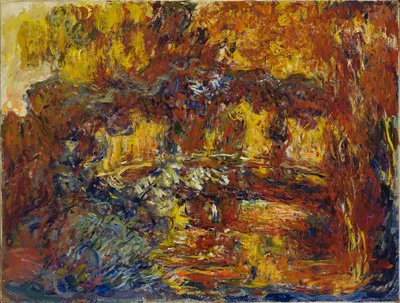
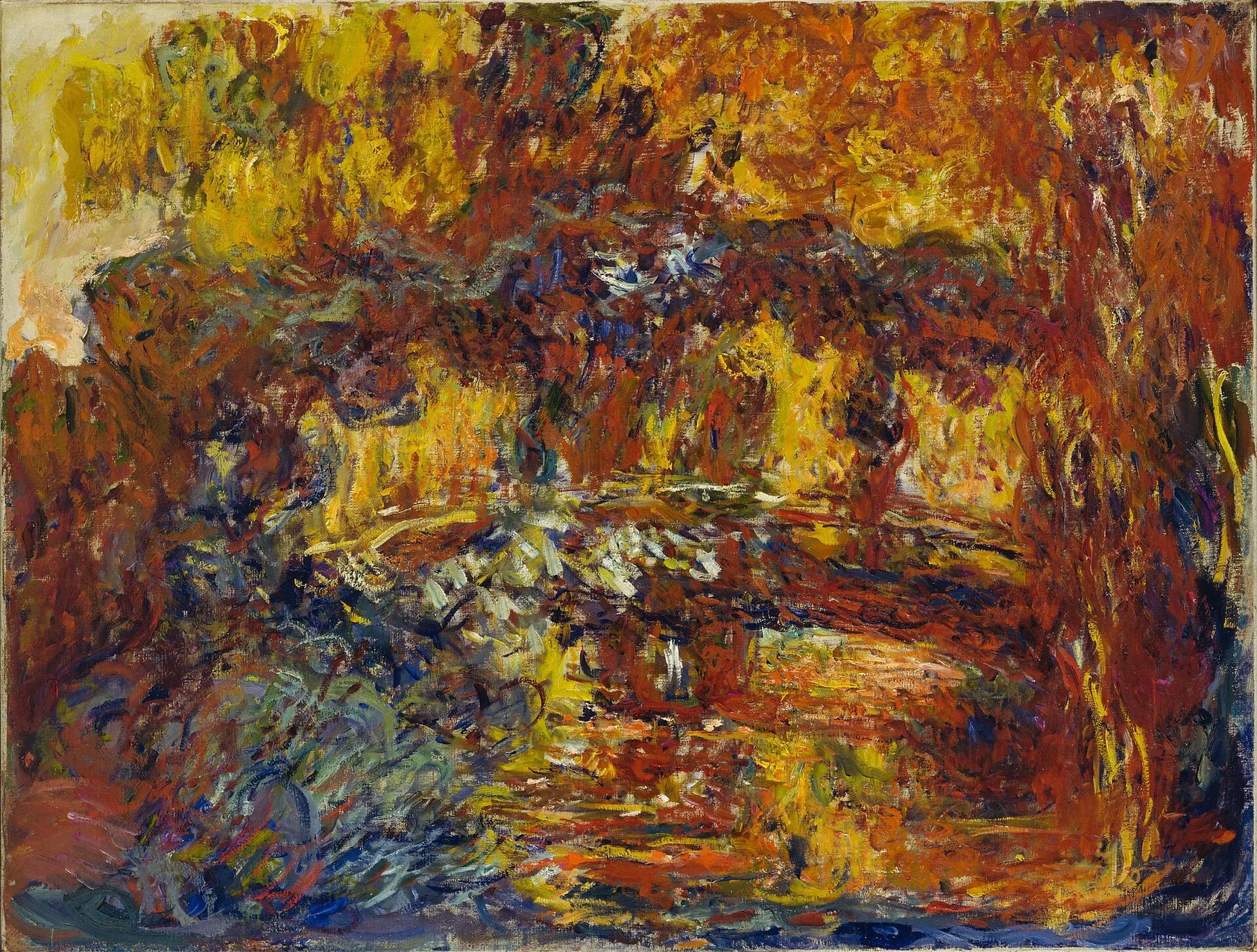
The Japanese Footbridge, c. 1920. Claude Monet. Museum of Modern Art, New York.
Look closer
7 things to notice
 1
01
A bridge almost dissolved
Across the middle runs a curved band of yellow and orange: the arch of the wooden footbridge over his water-lily pond, its railings just visible. In 1900 Monet showed his first group of garden pictures, most of them of this same bridge. Twenty years on, it is held together by little more than memory.
02
A pond on fire
Below the bridge, the water is a churn of red, orange and gold, with a few dark strokes where the lilies might be. As his sight failed, Monet's colours ran darker and his strokes grew broader, and he worked out the motif in his mind before he painted it. The pond he loved has turned to heat.
03
Blue in the shadows
On the left, a tangle of blue, green and grey strokes cools the lower corner, where the bank and its plants lie in shade. He found he could no longer make out the finer shades of colour seen close up, so he painted in large masses. Each stroke is a guess made with total confidence.
04
Willow strands at the edge
Long vertical strokes of rust and gold hang down the right side, falling like the fronds of a weeping willow. During the First World War, while his younger son Michel was serving, Monet painted a series of weeping willows in homage to France's fallen soldiers. These look as if they have not stopped mourning.
05
The one that escaped
At the far left edge the paint thins, and pale bare canvas shows through around a few flecks of peach. After his cataract operation in 1923, Monet destroyed a number of canvases from the years before it. This one survived, raw edges and all.
06
Slashes of deep blue
Above the bridge, dark blue strokes cut through the orange in quick, hooked marks. Studying colour, Monet once confided to Clemenceau, was a joy and a torment at once, and for years he put off surgery, afraid of losing the little sight he had. You can feel the struggle in these marks.
07
A canopy of yellow
Along the top, the foliage over the bridge is a blaze of yellow and ochre, scrubbed on with a loaded brush. He wore a broad straw hat while he worked to cut the glare that troubled his eyes. Up here the garden is pure light.
Our take
A fire, at first glance. Then a shape comes through: the hump of a wooden footbridge arching across the middle, a pond beneath it, willow strands hanging down the right. Monet had been painting this bridge in his garden at Giverny for twenty years. Here it has almost dissolved into slashes of orange, red, yellow and dark blue, laid on thick and fast. The bridge is there if you look for it.
He was about eighty and going blind with cataracts. He could no longer trust what he saw close up, so he labelled his paint tubes, kept his palette in strict order, wore a straw hat against the glare and painted the scene in big masses from memory. The colours ran hot and dark. Critics have since called these pictures a bridge to abstract art.
The painter's moment
1840–1926Painted it at 80Impressionism
Claude Monet was about eighty and had lived at Giverny since 1883, turning its grounds into the garden that fed his work for forty years. He made a water-lily pond there, with a Japanese bridge over it, and in 1899 began the water lilies, among them Water Lilies, that would occupy him to the end; his collection of Japanese woodblock prints shaped his eye. Then came the losses. He lost his wife Alice in 1911 and his eldest son Jean in 1914, and in those years the first signs of cataracts appeared. In 1913 he saw an eye specialist in London, accepted new glasses and refused an operation.
Encouraged by Clemenceau, he built a large new studio for a cycle of water-garden paintings and worked on it mostly from 1916 to 1921, while his sight kept failing. In 1923 he finally had the operation. Afterwards he could see true colours again, destroyed some of the canvases painted before it, and later retouched others, making their water bluer. He died in December 1926, aged 86, and is buried at Giverny; the next May his great water-lily murals opened in two oval rooms at the Orangerie in Paris. This canvas now belongs to New York's Museum of Modern Art.
In its time
The Japanese Footbridge was painted around 1920, when Monet was 80. Where it stands on Art Through Time:
Its colors
Elsewhere in the world
- 1914The First World WarExpressionists and Dadaists answer the catastrophe.
- 1919The Amritsar massacreBritish troops fire on a peaceful crowd, killing hundreds.
- 1919Korea declares independenceMillions join peaceful protests; Japan's police and army crush them.
- 1920Women win the voteThe Nineteenth Amendment is ratified.
- 1922Week of Modern Art, São PauloBrazil declares its own modernism.
The facts
- Title
- The Japanese Footbridge
- Artist
- Claude Monet (1840–1926)
- Date
- c. 1920
- Original medium
- Oil on canvas
- Style
- Impressionism
- Made in
- France
- Collection
- Museum of Modern Art, New York
Art Through Design
The mood
It brings heat and colour into a room, the feeling of a garden at the end of a blazing day. Close to abstract, it reads as pure energy, and it makes a wall feel alive.
The palette
Rust and Amber are the burning bridge and pond; Gold is the yellow foliage overhead; Cocoa and Smoke are the shadows and the cooler strokes on the left. From across a room, the orange arch and the blue scribbles around it hold the eye.
Who it finds
- Anyone who has watched someone they love lose their sight and keep working anyway.
- Anyone who loves abstract painting and wants to see where it came from.
- Anyone who knows Monet's gentle water lilies and wants the fierce, late Monet too.
See it in a room
Your photo is never uploaded, and it's gone when you leave.
Slashes of orange, red and dark blue: from a distance it reads first as pure colour, then the arch of a bridge comes through, and a pond beneath. Up close it breaks into a thousand thick strokes, each one placed fast and without hesitation, the record of a painter working against time.
About a third wider than tall, it suits a living room, a studio, an open-plan space or the wall behind a desk. Go big, since its strokes need room to breathe and the eye needs distance to pull them together. It holds its own beside modern furniture and bare plaster as easily as beside antiques.
Order on canvas, acrylic, or print
- True to the original
- Each file is color-matched to the museum original. If the color isn't right, we print it again, with our compliments.
- On canvas
- Fine-art canvas hand-stretched over a ¾″ solid-wood frame, with mirrored edges so nothing is lost.
- In our floating frame
- Our stretched canvas set in a slim floating frame, with a shadow gap so the painting seems to hover.
- As a framed print
- Archival pigment print on museum-grade cotton paper, in a solid-wood frame with UV-protective glazing.
- Ready to hang on arrival
- It arrives with the hanging hardware attached. No framer, no guesswork.
- Perfect on arrival
- If anything arrives damaged or not as you ordered, send us a photo within 7 days of delivery and we'll make it again, with our compliments.
Monet painted his footbridge from memory around 1920, half blind and fierce, and it burns on. Hang it where you want a wall to feel alive.