The story · 4 min read
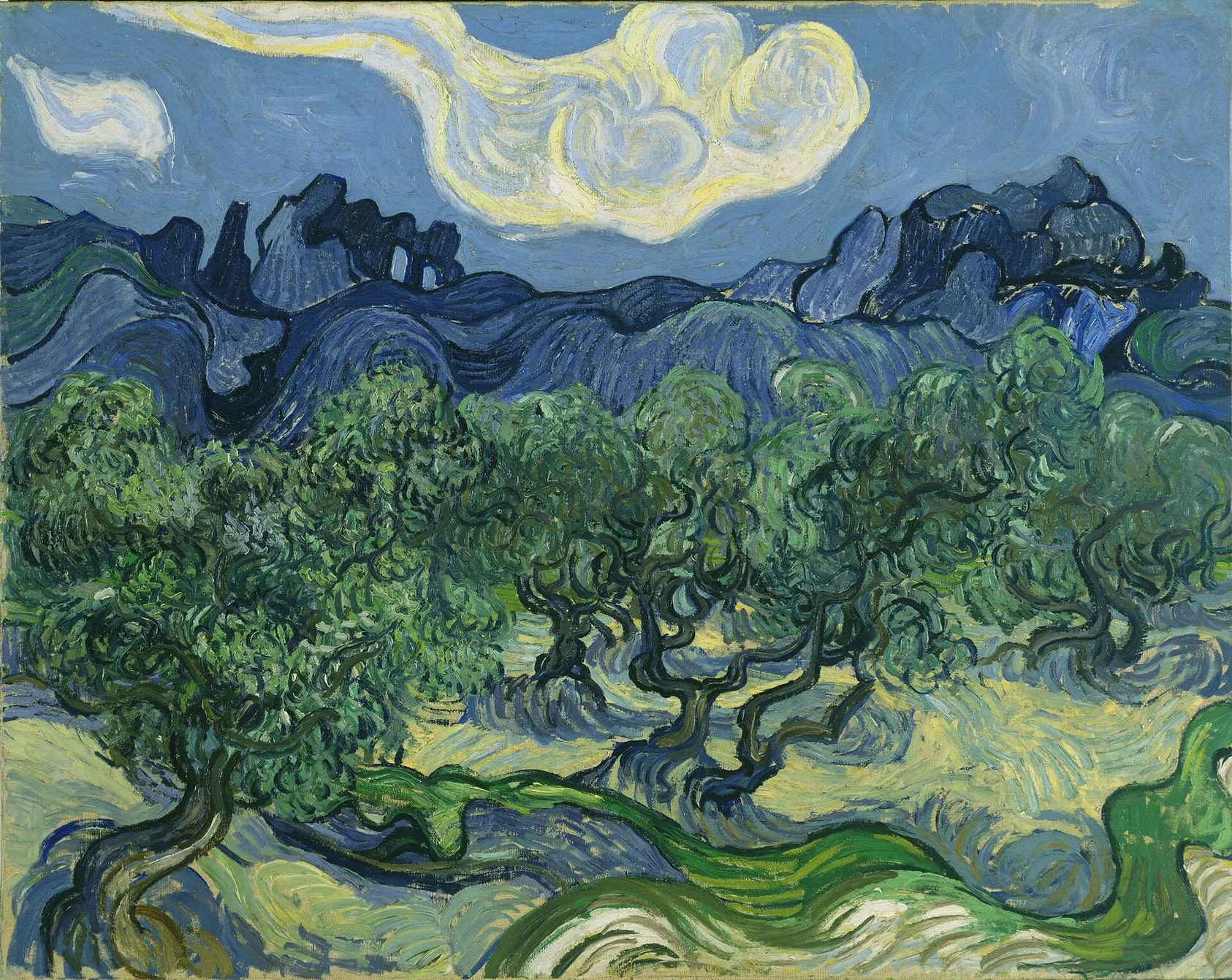
Olive trees writhing in the wind, the sunlit twin of a famous night.
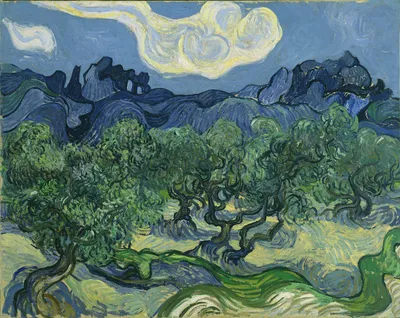
The Olive Trees, 1889. Vincent van Gogh. Museum of Modern Art, New York.
Look closer
7 things to notice
 1
01
A cloud that will not sit still
Across the top a thick white cloud loops and coils, outlined in pale yellow against the blue. It has been called ectoplasmic, and Van Gogh himself admitted that the cloud and the peaks behind the trees were exaggerated. In The Starry Night, painted beside it, the same coiling energy fills the night sky.
02
Mountains outlined in blue
Behind the grove rise the jagged blue peaks of the Alpilles, the small range near Saint-Rémy, each ridge edged in dark blue line. Van Gogh said he had stressed the outlines here as in some old woodcuts. The rock looks as restless as the clouds.
03
Trunks bent like old hands
In the middle, dark olive trunks bend and fork above the pale ground, gnarled and knotted. The critic Robert Hughes saw nature in these paintings as a continuous field of energy, the trees rendered gnarled and arthritic, almost like people. Each trunk is a knot of dark blue and green.
04
Leaves drawn with paint
The foliage is a mass of short, curved strokes in every green from sage to bottle, with flecks of blue. The National Gallery of Art sees these dashes as drawing done in paint, put down with a loaded brush. You can almost hear them rustle.
05
Ground that ripples like water
A ribbon of bright green winds through the bottom right, between bands of pale yellow and blue earth. The brushwork gives the soil, and the sky above, the same rustling life as the leaves, as if the Mediterranean wind ran through all of it. Even the ground refuses to keep still.
06
A blue for the divine
At the top right the sky is a clear blue, worked in small swirling strokes. In The Starry Night and in his olive paintings alike, Van Gogh used intense blue for what he felt as a divine, infinite presence. He had once trained to be a preacher.
07
An old trunk in the foreground
At the lower left, the thickest trunk of all leans out of a swirl of blue shadow. Olive trees carried for him the memory of Christ in the garden of Gethsemane, but he had given up trying to paint that scene from imagination and turned to the real groves instead. This tree carries the meaning without any figure at all.
Our take
A band of olive trees twists and ripples across the canvas under a ridge of blue mountains. Above them a great white cloud curls across the sky like smoke. Everything moves: the leaves, the trunks, the ground, even the mountains, all drawn in thick curving strokes of green, blue and cream. Van Gogh painted it in June 1889, while a patient at the Saint-Rémy asylum. It is the daylight partner of The Starry Night.
Writing to Theo, he mentioned it in one breath with his new night sky, and admitted both were exaggerated, their outlines stressed like old woodcuts. He was after intensity, well beyond photographic polish. He could leave the asylum grounds only with permission. These trees were his open air.
The painter's moment
1853–1890Painted it at 36Post-Impressionism
Vincent van Gogh was 36. On 8 May 1889 he had entered the asylum of Saint-Paul near Saint-Rémy of his own accord, given a pair of barred cells and using one as a studio. At first he painted the garden, Irises among its flowers; then he was allowed short supervised walks outside the walls, to the wheat fields, the cypresses and the olive groves. He ate mostly bread and soup, and his only treatment was a two-hour bath twice a week. Yet he found the routine steadying, and wrote that he was happier there with his work than he could be outside. In June he painted this and The Starry Night.
When both canvases were dry he sent them to Theo in Paris. He painted at least fifteen olive groves that year, in every season and light, and in the autumn he answered his friends Gauguin and Bernard, who had painted Christ in the Garden of Olives from imagination, with groves painted from life. He thought highly of the whole series. Early in 1890 his attacks grew worse, and in May he left for Auvers-sur-Oise, north of Paris, where he died on 29 July. MoMA in New York holds it today, along with The Starry Night.
In its time
The Olive Trees was painted in 1889, when Van Gogh was 36. Where it stands on Art Through Time:
Its colors
Elsewhere in the world
- 1884The Berlin ConferenceEurope's powers divide Africa among themselves.
- 1887French Indochina is formedFrance rules Vietnam and Cambodia, and later Laos.
- 1888Brazil abolishes slaveryThe Golden Law makes Brazil the last country in the Americas to end it.
- 1890Wounded KneeU.S. soldiers kill some 250 Lakota men, women and children.
- 1894The Dreyfus AffairA Jewish officer is falsely convicted of treason; France, and its painters, split in two.
The facts
- Title
- The Olive Trees
- Artist
- Vincent van Gogh (1853–1890)
- Date
- 1889
- Original medium
- Oil on canvas
- Style
- Post-Impressionism
- Made in
- Netherlands
- Collection
- Museum of Modern Art, New York
Art Through Design
The mood
It brings wind and life into a room. Greens and blues ripple across the whole surface, and the white cloud overhead makes a space feel fresh, moving and full of air.
The palette
Juniper, Pine and Sage are the olive leaves and their shadows; Steel is the blue of the mountains and the sky; Pistachio is the pale ground between the trees. Across a room, the white cloud curling over the dark band of trees is what you notice.
Who it finds
- Anyone who loves The Starry Night and wants the daylight picture he painted beside it.
- Anyone who has walked through an olive grove in the wind and heard the leaves.
- Anyone who has needed a long walk outdoors to put their mind back together.
See it in a room
Your photo is never uploaded, and it's gone when you leave.
A white cloud curling across a blue sky, a ridge of blue mountains, a band of dark rippling trees: at a distance the whole thing becomes one great wave of movement. Up close every stroke shows, thick, curved and fast, like handwriting.
About a quarter wider than tall, it fits a bedroom, a reading corner by a window, a study or a sitting room. Even a modest size carries its energy, and a larger one lets the strokes come alive. Hang it where daylight reaches it, since it is a daylight picture.
Order on canvas, acrylic, or print
- True to the original
- Each file is color-matched to the museum original. If the color isn't right, we print it again, with our compliments.
- On canvas
- Fine-art canvas hand-stretched over a ¾″ solid-wood frame, with mirrored edges so nothing is lost.
- In our floating frame
- Our stretched canvas set in a slim floating frame, with a shadow gap so the painting seems to hover.
- As a framed print
- Archival pigment print on museum-grade cotton paper, in a solid-wood frame with UV-protective glazing.
- Ready to hang on arrival
- It arrives with the hanging hardware attached. No framer, no guesswork.
- Perfect on arrival
- If anything arrives damaged or not as you ordered, send us a photo within 7 days of delivery and we'll make it again, with our compliments.
Van Gogh painted these olive trees at Saint-Rémy in June 1889, the daylight twin of The Starry Night. Hang it in a room that gets the morning sun.