The story · 3 min read
Red poppies, a summer walk, and the start of a whole movement.
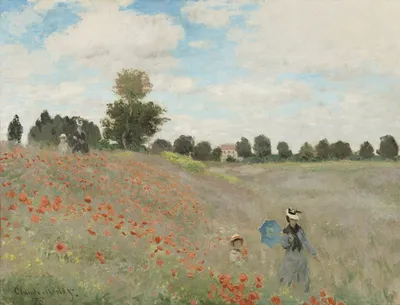
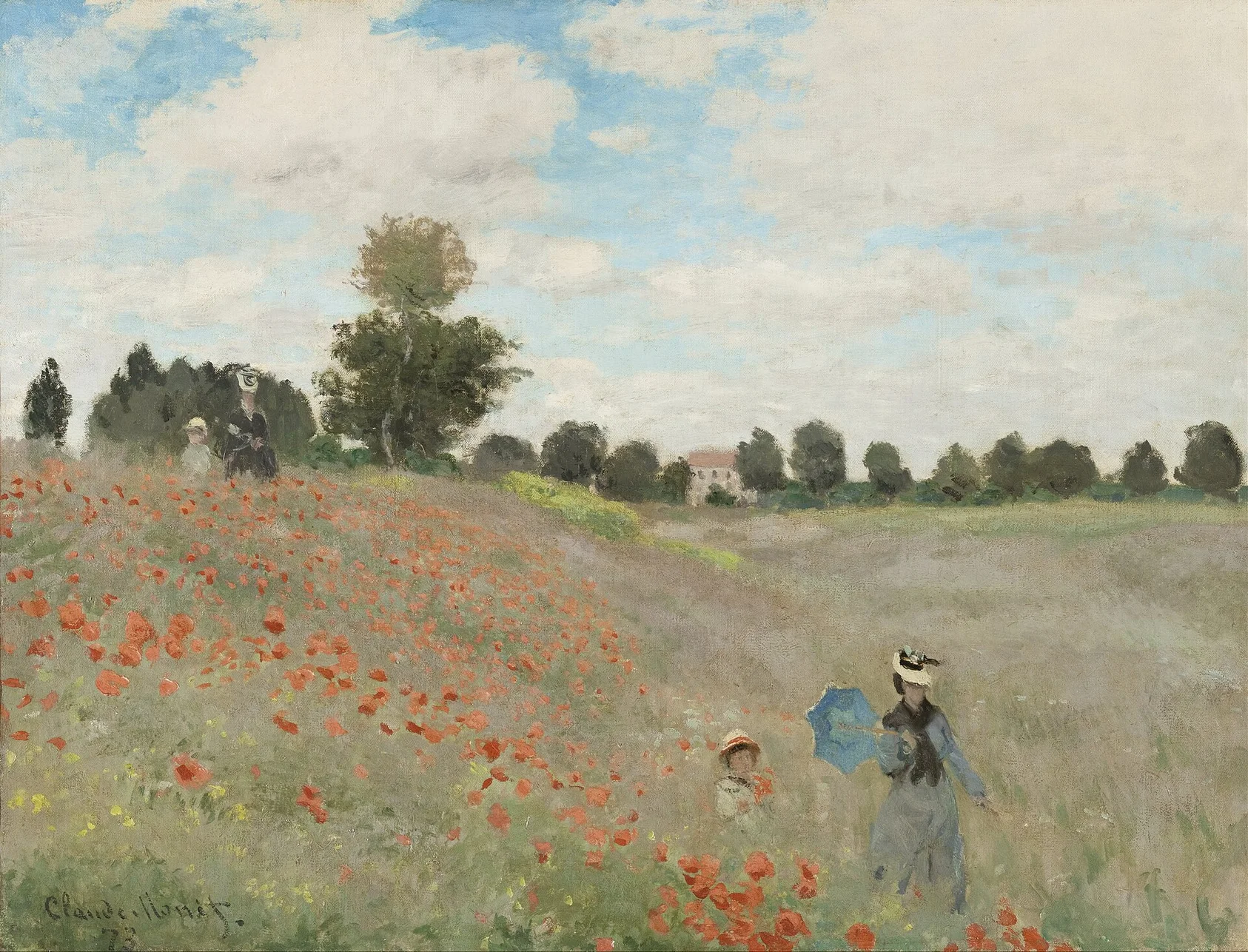
The Poppy Field near Argenteuil, 1873. Claude Monet. Musée d'Orsay, Paris.
Look closer
7 things to notice
 1
01
Red dabbed straight on
The poppies are single blobs of red paint, dropped onto the green with almost no detail. Close up they are just dots. Step back and they are a field in flower.
02
She walks, the painter watches
A woman in a straw hat walks through the grass with a blue parasol. She is a few strokes of paint, and you still know exactly how she is walking.
03
Almost swallowed by grass
Beside her, a child is almost lost in the tall grass, a straw hat and a few touches of colour. The grass comes up to the shoulders.
04
The same pair, again
At the top of the slope, a second woman and child walk the same way. The two pairs make a diagonal line down the hill, from top left to bottom right, and your eye follows it.
05
A tree as a big green blot
A single tree stands against the sky, painted in a few dark green strokes. Monet cared about the light on it more than its leaves.
06
A house in the distance
A small house sits behind a row of trees at the far edge of the field. It shows how much space lies between, and how slow the walk is.
07
A sky he had to catch fast
The sky is white cloud and patches of blue, brushed quickly. Monet painted outdoors, so he had to catch it fast, before it changed.
The story
What you are looking at
Two women and two children walk through a field of poppies outside Paris on a summer day. That is all, and that was the point. In 1873 Claude Monet, aged 33, was living in Argenteuil, then a country village near Paris, and painting whatever was in front of him. He was painting outside, in the open air, which was unusual for a serious picture. Most painters of the day worked indoors from sketches.
The show that gave Impressionism its name
The next year Monet and his friends, tired of being rejected by the official Paris Salon, held their own exhibition. This painting was in it. It shows everything the critics found strange: painted outdoors, in light colours, with details only sketched. Today that first group show is remembered as the birth of Impressionism.
Who owned it
The dealer Paul Durand-Ruel bought it, and it passed through the hands of a painter and an opera singer before the collector Étienne Moreau-Nélaton gave it to France in 1906. It moved from museum to museum and has been at the Musée d'Orsay since 1986.
Our take
Happiness is hard to paint, and this is about as close as anyone gets. Nothing happens and nobody poses. It is the feeling of a long walk in summer with someone you love, with nowhere you have to be.
Red and green are opposites on the colour wheel, so the poppies jump forward. Monet scatters them over the left half and leaves the right half pale and calm, a balance that keeps the eye moving down the slope with the walkers. The whole sky is light and airy, so the picture has room to breathe.
In its time
The Poppy Field near Argenteuil was painted in 1873, when Monet was 33. Its French title is Les Coquelicots. Where it stands on Art Through Time:
Its colors
Elsewhere in the world
- 1870The Wanderers break awayRealist painters leave the Academy to paint ordinary life.
- 1874The first Impressionist exhibitionIndependent artists show on their own terms.
- 1875Fort Marion ledger drawingsImprisoned Plains artists draw their world.
- 1876Centennial Exhibition, PhiladelphiaAmerica measures its art against the world.
- 1876Russia bans books in UkrainianThe Ems Decree suppresses the Ukrainian language in print.
The facts
- Title
- The Poppy Field near Argenteuil
- Artist
- Claude Monet (1840–1926)
- Date
- 1873
- Original medium
- Oil on canvas
- Style
- Impressionism
- Made in
- France
- Collection
- Musée d'Orsay, Paris
Art Through Design
The mood
It fills a room with summer air and light. A green field scattered with red poppies stretches under a bright sky, and the space feels relaxed, open and gentle.
The palette
Chalk and Sage are the bright clouds; Wheat and Olive are the field; Moss is the trees. Across a room, the scatter of red poppies on the left is what catches you.
Who it finds
- Anyone who has walked through a field in summer with a child and lost track of time.
- Anyone who has picked poppies and watched them wilt before getting home.
- Anyone who wants one picture in the house that is simply happy.
See it in a room
Your photo is never uploaded, and it's gone when you leave.
A green slope dotted with red reads as summer from any distance. Close up, the poppies turn into separate blobs, the walkers into a few brushstrokes, and the parasol into one patch of blue.
Its long, low shape belongs in a bedroom, a kitchen or a sunny breakfast room. It is happy at any size, and the larger it gets, the more it feels like you could walk straight into the field.
Order on canvas, acrylic, or print
- True to the original
- Each file is color-matched to the museum original. If the color isn't right, we print it again, with our compliments.
- On canvas
- Fine-art canvas hand-stretched over a ¾″ solid-wood frame, with mirrored edges so nothing is lost.
- In our floating frame
- Our stretched canvas set in a slim floating frame, with a shadow gap so the painting seems to hover.
- As a framed print
- Archival pigment print on museum-grade cotton paper, in a solid-wood frame with UV-protective glazing.
- Ready to hang on arrival
- It arrives with the hanging hardware attached. No framer, no guesswork.
- Perfect on arrival
- If anything arrives damaged or not as you ordered, send us a photo within 7 days of delivery and we'll make it again, with our compliments.
Monet painted a slow summer walk through a poppy field near Argenteuil in 1873. Hang it where summer feels far away.