The story · 4 min read
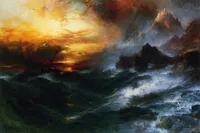
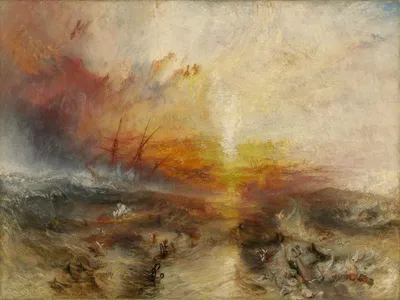
A blazing sunset at sea, and chains in the water beneath it.
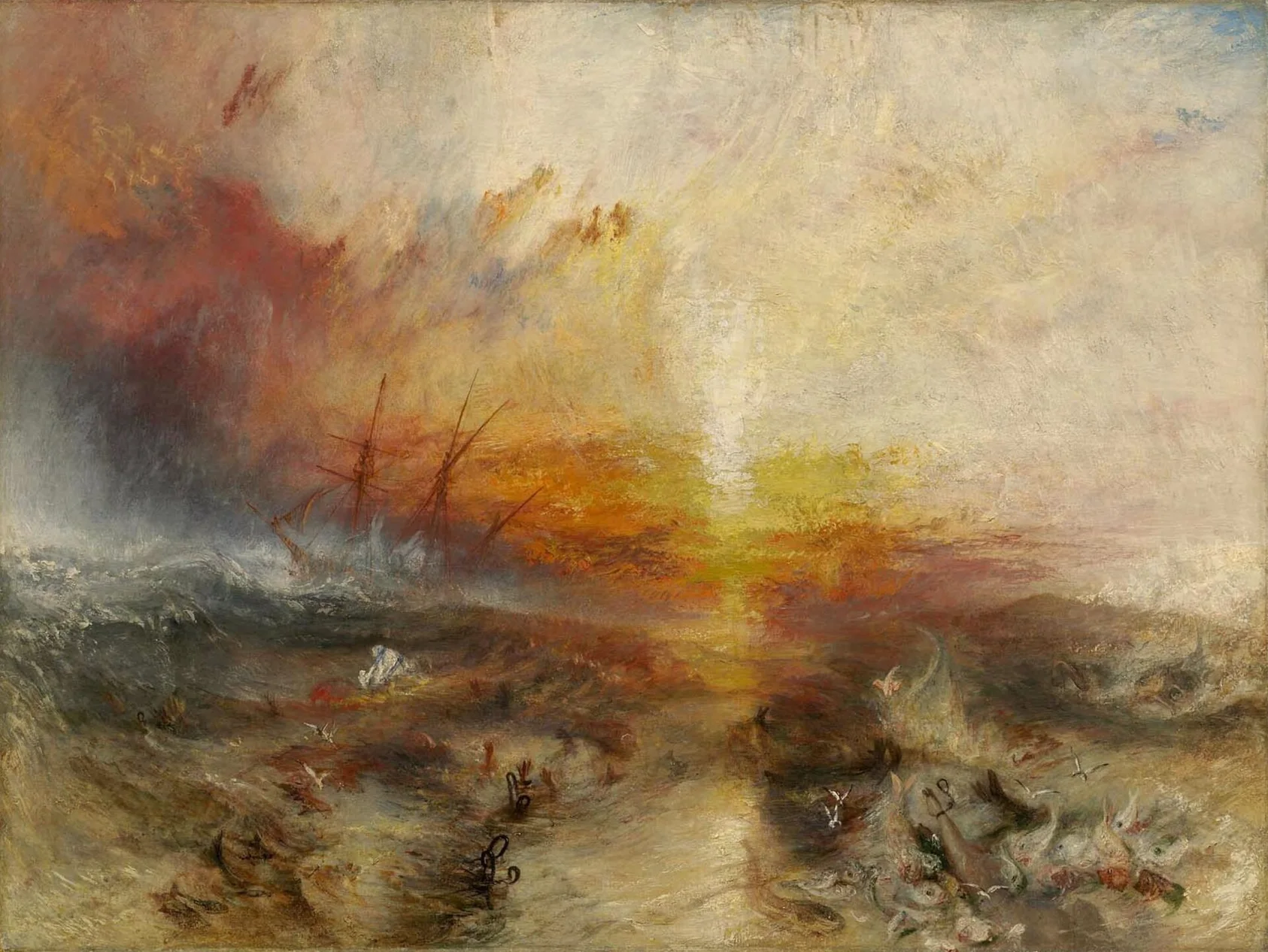
The Slave Ship, 1840. J. M. W. Turner. Museum of Fine Arts, Boston.
Look closer
7 things to notice
 1
01
A ship running from the storm
In the distance, a ship with red masts and furled sails leans into the rising sea. Its low, lean lines mark it as the kind of fast vessel slavers used to outrun navy patrols. The red of the masts is the red of the sky, as if the guilt had spread to everything.
02
A chain still on the ankle
In the right foreground, a dark leg rises out of the water, an iron chain locked round the ankle, while fish and gulls swarm in. Turner's original title spelled it out: slavers throwing overboard the dead and dying, with a typhoon coming on. The rest of the body is already gone under.
03
Chains that should have sunk
Iron chains lie on the surface near the centre, painted as if they could float. Mark Twain mocked them for that, along with the fish swimming on top of what he called mud, yet the chains are the point. Some writers argue that, to see them this close, you must be standing on the deck of the ship.
04
Hands above the waves
On the left, small dark shapes, hands and arms, break the churning surface among loose chains. They stand for the many others thrown from the ship and left to drown. Turner made them small and placed them at the edges, and that smallness is its own accusation.
05
A typhoon coming on
From the left a storm cloud rolls in, bruised red and grey, eating into the light. One reading sees in it divine punishment on its way to the slavers, a common idea in the abolitionist poetry of the time. The ship has nowhere to go.
06
A sun like an open wound
At the centre the sun sinks into the sea, spilling gold and blood red down a path across the water. The scene matches what the philosopher Edmund Burke called the sublime, the terror of human beings before the power of nature. It is the most beautiful part of the picture, and it lights the worst.
07
A sky that looks away
High on the right, the sky is pale and calm, cream fading to a scrap of blue. When the picture hung in New York, a critic complained that visitors came looking for a slaver in peril and found only a miracle of light and colour. Up here, nothing has happened at all.
Our take
A sunset blazes over a heaving sea, and a storm cloud sweeps in from the left. Far off, a ship with red masts and furled sails braces for the typhoon. Only when you come closer do the shapes in the foreground water make sense: raised hands, iron chains, a dark leg shackled at the ankle, and fish and gulls closing in. The ship has thrown its captives overboard. The sea is beautiful, and it is a grave.
Turner took the story from the Zong, a slave ship whose captain had more than a hundred enslaved Africans thrown into the sea so that their deaths could be claimed on insurance. He added the storm; the real killings happened in calm water. Critics have argued ever since over whether such splendour honours the victims or hides them. It cannot be unseen.
The painter's moment
1775–1851Painted it at 65Romanticism
J. M. W. Turner was 65 and one of Britain's best-known painters, his style dissolving more and more into colour; the year before, he had shown The Fighting Temeraire. He held liberal views, followed the news and knew the anti-slavery campaigns; in 1828 he had dedicated an engraving of his Deluge to an abolitionist. Britain had ended its slave trade in 1807 and slavery itself in 1833, but the trade carried on elsewhere. In 1839 a new edition of Thomas Clarkson's history of abolition retold the case of the Zong, whose captain in 1781 had 132 people thrown overboard, and the Amistad case was international news.
He showed the painting at the Royal Academy in 1840, the year two international anti-slavery conventions met in London, with lines from his own unfinished poem Fallacies of Hope telling the crew to throw the dead and dying overboard and "ne'er heed their chains". Thackeray could not decide whether it was sublime or ridiculous. In 1844 John Ruskin's father gave it to him, and Ruskin wrote that if Turner's immortality had to rest on one work, he would choose this. He sold it in 1872, and it went on view at New York's Metropolitan Museum. In 1876 Alice Hooper bought it at auction, and it passed to Boston's Museum of Fine Arts, where it hangs today.
In its time
The Slave Ship was painted in 1840, when Turner was 65.
Its colors
Elsewhere in the world
- 1838The Trail of TearsThe Cherokee are forced west under the Indian Removal Act; thousands die.
- 1839Photography is announcedPainting must rethink what it is for.
- 1839The Opium WarBritain forces open China's ports.
- 1840The Treaty of WaitangiMāori and the British Crown sign a founding treaty.
- 1845The New Zealand WarsDecades of war over land between Māori and the Crown.
The facts
- Title
- The Slave Ship
- Artist
- J. M. W. Turner (1775–1851)
- Date
- 1840
- Original medium
- Oil on canvas
- Style
- Romanticism
- Made in
- United Kingdom
- Collection
- Museum of Fine Arts, Boston
Art Through Design
The mood
It brings a storm of colour into a room, and a hard truth with it. From a distance it glows like a sunset; close up it asks you to look at what the sea is hiding.
The palette
Wheat and Sand are the pale burning sky; Ochre and Copper are the sunset on the water; Umber is the dark storm and the near sea. Across a room, the blaze of light at the centre comes first, and the figures in the water last.
Who it finds
- Anyone who believes a beautiful painting can also tell the truth about something terrible.
- Anyone who studies the history of slavery and abolition and wants it present at home.
- Anyone who loves Turner's storms and wants the one he painted with the most anger.
See it in a room
Your photo is never uploaded, and it's gone when you leave.
Gold and red flaring at the centre, a dark storm sweeping in from the left: across a room it passes for a sunset at sea. Only up close do the chains, the raised hands and the circling fish appear, and the picture changes completely.
Roughly four parts wide to three high, it belongs in a room for reflection: a study, a reading room, a quiet corridor, a classroom. A good size lets the details be found. Live with it deliberately; it is a picture that starts conversations and deserves them.
Order on canvas, acrylic, or print
- True to the original
- Each file is color-matched to the museum original. If the color isn't right, we print it again, with our compliments.
- On canvas
- Fine-art canvas hand-stretched over a ¾″ solid-wood frame, with mirrored edges so nothing is lost.
- In our floating frame
- Our stretched canvas set in a slim floating frame, with a shadow gap so the painting seems to hover.
- As a framed print
- Archival pigment print on museum-grade cotton paper, in a solid-wood frame with UV-protective glazing.
- Ready to hang on arrival
- It arrives with the hanging hardware attached. No framer, no guesswork.
- Perfect on arrival
- If anything arrives damaged or not as you ordered, send us a photo within 7 days of delivery and we'll make it again, with our compliments.
Turner set a storm against the cruelty of the slave trade in 1840, and the sea will not hide it. Hang it where it will be looked at, and talked about.