The story · 2 min read
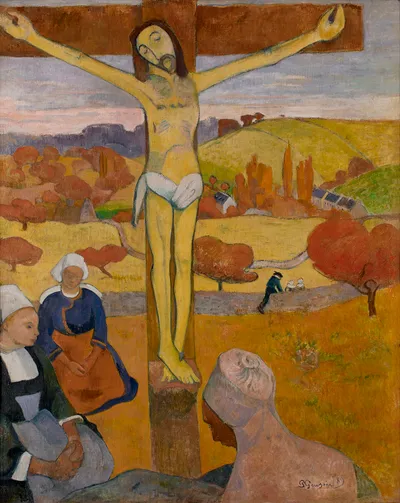
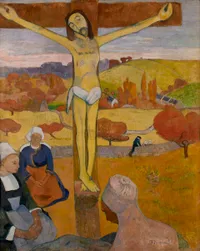
A yellow Christ on a cross, in a French field, with farm women praying.
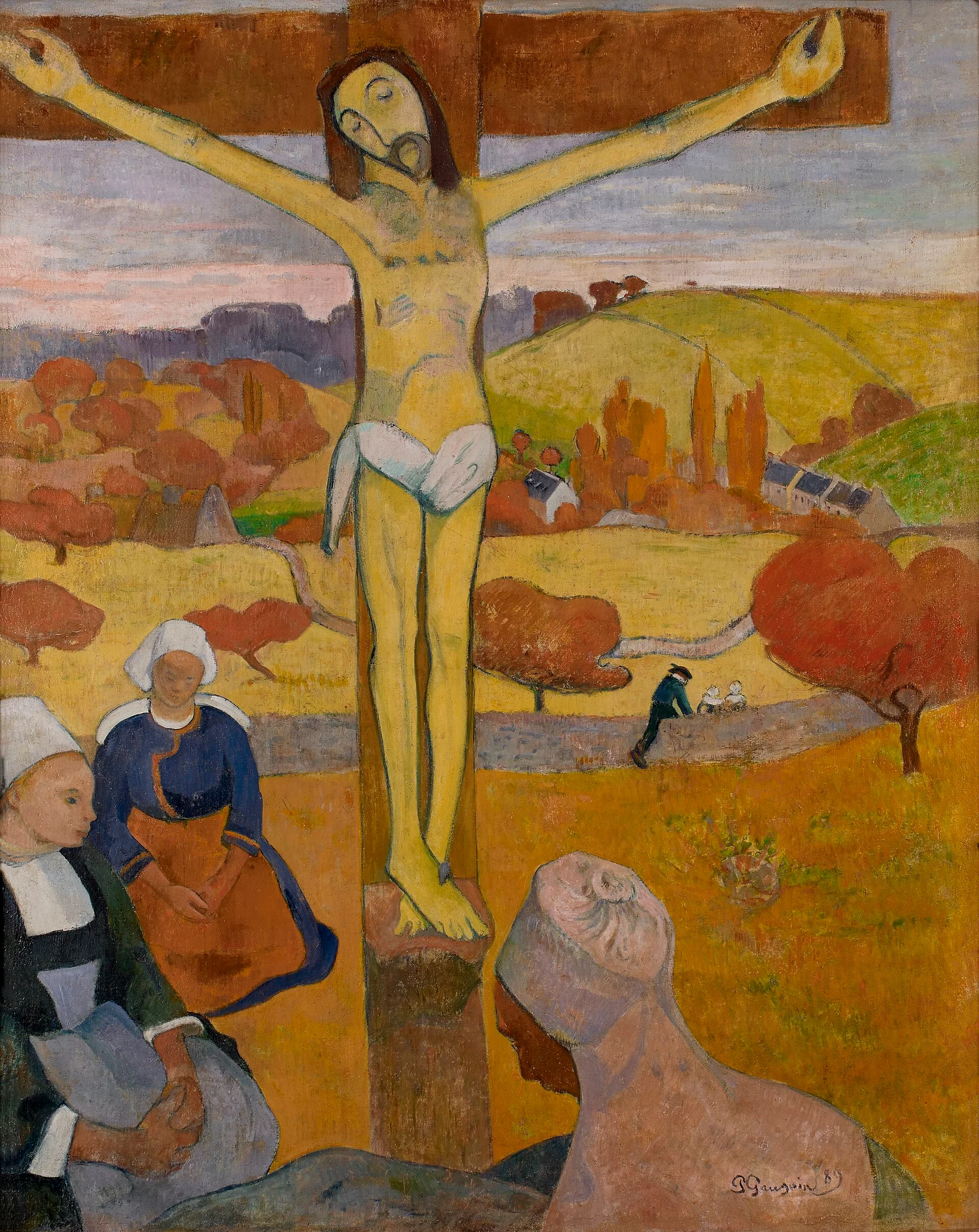
The Yellow Christ, 1889. Paul Gauguin. Buffalo AKG Art Museum, New York.
Look closer
7 things to notice
 1
01
A face carved more than painted
Christ's head tips to one side, eyes closed, the face outlined in thick dark lines. It looks less like a man than like a village wooden carving. That is the idea.
02
Yellow like the fields around him
The body is a flat, impossible yellow. Gauguin chose it so that Christ would belong to the autumn fields around him, the same colour as the land.
03
The only ones with real weight
These are Breton women, from Brittany in north-west France, in their local dress. Gauguin gives only the women any shading. They are the solid, real people here.
04
Her back to us
A woman sits with her back turned, her white cap almost pink in the light. We are seated in the same crowd, behind her.
05
Life going on behind
A man climbs over a wall in the distance while the crucifixion happens. Nobody in the background has noticed anything.
06
Trees like red pom-poms
The autumn trees are flat red shapes with dark outlines, like cut paper. This style, flat colour with heavy lines, was called cloisonnism, after enamel work.
07
A stockbroker's signature
He signs it P. Gauguin, 89. Ten years earlier he had been a rich stockbroker in Paris with no plans to give it up.
The story
What you are looking at
Jesus on the cross, as you have seen him a thousand times, except he is bright yellow and the hill of Calvary has been replaced by a field in France in the autumn. Farm women in their Sunday caps kneel around him. Paul Gauguin painted it in 1889 in Pont-Aven, a village in Brittany full of painters.
The banker who quit
For eleven years Gauguin was a stockbroker in Paris, earning a fortune and painting on weekends. Then the stock market crashed in 1882, the art market with it, and within two years he had made up his mind to paint full time. It was a disaster for his family's money. It was the making of him.
After Van Gogh
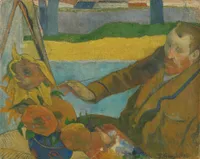
In 1888 he spent about two months living with Vincent van Gogh in Arles, and it ended badly. He went back to Brittany, made a quick trip to the World's Fair in Paris, and came back and painted this.
Why it matters
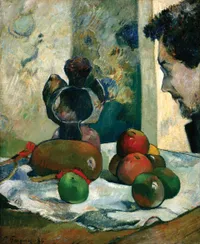
Thick outlines, flat colour, a religious scene that doubles as a mood about a place: it is one of the pictures that started the Symbolist movement. He thought enough of it to paint his own self-portrait in front of it the next year. It is now in Buffalo, New York.
Our take
Faith here feels local, like something the women grew themselves. To us the picture is less about suffering than about a community holding something in common, in the middle of an ordinary harvest afternoon.
Yellow, orange and red belong to autumn and to warmth. Gauguin lets them flood the whole canvas, so the cross becomes part of the landscape. Hard outlines make it all feel like a stained-glass window.
In its time
The Yellow Christ was painted in 1889, when Gauguin was 41. Its French title is Le Christ jaune. Where it stands on Art Through Time:
Its colors
Elsewhere in the world
- 1884The Berlin ConferenceEurope's powers divide Africa among themselves.
- 1887French Indochina is formedFrance rules Vietnam and Cambodia, and later Laos.
- 1888Brazil abolishes slaveryThe Golden Law makes Brazil the last country in the Americas to end it.
- 1890Wounded KneeU.S. soldiers kill some 250 Lakota men, women and children.
- 1894The Dreyfus AffairA Jewish officer is falsely convicted of treason; France, and its painters, split in two.
The facts
- Title
- The Yellow Christ
- Artist
- Paul Gauguin (1848–1903)
- Date
- 1889
- Original medium
- Oil on canvas
- Style
- Symbolism
- Made in
- France
- Collection
- Buffalo AKG Art Museum, New York
Art Through Design
The mood
It fills a room with autumn warmth and a calm, homegrown kind of faith. Yellow and red fields surround one simple figure, and the space feels warm, grounded and settled.
The palette
Ochre and Wheat are the yellow fields and the figure; Copper is the red trees; Bark is the cross and the women's dark dresses; Oat is the pale sky. Across a room, the yellow figure with its arms stretched wide is what you see.
Who it finds
- Anyone who left a safe career for something that made no sense on paper.
- Anyone who grew up in a small place where everyone knelt in the same church.
- Anyone who loves the colours of a field in October more than any other season.
See it in a room
Your photo is never uploaded, and it's gone when you leave.
One yellow figure with arms spread, on a cross among yellow fields, carries across any room. Closer, the women's caps appear, then the tiny man climbing the wall, and the thick dark lines around every shape.
Upright, it fits a study, a reading corner or a hallway you pass through every day. It works at moderate sizes and grows warmer the bigger it gets. Give it a plain, warm-toned frame so the outlines do the talking.
Order on canvas, acrylic, or print
- True to the original
- Each file is color-matched to the museum original. If the color isn't right, we print it again, with our compliments.
- On canvas
- Fine-art canvas hand-stretched over a ¾″ solid-wood frame, with mirrored edges so nothing is lost.
- In our floating frame
- Our stretched canvas set in a slim floating frame, with a shadow gap so the painting seems to hover.
- As a framed print
- Archival pigment print on museum-grade cotton paper, in a solid-wood frame with UV-protective glazing.
- Ready to hang on arrival
- It arrives with the hanging hardware attached. No framer, no guesswork.
- Perfect on arrival
- If anything arrives damaged or not as you ordered, send us a photo within 7 days of delivery and we'll make it again, with our compliments.
Gauguin set a yellow Christ in a Breton field in the autumn of 1889. Hang it where the late afternoon light falls.