The story · 4 min read
A summer gust, a turned head, and four years later she was gone.
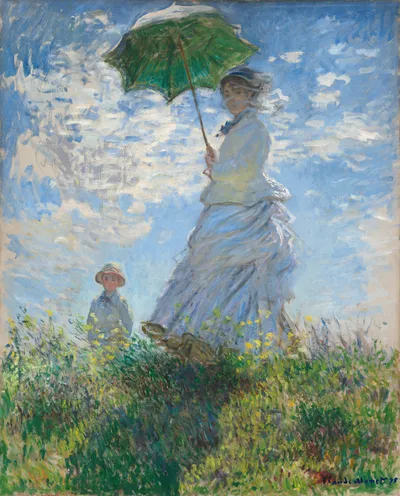
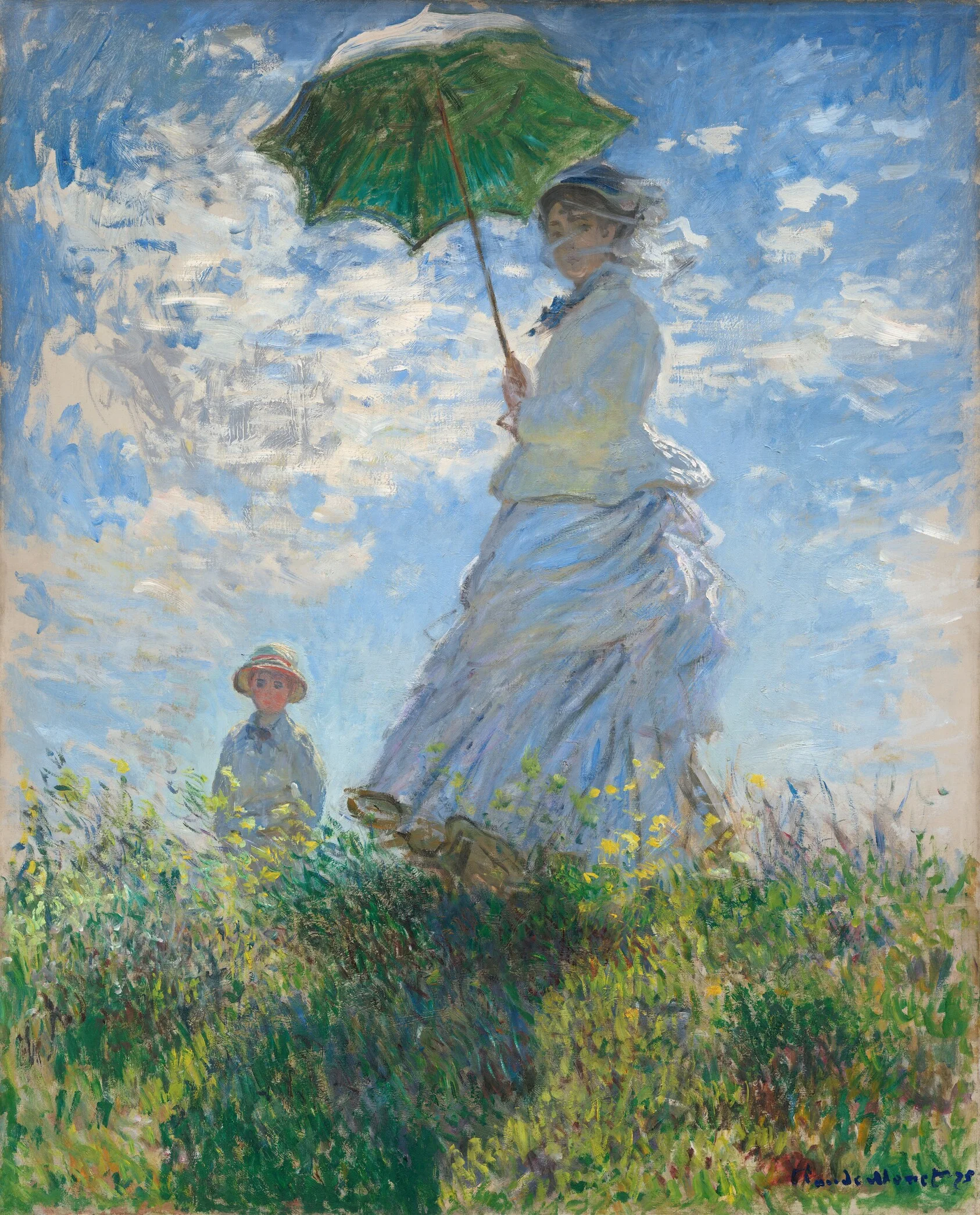
Woman with a Parasol - Madame Monet and Her Son, 1875. Claude Monet. National Gallery of Art, Washington.
Look closer
7 things to notice
 1
01
A face behind blowing gauze
At the top of the slope Camille turns her head toward us, her face half hidden by a veil the wind has caught, a blue bow at her throat. Monet painted her from below, against the sky, so that she seems to stand above us. Her face is a few quick strokes, and yet they look straight at you.
02
Green underneath, like the grass
Above her the parasol tilts against the clouds, its underside a deep green. The sources point out that this green repeats the waving grass of the meadow below, tying the sky to the ground. Its handle runs down to her hand like a single brown line.
03
A boy behind the rise
Further off on the left, their son Jean stands in a round straw hat, visible only from the waist up behind a swell in the ground. He was seven, and setting him lower and farther away is what opens up the depth of the hillside. His cheeks are two dabs of pink.
04
A dress the wind won't leave alone
Her long white dress billows to the right, blue and violet in its shadows, its hem lost in the grass. At about a metre tall this was Monet's largest canvas of the 1870s, and he seems to have painted it in a single sitting. The folds are built from long, fast sweeps of the brush.
05
Grass bent by the same gust
Along the bottom the meadow tosses in greens and yellows, with small yellow flowers scattered through it. The same wind that lifts the veil flattens this grass, and Monet set down both with the same short, quick strokes. The whole meadow leans one way.
06
Clouds tearing past
On the left, white clouds rip across a blue sky in loose, broken strokes, more paint than cloud when seen up close. It was one of eighteen canvases Monet hung in the Impressionists' 1876 show. From a few steps back, the strokes turn back into a windy afternoon.
07
Signed, then paid to the doctor
In the bottom right corner, among the grass, Monet signed in dark paint: Claude Monet 75. In November 1876 he sold the painting to Georges de Bellio, the homeopath he regularly paid in paintings. The signature sits in the meadow like another tuft of grass.
Our take
The wind is doing most of the work. It lifts Camille's veil, pushes her white dress sideways, bends the grass and drives the clouds across a blue sky, while she looks down at us from the top of a slope, a green parasol tilted against the light. Their son Jean, seven, stands further off, half hidden by the rise. Monet painted it outdoors and fast, probably in a few hours. It feels like a glance, and it was meant to.
He was attempting what he called an old dream: figures painted in the open air, as he saw them. He told a friend it was so hard it was almost making him ill. Within a year Camille was seriously ill herself, and she died in 1879. Seen now, her face behind the blowing veil is almost too faint to hold on to.
The painter's moment
French, 1840 - 1926Impressionism
Claude Monet was 34 and living in Argenteuil, on the Seine near Paris, where the family had settled in 1871. He had met Camille Doncieux when she modelled for him in 1865; their son Jean was born in 1867, and Monet's father cut off his support over it. They married in the summer of 1870, weeks before war with Prussia drove them to London. In 1875, after years away from figure painting, he went back to it out of doors, and wrote to his friend Théodore Duret that he was working as never before on figures in the open air, a dream that had always obsessed him and that he wanted to master once and for all.
The painting hung in the second Impressionist exhibition at Paul Durand-Ruel's gallery in April 1876, where the young John Singer Sargent saw it; years later he painted his own Two Girls with Parasols at Fladbury. That same year Camille fell seriously ill. A second son, Michel, arrived in 1878; cancer was found the same year, and she died in 1879. In 1886 Monet painted the scene again at Giverny, with his second wife's daughter Suzanne under the parasol. This first version passed from de Bellio's family to Paul and Bunny Mellon, and in 1983 Paul Mellon gave it to Washington's National Gallery of Art.
In its time
Woman with a Parasol - Madame Monet and Her Son was painted in 1875, when Monet was 35. Where it stands on Art Through Time:
Its colors
Elsewhere in the world
- 1874The first Impressionist exhibitionIndependent artists show on their own terms.
- 1875Fort Marion ledger drawingsImprisoned Plains artists draw their world.
- 1876Centennial Exhibition, PhiladelphiaAmerica measures its art against the world.
- 1876Russia bans books in UkrainianThe Ems Decree suppresses the Ukrainian language in print.
- 1876Battle of the Little BighornRecorded by Lakota and Cheyenne artists.
The facts
- Title
- Woman with a Parasol - Madame Monet and Her Son
- Artist
- Claude Monet (French, 1840 - 1926)
- Date
- 1875
- Original medium
- Oil on canvas
- Style
- Impressionism
- Made in
- French
- Collection
- National Gallery of Art, Washington
Art Through Design
The mood
It lets the wind into a room. Everything leans the same way, veil, dress, grass and clouds, and the space feels lighter and more awake, like a window thrown open on a June afternoon.
The palette
Mist and Steel are the sky and the shadows in the white dress, Slate the deeper blues, Sage and Fern the meadow and the parasol. From across a room, the white figure against the blue and the dark green parasol above her are what you see.
Who it finds
- Anyone who keeps a photograph of someone they lost, taken on an ordinary windy day.
- Anyone who has walked up a hill with a child trailing behind and turned to check on them.
- Anyone who loves the moment before a summer storm, when the whole field turns the same way.
See it in a room
Your photo is never uploaded, and it's gone when you leave.
From the doorway it is a white figure against blue, a dark green disc above her and a bank of green below. Close up, it turns into weather: torn cloud, bent grass, a veil caught mid-flutter, a boy's pink cheeks, a signature tucked into the meadow.
It is upright, a little taller than wide, and suits a bedroom, a sunny hallway, a stairwell or the wall facing a window. Hang it so her face sits a little above eye level, the way Monet painted her, looking down from the slope. A generous size lets the wind in the brushwork show.
Order on canvas, acrylic, or print
- True to the original
- Each file is color-matched to the museum original. If the color isn't right, we print it again, with our compliments.
- On canvas
- Fine-art canvas hand-stretched over a ¾″ solid-wood frame, with mirrored edges so nothing is lost.
- In our floating frame
- Our stretched canvas set in a slim floating frame, with a shadow gap so the painting seems to hover.
- As a framed print
- Archival pigment print on museum-grade cotton paper, in a solid-wood frame with UV-protective glazing.
- Ready to hang on arrival
- It arrives with the hanging hardware attached. No framer, no guesswork.
- Perfect on arrival
- If anything arrives damaged or not as you ordered, send us a photo within 7 days of delivery and we'll make it again, with our compliments.
Monet caught Camille and Jean on a windy hill in 1875, in a few hours of open air. Hang them where a window lets the breeze in.