The story · 4 min read
Three people making music, and nobody knows where they are now.
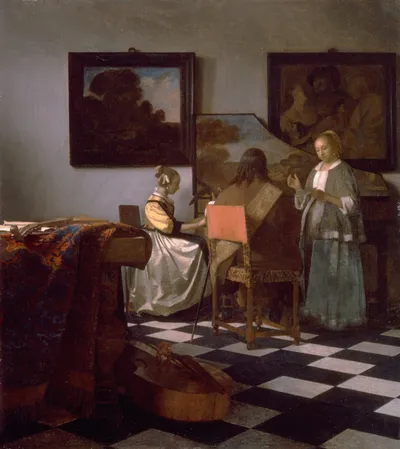
The Concert, 1663. Johannes Vermeer. Isabella Stewart Gardner Museum, Boston (stolen 1990, missing).
Look closer
7 things to notice
 1
01
Lost in the keys
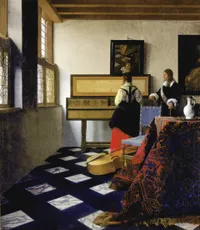
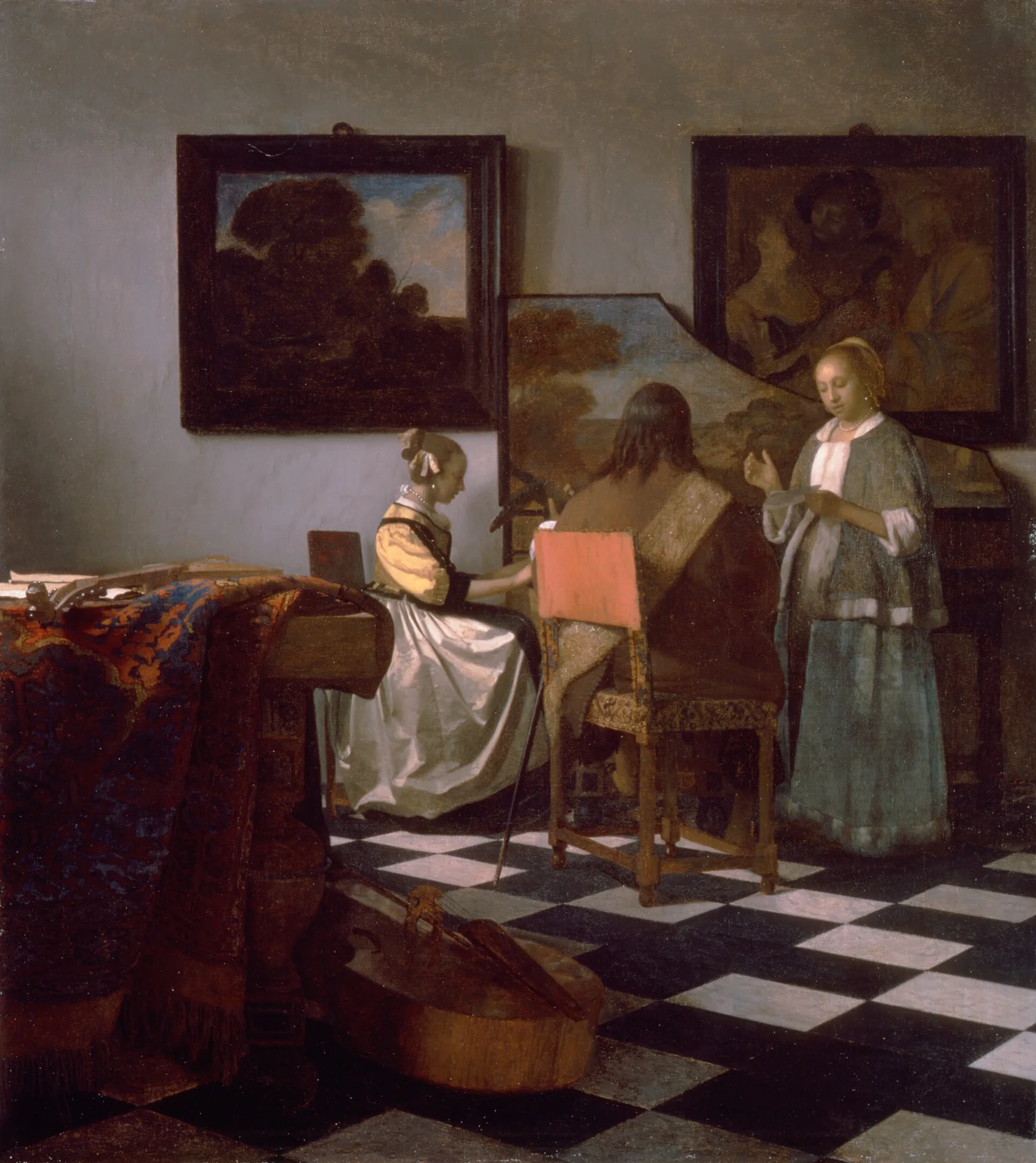
At the harpsichord sits a young woman in a yellow bodice and a pale satin skirt, her hair tied back with a ribbon, her eyes on the keyboard. Her clothes, the instruments and the room mark these players as well-to-do townspeople. She does not look up at the singer, or at you.
02
Singing with one hand lifted
On the right, a woman in a fur-trimmed grey jacket stands with a sheet of music in one hand and the other raised, her face lowered as she sings. The light from the left catches her collar and the pearls at her throat. Vermeer worked slowly, probably finishing about three paintings a year, and she is one reason why.
03
A gentleman we never see
In the middle, a man sits facing away from us on a chair with a red back, playing a lute we can barely make out, a gold shoulder belt across his brown coat. The belt carries a sword, a sign, the sources say, of his standing. Vermeer gives us his long hair and his shoulders, and keeps his face hidden.
04
Love for sale, above the music
On the wall behind the singer hangs The Procuress by Dirck van Baburen, a bawdy picture of paid love. It was the property of Vermeer's mother-in-law, Maria Thins, and he painted it again in a later picture. The sources suggest it is there for contrast: below it, the people in this room are only making music.
05
A gentle country inside the lid
The harpsichord's lid stands open, painted inside with a bright, calm landscape of trees and sky. The sources set that gentle scene against the wild, dark landscape on the wall to the left, one tamed and one untamed. Music, the arrangement seems to say, belongs with the calm one.
06
An instrument nobody picked up
In the foreground a viola da gamba lies on the black and white marble floor, its strings toward us, as if a fourth player had set it down. That marble floor, plain as it looks, was an expensive luxury. The instrument has lain there unplayed since 1990, wherever there now is.
07
Wild country in a black frame
On the left wall hangs a dark landscape in a heavy black frame, trees bunched against a pale sky. The sources call it a wild pastoral scene, the opposite of the gentle view on the harpsichord's lid. Vermeer lets the two pictures argue across the room while the music goes on between them.
Our take
A young woman plays the harpsichord, a man in a rich coat accompanies her on the lute with his back to us, and a second woman stands to sing, one hand raised. The room is quiet and costly: a marble floor, a patterned carpet, paintings on the grey wall. Behind the singer hangs a bawdy picture of love for sale owned by Vermeer's mother-in-law. Music in Dutch paintings of the day usually meant romance. Here it may simply mean music.
One night in 1990, two men dressed as police talked their way into the Isabella Stewart Gardner Museum, tied up the guards and took thirteen works. They lifted The Concert out of its frame. It has not been seen since, and it is believed to be the most valuable stolen painting still missing. Its empty frame hangs in the museum, waiting.
The painter's moment
1632–1675Painted it at 31Dutch Golden Age
Johannes Vermeer had married Catharina Bolnes, a Catholic, in April 1653, probably converting at the insistence of her mother, Maria Thins, who was much richer than he was. The couple moved into her spacious house on the Oude Langendijk in Delft, and he painted in a front room upstairs for the rest of his life. He was elected head of the painters' guild in 1662 and again in 1663. He worked slowly, probably three paintings a year; when a French diplomat called in 1663 hoping to see his work, Vermeer had nothing to show, and the visitors were sent to a baker who held a couple of his pictures as security for a debt. The Procuress on the back wall here hung in the house where he lived.
He died in December 1675, at 43, after a short illness; his widow, left with eleven children and heavy debts, blamed the collapse of the art market. The Concert is first recorded only in 1780. Isabella Stewart Gardner bought it at auction in Paris in 1892 for $5,000, and her will ordered that nothing in her museum be moved, sold or added. So since thieves took it in 1990, its frame has hung empty. The museum offers a $10 million reward for the stolen works, and The Concert has turned up in novels by Steve Martin, Kate Atkinson and Daniel Silva.
In its time
The Concert was painted in 1663, when Vermeer was 31. Where it stands on Art Through Time:
Its colors
The facts
- Title
- The Concert
- Artist
- Johannes Vermeer (1632–1675)
- Date
- 1663
- Original medium
- Oil on canvas
- Style
- Dutch Golden Age
- Made in
- Netherlands
- Collection
- Isabella Stewart Gardner Museum, Boston (stolen 1990, missing)
Art Through Design
The mood
It brings the hush of a private concert into a room: three people intent on one piece of music, a chair, a carpet, a cool grey wall. It asks for quiet, and the room around it tends to give it.
The palette
Oxblood, Mahogany and Walnut are the carpet, the chair and the dark frames; Taupe and Mauve are the grey wall and its soft shadows. From across a room, the yellow bodice and the red chair back stand out against the grey.
Who it finds
- Anyone who has played music with friends after dinner and remembers how quiet the room went.
- Anyone who has lost something irreplaceable and kept a space for it, in case it came back.
- Anyone who loves Vermeer and wants the one painting of his that nobody can visit.
See it in a room
Your photo is never uploaded, and it's gone when you leave.
Three figures in a band of light, two dark paintings above them, a black and white floor running toward you: it reads first as calm geometry. Close up, it fills with quiet details, a ribbon in the hair, pearls at a throat, a landscape inside a lid, an instrument on the floor.
It is nearly square, a little taller than wide, and it suits a music room, a sitting room or a study, anywhere people play, read or listen. A medium size, near its original 72 by 65 centimetres, keeps its intimacy.
Order on canvas, acrylic, or print
- True to the original
- Each file is color-matched to the museum original. If the color isn't right, we print it again, with our compliments.
- On canvas
- Fine-art canvas hand-stretched over a ¾″ solid-wood frame, with mirrored edges so nothing is lost.
- In our floating frame
- Our stretched canvas set in a slim floating frame, with a shadow gap so the painting seems to hover.
- As a framed print
- Archival pigment print on museum-grade cotton paper, in a solid-wood frame with UV-protective glazing.
- Ready to hang on arrival
- It arrives with the hanging hardware attached. No framer, no guesswork.
- Perfect on arrival
- If anything arrives damaged or not as you ordered, send us a photo within 7 days of delivery and we'll make it again, with our compliments.
Vermeer's three musicians began playing in the 1660s and vanished in 1990. Hang them where music is played, and give them a frame to come home to.