The story · 2 min read
Vermeer's smallest painting, and the thread is coming out of the cushion like liquid.
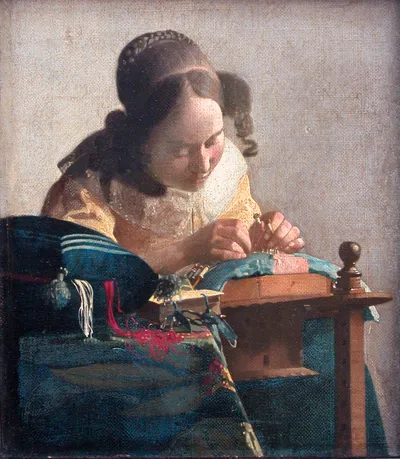
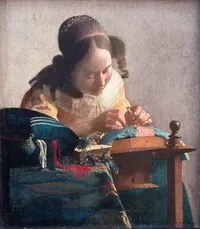
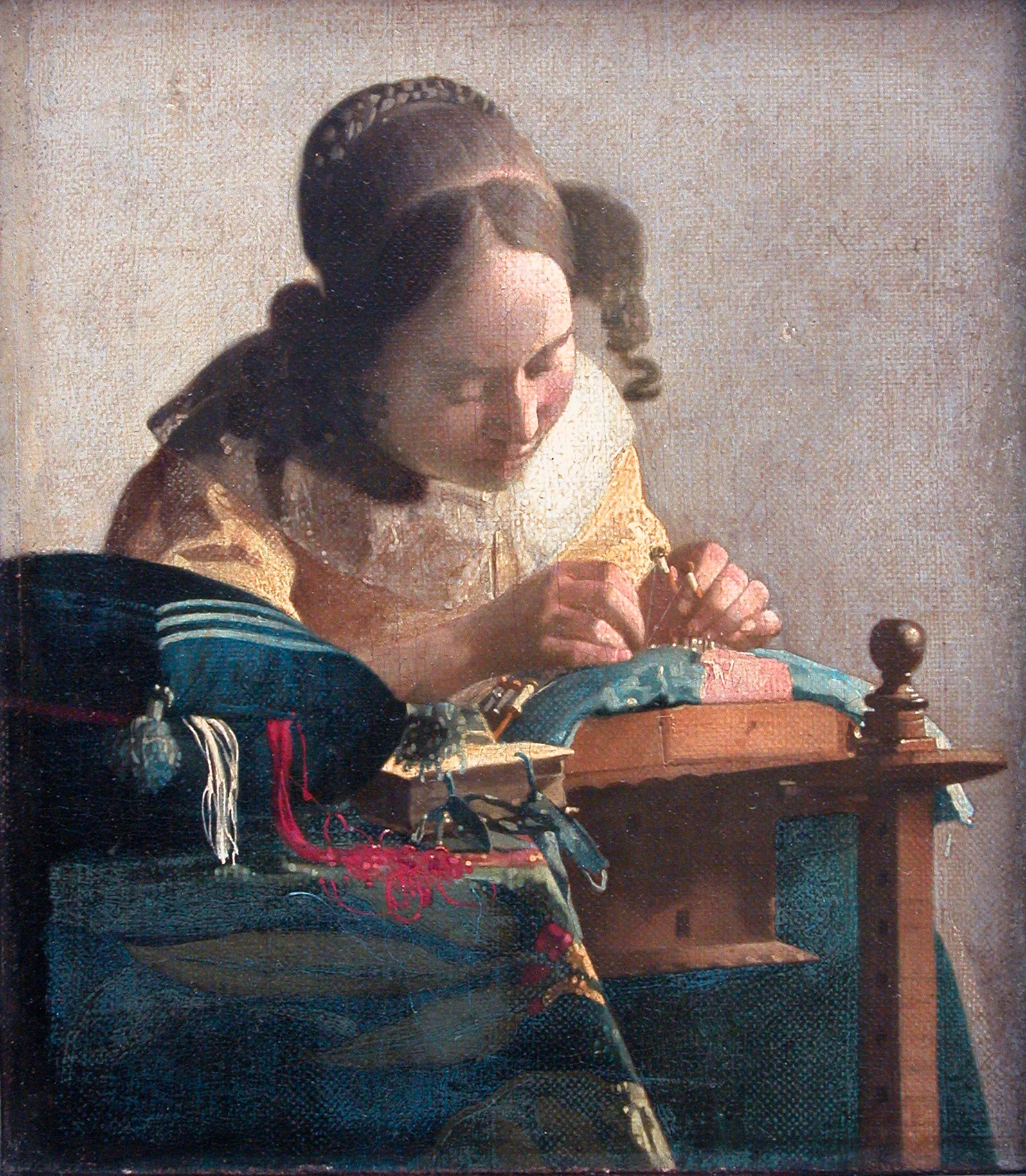
The Lacemaker, 1669. Johannes Vermeer. Musée du Louvre, Paris.
Look closer
7 things to notice
 1
01
Nothing in the world but this
She bends her head over the work, eyes lowered, hair pinned into tight ringlets. Vermeer has left a bare wall behind her, so your attention stays put.
02
The sharpest thing in the picture
This is where he aims your eye: two hands, a pair of bobbins and a pin going in. Vermeer shows every step of this difficult craft correctly.
03
Red thread turned to liquid
Up close these red and white threads are not threads at all. They spill out of the sewing cushion in loose blobs of paint, right beside the exact lace she is working on.
04
Deliberately out of focus
The blue cushion in front is soft and blurred, the way close things look through a camera lens. He may well have worked with a camera obscura, an early projecting device.
05
Yellow in a small room
Her bodice is the warm yellow he loved, laid over cool grey light. Yellow against blue was his signature, and even at this tiny scale it glows.
06
A wooden knob, carefully lit
This little turned knob belongs to her lace table. He gave it the same attention as her face.
07
A wall with nothing on it
Vermeer's other rooms have maps, windows and paintings. Here the wall is empty, and the grain of the canvas shows through the paint.
The story
What you are looking at
Making lace was fine, slow, expensive work, done with pins and small weighted bobbins, and this young woman is deep in it. The Dutch painter Johannes Vermeer made this around 1669. The whole canvas is only about 24 centimetres tall, smaller than a sheet of paper. It is the smallest picture he ever painted.
How he made you concentrate
Everything around her hands is blurred, and only the hands are sharp. Vermeer seems to have studied how a lens sees and copied it. You are forced to look exactly where she is looking, and your eyes work the way hers do.
What people say
The art historian Lawrence Gowing wrote that this picture could never be repeated. The Louvre, in Paris, has it now, in a small frame on a big wall. Few people walk past it without bending closer, as if they were the ones doing the lacework.
A strange fan
The Spanish surrealist Salvador Dalí was obsessed with it. In 1955 he painted his own copy, and then a further study of it, full of what he called his paranoid method.
Our take
Attention can be a form of love, and this is what it looks like. She is not performing for anyone. To watch somebody who has completely forgotten you exist is unusually calming.
The design funnels you. Blurred at the edges, sharp at the centre, with the head, arms and table all aiming down at one point. The colours are few, yellow, blue and grey with one flash of red, so that nothing argues with her hands.
In its time
The Lacemaker was painted in 1669, when Vermeer was 37. Its Dutch title is De kantwerkster. Where it stands on Art Through Time:
Its colors
The facts
- Title
- The Lacemaker
- Artist
- Johannes Vermeer (1632–1675)
- Date
- 1669
- Original medium
- Oil on canvas
- Style
- Dutch Golden Age
- Made in
- Netherlands
- Collection
- Musée du Louvre, Paris
Art Through Design
The mood
It brings a small, deep concentration into a room. One bent head in warm light against a bare wall steadies everything near it, and the space feels close, patient and hushed.
The palette
Oat and Mushroom are the bare wall; Clay is its shaded side; Slate and Ink are the cushion and the dark tablecloth. Seen from the doorway, her yellow bodice and small bent head are what catch you.
Who it finds
- Anyone who has lost a whole afternoon to something fiddly and been happy about it.
- Anyone who learned a difficult craft from a grandmother and still has her tools.
- Anyone who has watched a person they love concentrate and not wanted to interrupt.
See it in a room
Your photo is never uploaded, and it's gone when you leave.
Small and warm, it comes across the room as one glowing head and a dark cushion. Up close, the red thread dissolves into wet paint and the pin in her fingers turns out to be just a couple of strokes.
It was made tiny, so keep it near the size of a book, on a small wall by a desk, a sewing table or a bedside. It wants to be seen from a foot away, and it does not need to be any larger.
Order on canvas, acrylic, or print
- True to the original
- Each file is color-matched to the museum original. If the color isn't right, we print it again, with our compliments.
- On canvas
- Fine-art canvas hand-stretched over a ¾″ solid-wood frame, with mirrored edges so nothing is lost.
- In our floating frame
- Our stretched canvas set in a slim floating frame, with a shadow gap so the painting seems to hover.
- As a framed print
- Archival pigment print on museum-grade cotton paper, in a solid-wood frame with UV-protective glazing.
- Ready to hang on arrival
- It arrives with the hanging hardware attached. No framer, no guesswork.
- Perfect on arrival
- If anything arrives damaged or not as you ordered, send us a photo within 7 days of delivery and we'll make it again, with our compliments.
Vermeer painted the smallest picture of his life around 1669, of a girl placing a pin. Hang it close to where you do your own careful work.


%20-%20Google%20Art%20Project.jpg&w=200)