The story · 2 min read
A woman reads a letter, and nobody knows who sent it.
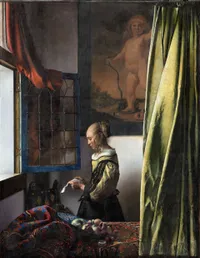
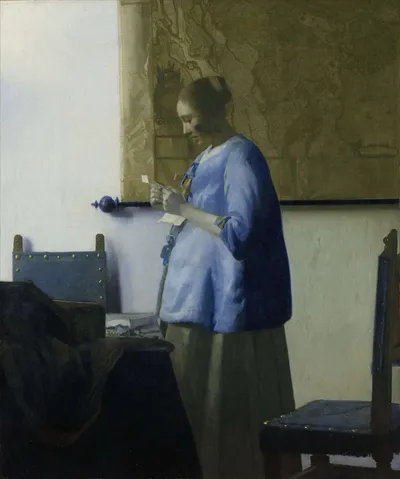
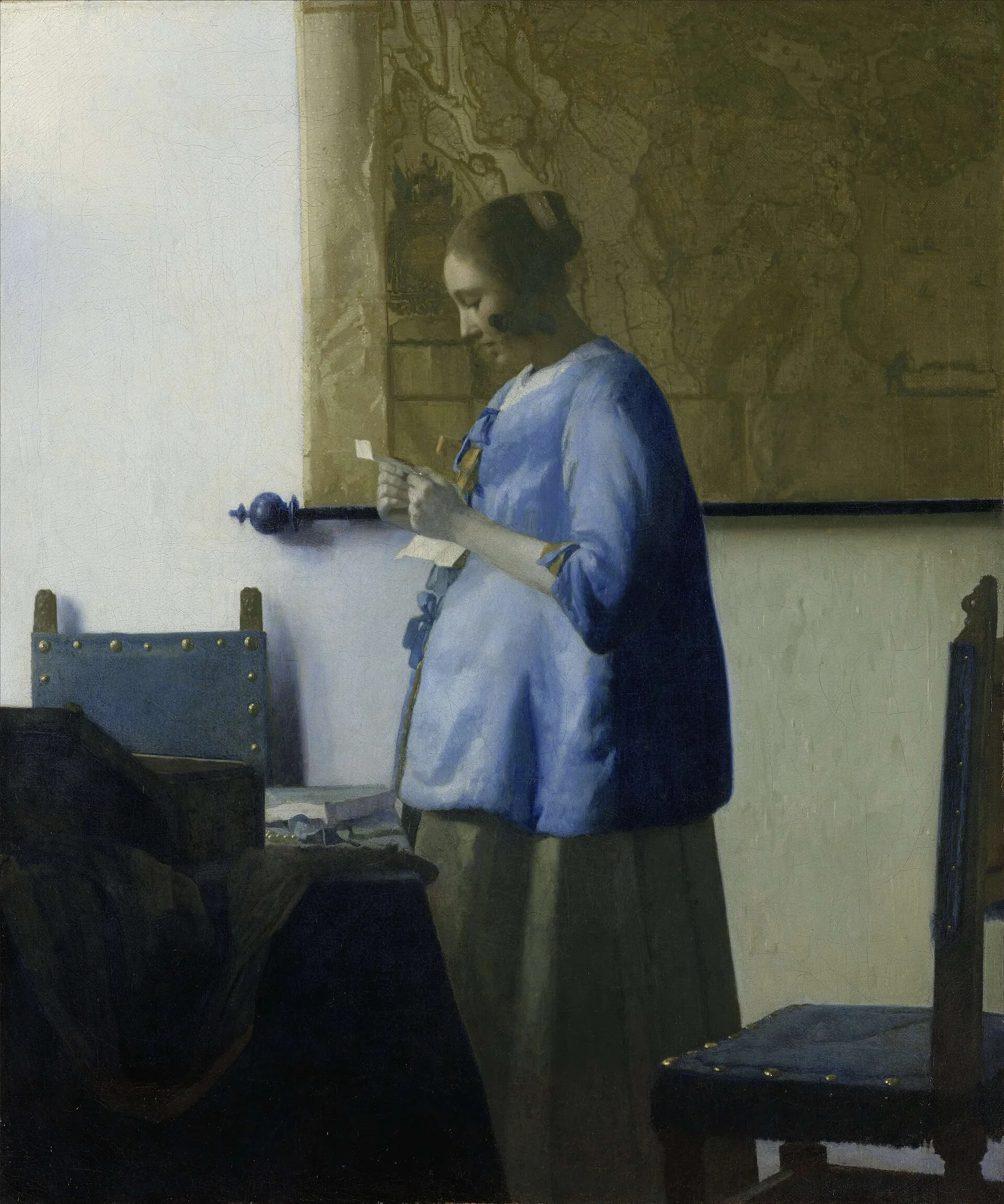
Woman in Blue Reading a Letter, 1664. Johannes Vermeer. Rijksmuseum, Amsterdam.
Look closer
7 things to notice
 1
01
Reading it again
She bends over the letter, lips just parted, completely absorbed. We cannot read what it says. Vermeer makes sure of that.
02
Two pages, one held tight
She holds the letter close in both hands. A second sheet lies on the table, as if she had already read it and gone back to the start.
03
A map of home
The map behind her shows Holland and West Friesland. It is a real map from 1620. Some think it hints that the letter comes from a husband far away.
04
Blue that fills the room
Her jacket is the most intense blue in the picture, soft and glowing against the pale wall. It is the colour you remember long after you have looked away.
05
A clue she has pushed aside
On the table, almost hidden, sits a box of pearls. Pearls sometimes stood for vanity or a lover, and some read the letter as a love letter instead.
06
An empty chair waits
A chair with blue leather and rows of shining brass nails stands empty on the left. Vermeer paints each nail as a single point of light.
07
No corner, no floor, no ceiling
Look around the edges. You cannot see a corner, a floor or a ceiling anywhere, which is unique among his interiors. The room closes tight around her.
The story
What you are looking at
Around 1663 Johannes Vermeer, a Dutch painter who left behind only a few dozen pictures, painted a young woman standing by a window, reading a letter. We never see the window, the letter's words or who sent it. We only see her reading, and that turns out to be enough.
Is she pregnant?
Her blue jacket bulges at the front, and many people think she is expecting a child. Others point out that the fashion of the time made women look like this. Pregnancy was rarely painted then, so the question has never been settled.
Clues on the wall
Behind her hangs a real map of Holland, printed in 1620; a copy still survives in a museum in the town of Hoorn. Some read it as a sign of a husband travelling far away. The pearls on the table point to something else. Vermeer leaves both doors open.
The first Vermeer
It came to the city of Amsterdam in 1854, as part of a collector's bequest, and when the Rijksmuseum opened in 1885 it became the first Vermeer the museum owned.
Our take
Few experiences are as private as reading a letter that matters to you, and Vermeer catches the exact posture: shoulders forward, the world gone. To us the picture is about the strange intimacy of watching someone receive news.
Blue and pale gold, with almost nothing else, make the room feel cool and calm. Strong verticals and horizontals, the map, the rod, the chairs, hold her steady in the middle like a frame inside a frame. She is the only soft thing in a room of straight lines.
In its time
Woman in Blue Reading a Letter was painted in 1664, when Vermeer was 32. Its Dutch title is Brieflezende vrouw in het blauw. Where it stands on Art Through Time:
Its colors
The facts
- Title
- Woman in Blue Reading a Letter
- Artist
- Johannes Vermeer (1632–1675)
- Date
- 1664
- Original medium
- Oil on canvas
- Style
- Dutch Golden Age
- Made in
- Netherlands
- Collection
- Rijksmuseum, Amsterdam
Art Through Design
The mood
It brings soft light and a hush into a room. A woman in blue stands against a pale wall, and the space around her feels private and calm.
The palette
Chalk is the pale wall; Olive is the map; Sage is the light on her jacket; Ink and Moss are the dark chairs and table. Across a room, the blue of her jacket is what holds the eye.
Who it finds
- Anyone who has read a letter twice before letting themselves feel what it said.
- Anyone who has checked the post every morning for word from someone far away.
- Anyone who has been pregnant and wondered what the next letter would bring.
See it in a room
Your photo is never uploaded, and it's gone when you leave.
A woman in blue against a pale wall reads as one calm shape from far away. Close up, you find the brass nails on the chair, the pearls on the table and the two sheets of the letter.
Upright and small in feeling, it belongs in a bedroom, a reading nook or beside a writing desk. It suits being seen up close, the way she reads, from a step or two away.
Order on canvas, acrylic, or print
- True to the original
- Each file is color-matched to the museum original. If the color isn't right, we print it again, with our compliments.
- On canvas
- Fine-art canvas hand-stretched over a ¾″ solid-wood frame, with mirrored edges so nothing is lost.
- In our floating frame
- Our stretched canvas set in a slim floating frame, with a shadow gap so the painting seems to hover.
- As a framed print
- Archival pigment print on museum-grade cotton paper, in a solid-wood frame with UV-protective glazing.
- Ready to hang on arrival
- It arrives with the hanging hardware attached. No framer, no guesswork.
- Perfect on arrival
- If anything arrives damaged or not as you ordered, send us a photo within 7 days of delivery and we'll make it again, with our compliments.
Around 1663 Vermeer painted a woman reading a letter we will never see. Hang it where you read your own.