The story · 4 min read
The whole world under attack, and two lovers in the corner keep singing.
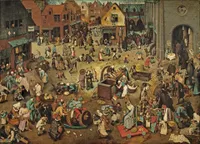
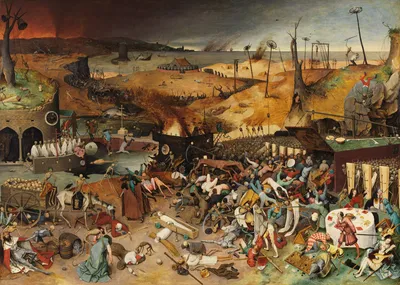
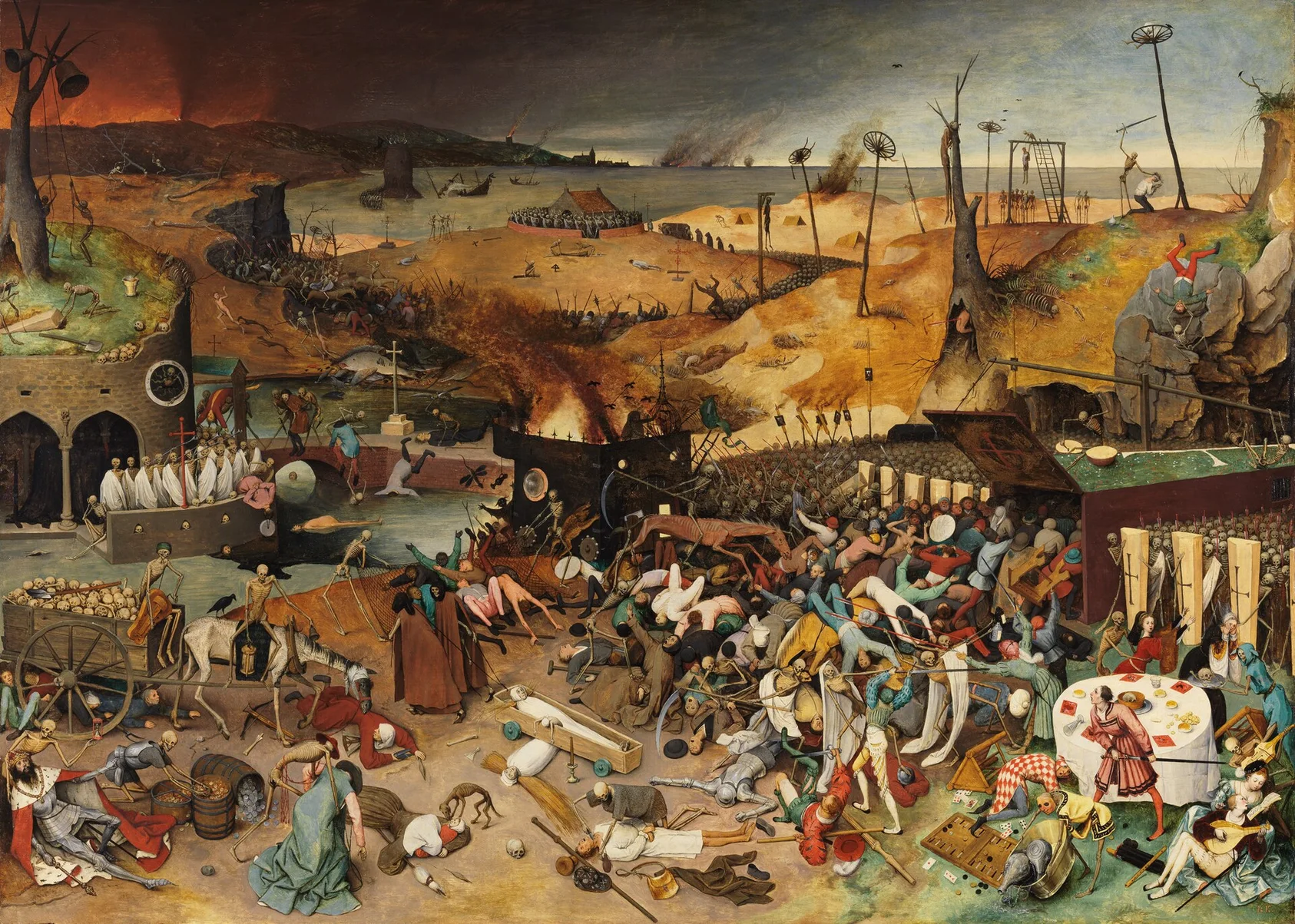
The Triumph of Death, c. 1562. Pieter Brueghel the Elder. Museo del Prado, Madrid.
Look closer
7 things to notice
 1
01
A king reaching for his gold
In the bottom left corner a king in red and ermine has fallen to the ground, his crown on his head, while a skeleton behind him holds up an empty hourglass. Another, in armour, scoops coins out of his barrels of gold and silver. Even now the king's hand stretches toward the money.
02
Singing through the end
In the bottom right corner a young man plays the lute while the woman beside him sings, their heads close together. Behind them a skeleton plays along, and neither of them has looked up. The poet Sylvia Plath wrote about these two lovers in Two Views of a Cadaver Room.
03
Supper, broken up
A dinner lies overturned just above them. Diners draw their swords against skeletons in winding sheets, cards and a backgammon board lie scattered, the jester crawls under the table, and on the cloth the last course is a few pale rolls and a skull. A masked skeleton calmly empties the wine.
04
A wagon heaped with skulls
On the left, a gaunt horse hauls a cart piled with skulls, ridden by skeletons, its wheels rolling over whoever is in front. One of them cranks a hurdy-gurdy, which the sources read as a mockery of human pleasure, while the cart crushes a man. A crow sits on the load.
05
One box for everyone
Right of centre, crowds are driven into a long wooden trap shaped like a coffin and decorated with crosses, while ranks of skeletons close in behind. Peasants, soldiers and nobles are swept along together, and the sources stress that death here takes no notice of rank. Nobody at the front can turn back.
06
A bell for the whole world
In the upper left corner a bell hangs from a bare tree, rung by the dead. The sources read its sound as the death knell of the whole world, every life at once. Below it the land is burnt black as far as you can see, all the way to the coast.
07
Every punishment on the skyline
Along the far ridge stand the machines of execution, wheels raised on poles, a gallows with bodies, and a headsman lifting his sword over a kneeling man. That man, the sources note, has just been given wine and communion. Beyond them the sea lies calm and grey.
Our take
An army of skeletons pours across a burnt country, and swords, gold and prayer are all useless against it. Ships sink off the coast, fires burn on the horizon, and a bell tolls from a dead tree. In front, a king, a cardinal, soldiers, peasants and pilgrims all go the same way, herded toward a long box marked with crosses. In the bottom right corner a young man plays the lute to his lady. They haven't noticed.
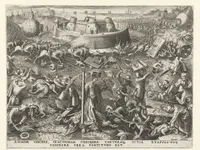
Bruegel painted it around 1562, in years when plague was a constant danger. He joined two old ways of picturing death in one panel, the Dance of Death of northern woodcuts and the Triumph of Death of Italian frescoes. After he died, his family copied it five times, tracing the drawings he left behind.
The painter's moment
1525–1569Painted it at 37Northern Renaissance
Pieter Bruegel the Elder was living in Antwerp, the busiest city for printing in northern Europe, where since 1555 he had earned his living mostly by designing prints, more than forty of them; his dated paintings only begin in 1557. Around 1562 his painting grew dark and crowded. The same year he painted The Fall of the Rebel Angels and The Suicide of Saul, and he is said to have come under the spell of the mystic Hendrik Niclaes, whose pacifist ideas some scholars find in the work of that year. In 1563 he married Mayken Coecke, whose father, Pieter Coecke van Aelst, had been a painter, in Brussels and moved there for good; his early biographer van Mander says her mother pushed the move to part him from a servant girl he had been living with.
Bruegel died in Brussels in September 1569, too soon to train his two sons, who both became painters, and was buried in the Kapellekerk. The Triumph of Death lived on in his family: Jan Brueghel the Elder copied it once, Pieter Brueghel the Younger three times and Jan Brueghel the Younger once, each working from his drawings rather than the panel. The original reached the Prado in Madrid in 1827. Since then it has turned up in a Monty Python sketch, on a Black Sabbath record and in Don DeLillo's novel Underworld, where J. Edgar Hoover becomes obsessed with it.
In its time
The Triumph of Death was painted around 1562, when Brueghel was 37. Its Dutch title is De triomf van de Dood. Where it stands on Art Through Time:
Its colors
Elsewhere in the world
- 1556Akbar's reign beginsAn imperial painting workshop is born.
- 1568Cochin's Paradesi Synagogue is builtKerala's Jews have lived under Hindu kings' protection for centuries.
The facts
- Title
- The Triumph of Death
- Artist
- Pieter Brueghel the Elder (1525–1569)
- Date
- c. 1562
- Original medium
- Oil on panel
- Style
- Northern Renaissance
- Collection
- Museo del Prado, Madrid
Art Through Design
The mood
It brings a whole world into a room, and an argument along with it. The eye can wander it for an hour, from the burning coast to the dinner table, and it keeps a room honest about what matters.
The palette
Russet, Bronze and Ochre are the scorched earth that covers almost everything; Umber is the shadow and the dead trees, Sand the bone. From across a room, the red sky at the top left and the white tablecloth at the right catch the eye first.
Who it finds
- Anyone who keeps a memento mori on their desk, a skull, a stone, a note, to remember what matters.
- Anyone who lived through a pandemic and noticed the people who kept on with dinner and music anyway.
- Anyone who loves a picture they can look into for an hour and keep finding something new.
See it in a room
Your photo is never uploaded, and it's gone when you leave.
At a glance it is a brown, crowded field under a smoky sky, with a white tablecloth on the right and a cart of skulls on the left. Close up, it becomes hundreds of small scenes: a jester under the table, a king with his gold, two lovers who have not looked up.
It is wider than tall, a long landscape shape, and it wants a wall where people linger: a study, a library, a den or a long hall. Give it size, because the detail is the point. Small, it reads as brown texture; large, every figure has a story.
Order on canvas, acrylic, or print
- True to the original
- Each file is color-matched to the museum original. If the color isn't right, we print it again, with our compliments.
- On canvas
- Fine-art canvas hand-stretched over a ¾″ solid-wood frame, with mirrored edges so nothing is lost.
- In our floating frame
- Our stretched canvas set in a slim floating frame, with a shadow gap so the painting seems to hover.
- As a framed print
- Archival pigment print on museum-grade cotton paper, in a solid-wood frame with UV-protective glazing.
- Ready to hang on arrival
- It arrives with the hanging hardware attached. No framer, no guesswork.
- Perfect on arrival
- If anything arrives damaged or not as you ordered, send us a photo within 7 days of delivery and we'll make it again, with our compliments.
Bruegel sent an army of skeletons across the world around 1562, and the two lovers in the corner have not stopped singing. Hang it where people read late.